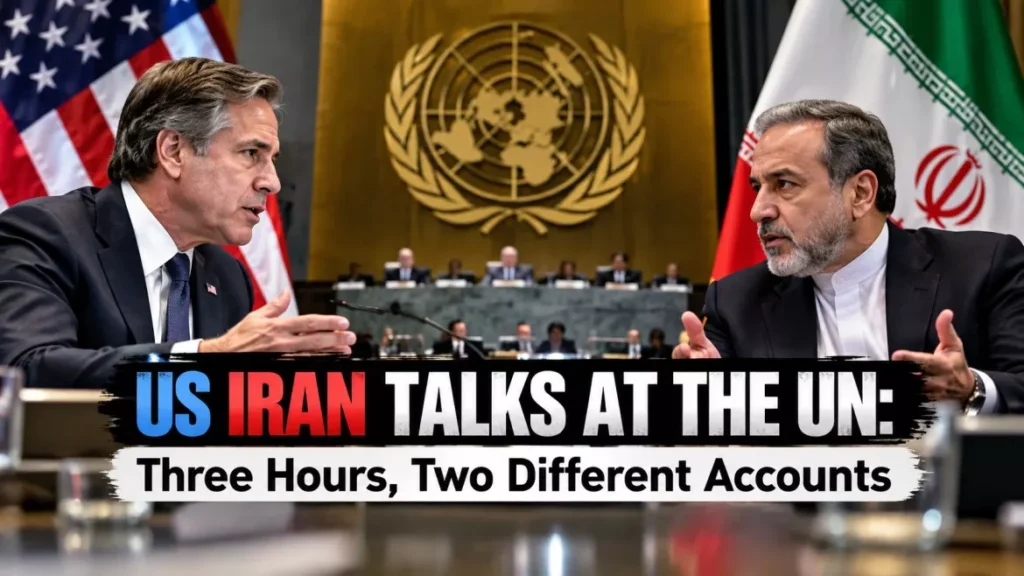

US Iran talks took place in New York on 22 September 2026, on the sidelines of the United Nations General Assembly. President Donald Trump said American envoys met Iranian officials for three hours; his envoy Steve Witkoff described mediators shuttling between the two delegations. No agreement was announced.
The meeting concerns the war between the United States and Iran, which is entering its eighth month, and the closure of the Strait of Hormuz, the shipping channel at the mouth of the Gulf through which a large share of the world’s seaborne oil normally passes. Qatar is acting as a mediator.
What Happened at the United Nations on 22 September
Representatives of the United States and Iran were in the same building and, by at least three accounts, in contact for several hours. Trump said afterwards that it was “a very good meeting, a very productive meeting” and that there was “a lot of momentum” towards an agreement. He added that “they have another one scheduled in the very near future.”
Reports by Axios and the Israeli newspaper Israel Hayom said Witkoff, the US special envoy, and Jared Kushner were present on the American side, with Iranian Foreign Minister Abbas Araghchi on the Iranian side. Qatar’s Prime Minister and Foreign Minister, Sheikh Mohammed bin Abdulrahman Al Thani, was reported to have been present for most of the session.
Iran’s state broadcaster IRIB confirmed a meeting between Araghchi and Witkoff, and said it was requested by the United States. Iranian state television said the discussion was driven by the need to convey Tehran’s conditions for reopening the Strait of Hormuz.
Direct Meeting or Shuttle Diplomacy? The Accounts Differ
This is the part of the story that has not been settled, and it matters, because a direct meeting between the two governments would be a first in this war while indirect contact through mediators would not.
| Source | How the contact is described |
|---|---|
| Donald Trump, US president | US envoys met Iranian officials for three hours |
| Steve Witkoff, US special envoy, on X | Mediators “shuttled between” the delegations and “successfully completed a round of discussions” |
| IRIB, Iranian state broadcaster | Araghchi met Witkoff; the meeting was requested by the United States |
| Al Jazeera | Reported the talks as mediated rather than face to face |
Neither government has published a joint statement or a readout, and neither has said in terms whether the two delegations sat in the same room. As of 23 September 2026 the question remains open.
What Iran Says It Wants
Iran’s conditions have been set out through its state media and through officials speaking to news agencies rather than in a published document. According to Iranian state television, Tehran’s terms are:
- Lifting the naval blockade: an end to the US blockade of Iranian ports.
- Releasing frozen assets: the unfreezing of Iranian funds held abroad.
- Ending the war on all fronts: a halt to hostilities, not a partial pause.
A senior Iranian official told Reuters on 22 September 2026 that Iran could reopen the Strait of Hormuz “within seven days if the United States eases military pressure and lifts its blockade on Iranian ports.” The same official said the sequence matters: “The US needs to announce that it wants to resolve the issue diplomatically, make that official, and then agree on a timeline for how the process will move forward.” Tehran’s proposal, the official said, was passed to Washington through mediators on 16 September, and the Iranian delegation in New York has full authority to revive diplomacy.
Those are Iran’s assertions, reported by Reuters and attributed to an unnamed official. No American official has publicly confirmed receiving the 16 September proposal or accepted the seven-day timetable.
Why the Strait of Hormuz Sits at the Centre
The Strait of Hormuz is the narrow sea lane between Iran and Oman that connects the Gulf to the Arabian Sea. It is the only maritime route out of the Gulf, which makes it one of the few places in the world where a single government can interrupt a large fraction of global energy trade.
It has been shut to normal traffic for months. Transit had fallen to about ten ships a day by early September 2026, and the consequences have reached consumers a long way from the Gulf, including record American diesel prices. Iran links reopening to the lifting of the US blockade on its ports; the United States has not said it will lift it.
What Pezeshkian Told the General Assembly
Iranian President Masoud Pezeshkian addressed the General Assembly on 23 September 2026, the day after Trump. He opened by turning the American charge back on Washington: “Those who are terrorists…describe us using that word,” he said, in remarks reported by UN News.
He held up photographs of children he said had been killed by American and Israeli bombs, said of Iran’s military response that “we responded, but we did not hit civilian populations,” and defended the country’s nuclear programme in civilian terms: “For our sick people it is cure and treatment, for the agricultural sector it is food security.” On inspections he said: “The nuclear weapon is in Israel, but the inspectors are in Iran.”
Pezeshkian also said Iran was “ready for dialog and diplomacy and negotiations without accepting the language of force.” He did not meet Trump at the United Nations.
Trump, in his own address on 22 September, framed the choice in stark terms, asking whether a deal would be made “that lets them rebuild” or whether he should “annihilate the Islamic Republic and do it quickly.” He also said he expected an agreement only after the United States votes: “I believe we’ll make a deal right after the election because it doesn’t make sense for them not to.”
What Is Agreed, What Is Claimed and What Is Not Established
Agreed by both sides: contact took place in New York on 22 September 2026; mediators were involved; further contact is expected; no agreement has been reached.
Claimed by one side only: that the meeting lasted three hours and was productive (Trump); that the United States requested it (Iranian state media); that Iran can reopen the strait within seven days on its terms (a senior Iranian official, via Reuters); that Kushner attended (press reports rather than an official readout).
Not established: whether the delegations met face to face; whether Washington has accepted or rejected any element of Iran’s conditions; whether the next round has a date; and what, if anything, either side has offered in return. Casualty and damage claims made by both governments during the war remain contested and are not independently verified here.
What Happens Next
Trump says another meeting is scheduled without giving a date. Witkoff says mediators “will continue their work.” Qatar has said it is working with Pakistan to reduce tensions and encourage dialogue. None of that amounts to a negotiating timetable, and the American midterm elections in November 2026 now sit between the two sides and any deal Trump says he expects.
The war crimes report published earlier this month, which levelled accusations at both Washington and Tehran, remains before the United Nations. Nothing announced in New York this week changes the status of the Strait of Hormuz.
Frequently Asked Questions
Did the United States and Iran Meet Directly?
That is disputed. President Trump said US envoys met Iranian officials for three hours on 22 September 2026, while his envoy Steve Witkoff described mediators shuttling between the delegations, and Al Jazeera reported the talks as mediated. Neither government has published a readout.
Who Took Part in the US Iran Talks?
Press reports named US special envoy Steve Witkoff and Jared Kushner on the American side and Foreign Minister Abbas Araghchi on the Iranian side, with Qatar’s Prime Minister and Foreign Minister Sheikh Mohammed bin Abdulrahman Al Thani mediating. Iranian state broadcaster IRIB confirmed an Araghchi-Witkoff meeting.
What Does Iran Want in Exchange for Reopening the Strait of Hormuz?
Iranian state television said Tehran’s conditions are the lifting of the US naval blockade on its ports, the release of frozen Iranian assets and an end to the war on all fronts. A senior Iranian official told Reuters on 22 September 2026 that the strait could reopen within seven days if those conditions were met.
Was Any Agreement Reached?
No. As of 23 September 2026 no agreement, ceasefire or timetable has been announced by either government, and the Strait of Hormuz remains shut to normal traffic.
When Might a Deal Happen?
Trump said he expects a deal “right after the election,” referring to the United States midterm elections in November 2026. Iran has not endorsed that timetable, and no date has been announced for the next round of talks.