
US strikes on Iranian tankers destroyed five vessels in the Gulf of Oman and near Kharg Island on 8 September 2026, US Central Command said. Iran’s Revolutionary Guard replied with ballistic missiles aimed at the Al-Azraq air base in Jordan. Jordan’s armed forces said 18 of the 20 missiles were intercepted and nobody was hurt.
It was the second such round in four days, and it came alongside a separate United States Treasury action against Iran’s airlines. Both sides described the day very differently, and several of the claims made on 8 and 9 September have not been independently confirmed by anyone outside the party making them.
Which Iranian Tankers CENTCOM Says It Destroyed
US Central Command, the American military headquarters responsible for the Middle East, said its forces struck five Iranian crude oil carriers on 8 September after the Islamic Revolutionary Guard Corps targeted a US Navy warship with ballistic missiles twice over the preceding two days.
CENTCOM named the vessels as the M/T Kaviz, M/T Charminar, M/T Horizon 1 and M/T Riesco, struck in the Gulf of Oman, and the M/T Derya, struck near Kharg Island in the northern Persian Gulf. Kharg Island is Iran’s main crude export terminal.
CENTCOM said American forces “directed the crews to abandon ship before the vessels were struck and rendered inoperable”, and that the warship targeted by the IRGC “successfully evaded the attempted Iranian attacks”. No American personnel were harmed, according to the same statement.
Admiral Brad Cooper, the CENTCOM commander, set out the arithmetic behind the response in blunt terms: “If you shoot at two of our ships, we will impose an even higher economic cost — taking out three of yours.” US Secretary of State Marco Rubio put it more simply, saying that every time Iran tries to hit a US naval ship, “they’re going to lose tankers”.
What Iran Says It Did in Reply
The IRGC said it subjected the Al-Azraq base in Jordan to what it called “fierce missile strikes” and claimed that hangars used by US fighter aircraft were destroyed. Jordan’s armed forces said air defences intercepted 18 ballistic missiles and that two fell in unpopulated areas, with no casualties.
The IRGC separately claimed ballistic missile attacks on two US Navy destroyers, identified in its statements only by the hull numbers DDG-119 and DDG-53, and said its naval forces had targeted two American vessels and eight tankers in the region, “causing great damage to them”. A US official said the Iranian response was considered ineffective and that integrated air and missile defences thwarted the strikes, with all American forces in Jordan accounted for.
Iran’s foreign ministry condemned the American strikes as violations of the United Nations charter and described them as war crimes, according to reporting by Al Jazeera. The United States has not accepted that characterisation.
Confirmed, Claimed and Unverified
The clearest way to read 8 September is to separate what both sides agree on from what only one side asserts. The table below reflects the position as of 9 September 2026.
| Claim | Who says it | Status |
|---|---|---|
| Five Iranian tankers struck and rendered inoperable | US Central Command | Stated by CENTCOM; Iran has not disputed that the vessels were hit |
| Crews were warned to abandon ship first | US Central Command | Asserted by the US only; no independent confirmation |
| Missiles fired at Al-Azraq base in Jordan | IRGC, and Jordan’s armed forces | Agreed by both sides |
| 18 of 20 missiles intercepted, no casualties | Jordan’s armed forces | Stated by Jordan; disputed by the IRGC’s damage claim |
| Hangars holding US fighter jets destroyed | IRGC | Claimed by Iran only; contradicted by Jordan and by a US official |
| “Great damage” to two US destroyers and eight tankers | IRGC | Claimed by Iran only; the US said the response was ineffective |
Casualty and damage figures in this conflict have repeatedly come from one side alone. Where that is the case above, the article says so rather than settling it.
Why Almost Nothing Is Sailing Through the Strait of Hormuz
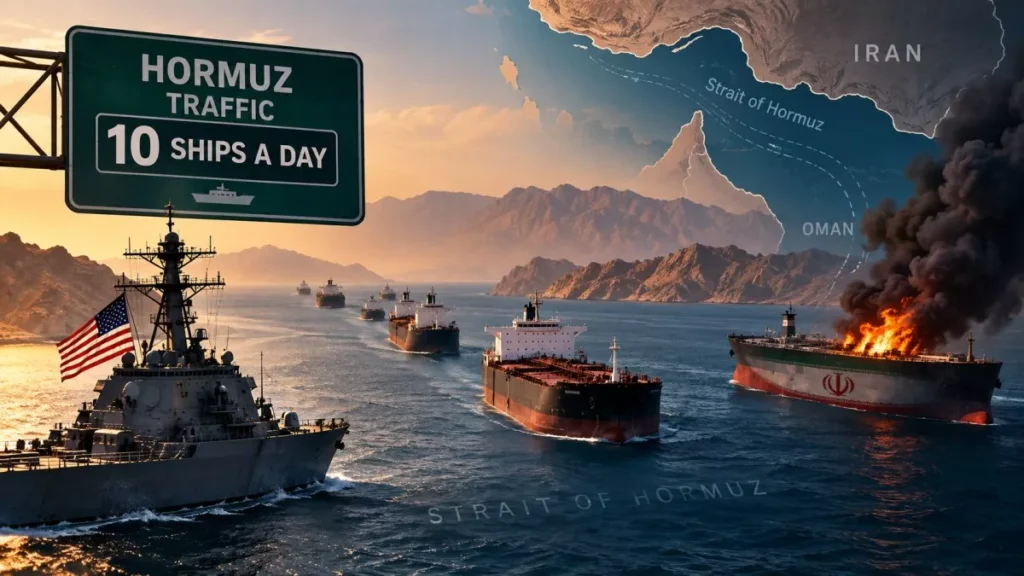
The Strait of Hormuz is the narrow sea passage between Iran and Oman through which roughly one-fifth of the world’s seaborne oil moved before the war. As of 9 September 2026 it remains effectively shut to commercial traffic, and has been for most of the period since Iran closed it to foreign shipping in early March 2026.
CBS News reported that an average of about 10 ships a day were transiting the strait as of 7 September 2026, the lowest figure since May, with two vessels recorded on the Saturday and six on the Sunday, against a pre-war baseline it put at about 130 ships a day. That single-source figure has not been matched against a second independent count, and daily transit numbers move sharply from day to day.
The price effect has been visible. Brent crude, the international oil benchmark, briefly touched $99.46 a barrel on 8 September 2026 before settling around $97.54, according to readings reported by CBS News and PBS NewsHour that day. Oil markets were already unsettled by the attack on Saudi energy facilities on 8 September. Crude prices move continuously; the figures above are a snapshot of that trading day, not a standing level.
The Aviation Sanctions That Landed the Same Day
Separately from the military exchange, the US Department of the Treasury’s Office of Foreign Assets Control sanctioned 36 targets on 8 September 2026 for supporting Iran’s aviation sector, which it said “the regime uses to move weapons, personnel, and illicit cargo”.
The action covers 27 Iranian airlines — among them Iran Aseman Airlines, Kish Air, Qeshm Air, Air Shiraz and Mahan Air, which was already under sanction — plus eight companies and one individual described as front companies, foreign intermediaries and cargo operators. Treasury Secretary Scott Bessent said the department had “promised severe consequences for those providing financial lifelines to the Iranian regime” and had followed through. The Financial Crimes Enforcement Network issued an accompanying alert asking financial institutions to report aircraft procurement networks tied to Iran. The measures sit under a sanctions framework Treasury calls Operation Economic Outcast, launched on 24 August 2026. The full designation list is published on the Treasury Department’s press release page.
Sanctions of this kind apply to United States jurisdiction and to non-US firms that risk secondary designation for dealing with those listed. They do not, by themselves, ground an aircraft flying inside Iran.
How the War Reached Its Seventh Month
The exchange on 8 September is the latest turn in a conflict that began in late winter. The sequence below is drawn from the House of Commons Library’s research briefings on the war and on the strait.
- 28 February 2026: The United States and Israel launch air strikes against Iran.
- Early March 2026: Iran closes the Strait of Hormuz to foreign shipping and the IRGC warns vessels away by radio.
- 8 April 2026: A pause in fighting is announced, later extended.
- 17 June 2026: The US and Iranian presidents sign a memorandum intended to end the war and lift the dual blockades.
- 8 July 2026: The interim truce collapses after attacks on commercial vessels in the strait.
- 24 August 2026: Treasury launches the Operation Economic Outcast sanctions framework.
- 5 September 2026: US forces strike three Iranian tankers after saying Navy ships were targeted.
- 8 September 2026: US forces strike five more tankers; Iran fires on Al-Azraq base in Jordan.
What Has Not Been Settled
No new ceasefire has been announced. Iran has said a ceasefire between Israel and Hezbollah in Lebanon is a precondition for wider talks, and has said its ballistic missile programme is not open for negotiation. Those two positions were the obstacles when the June memorandum was signed, and neither has been reported as resolved.
Nor is there any published timetable for reopening the Strait of Hormuz. Danny Citrinowicz, an Iran analyst quoted by PBS NewsHour, summarised the difficulty: “There is no kinetic solution to the Strait of Hormuz problem.” Whether the tanker strikes change Iranian behaviour, or simply add another round, is not something the record so far answers.
Frequently Asked Questions
How Many Iranian Tankers Have US Strikes Destroyed?
US Central Command said it destroyed five Iranian crude carriers on 8 September 2026, after saying it struck three on 5 September 2026. That is eight vessels in four days by CENTCOM’s own account.
Which Tankers Did CENTCOM Name?
CENTCOM named the M/T Kaviz, M/T Charminar, M/T Horizon 1 and M/T Riesco in the Gulf of Oman, and the M/T Derya near Kharg Island. Some outlets have rendered the first name differently in transliteration.
Was Anyone Killed in the Attack on the Jordan Base?
Jordan’s armed forces said 18 of the 20 ballistic missiles were intercepted, two fell in unpopulated areas, and there were no casualties. The IRGC claims it destroyed hangars used by US fighter jets; that claim has not been confirmed by Jordan or by the United States.
Is the Strait of Hormuz Open?
No. As of 9 September 2026 the strait remains effectively closed to commercial shipping, with only a trickle of transits. Around one-fifth of the world’s seaborne oil moved through it before the war began in February 2026.
Which Iranian Airlines Were Sanctioned on 8 September 2026?
The US Treasury designated 27 Iranian airlines, including Iran Aseman Airlines, Kish Air, Qeshm Air and Air Shiraz, as part of a 36-target action. The complete list is published by the Treasury Department’s Office of Foreign Assets Control.