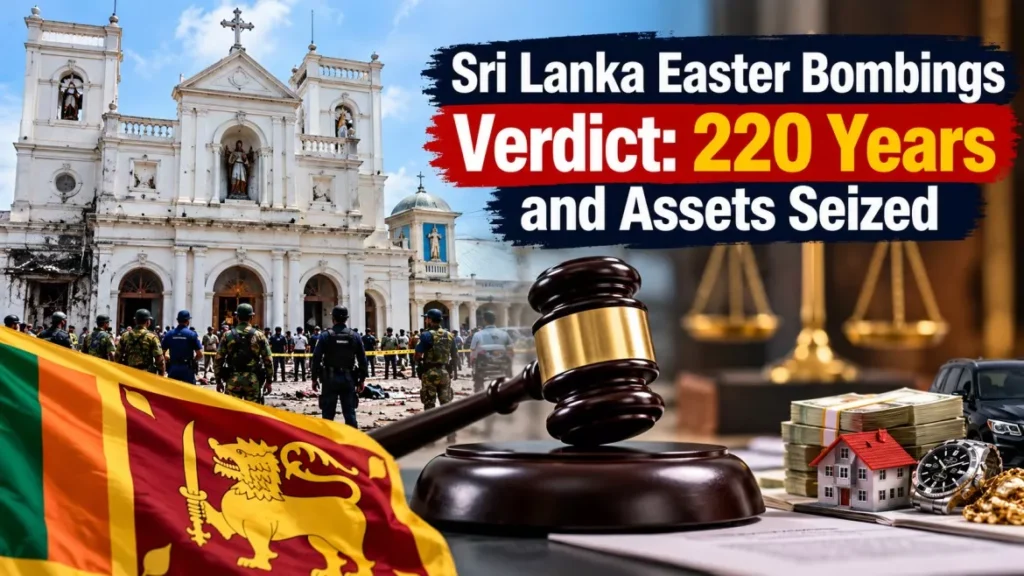

The Sri Lanka Easter bombings verdict convicted 15 men and acquitted nine at the Colombo High Court on 22 September 2026. Each convicted man was sentenced to 220 years of rigorous imprisonment, and the court ordered the state to seize their property. The trial had run for five years.
The ruling closes the main criminal case over the attacks of 21 April 2019, in which coordinated suicide bombers struck three churches and three luxury hotels on the island. It does not close every question. Reported figures for the death toll and the sentence still differ between news organisations, and a separate investigation into whether officials knew in advance is unfinished.
What the Court Decided
The case was heard by the Colombo Permanent High Court Trial-at-Bar, a three-judge panel used in Sri Lanka for serious cases that are tried without a jury. The bench comprised Justices Navarathna Marasinghe, who presided, Ramanathan Kannan and Sujeewa Nissanka.
Of the 15 convicted, 14 were found guilty on all charges and one on some of them. The charges included murder, conspiracy to commit terrorism, and firearms and explosives offences under Sri Lanka’s Prevention of Terrorism Act, a law that allows extended detention and has been criticised by United Nations human rights bodies.
Nine defendants were acquitted and released. Sri Lankan reports stated that the prosecution had failed to establish the charges against them beyond reasonable doubt. Twenty-five men were originally indicted; one died in custody, leaving 24 to face judgment.
The scale of the prosecution was unusual. Gulf News reported that the indictment ran to about 8,900 pages across nine volumes and contained 23,270 charges, the largest number brought in a single Sri Lankan case. Hundreds of police officers, commandos and sniffer dogs were deployed around the courthouse for the verdict.
The Sentence, and Why Reports of It Differ
The sentence most widely reported, and the one carried by Sri Lankan outlets closest to the court, is 220 years of rigorous imprisonment for each convicted man. Rigorous imprisonment, in Sri Lankan law, means a custodial term with hard labour, as distinct from simple imprisonment.
International coverage has not been consistent, and a reader comparing headlines will find three different answers.
| Source | Sentence reported |
|---|---|
| Newswire (Sri Lanka), 22 September 2026 | 220 years’ rigorous imprisonment each |
| Gulf News, 22 September 2026 | 220-year jail terms each |
| Associated Press, 22 September 2026 | 200 years each, headlined as life in prison |
| Sri Lanka Brief, 22 September 2026 | Headlined 220 years each; its text described terms varying between 200 and 260 years |
The weight of reporting supports 220 years. The suggestion that individual terms varied appears in one publication’s text and is not corroborated elsewhere, so it should be treated as unconfirmed until the court’s written judgment is available. What is agreed across all accounts is that the terms are long enough to keep every convicted man in prison for life, and that the court additionally ordered the confiscation by the state of all movable and immovable property belonging to those convicted, with effect from the start of their sentences.
Why the Death Toll Is Reported Three Different Ways
The number of people killed on 21 April 2019 has never settled on a single agreed figure, and the verdict coverage reflects that.
- 279 dead, including 45 foreign nationals: reported by Al Jazeera and Gulf News.
- More than 260 dead, including 42 foreign nationals: reported by the Associated Press.
- Around 269 dead: a figure used in coverage of the separate negligence case against two former officials.
Injury figures are similarly variable, ranging from about 450 to more than 500 across accounts. The higher death tolls published in the days after the attacks were later revised downward by Sri Lankan authorities, which is the usual explanation for the spread. Al Jazeera’s report of the verdict gives the figure as 279 killed, including 45 foreigners, and more than 500 injured. Readers should treat any single number as the figure one organisation published rather than a settled fact.
What is not disputed: the attacks were the deadliest in Sri Lanka since its civil war ended in 2009, and the dead included both Sri Lankan worshippers and foreign tourists.
Who Mohamed Naufar Is, and Who Never Stood Trial
Among those convicted on all charges was Mohamed Naufar, rendered in some reports as Naufer Moulavi. Prosecutors identified him as the ringleader who supported the eight-member squad that carried out the bombings. The court’s finding is that he is guilty of the charges brought; the description of him as mastermind is the prosecution’s characterisation.
None of the men who actually detonated the bombs was on trial. All the attackers died in the bombings. That is why this case concerned conspiracy, support and preparation rather than the attacks themselves, and it is part of why the Catholic Church in Sri Lanka has been unsatisfied with the outcome.
Church leaders have argued that the people identified so far are not the true masterminds. The Associated Press noted that the Church has made that claim without providing evidence. Cardinal Malcolm Ranjith, the Archbishop of Colombo, has previously described the attacks as part of what he called a grand political plot.
Outside the courtroom, reaction from those affected was more direct. A Catholic priest, Jude Fernando, told reporters: “Finally, we have justice. It has taken a long time to get to this point.”
The Separate Cases Against Sri Lankan Officials
The question of whether the state could have prevented the attacks has been litigated separately, and those proceedings have produced findings of their own.
- 2023, Supreme Court: Sri Lanka’s Supreme Court ruled that former President Maithripala Sirisena and four other senior officials had failed to prevent the bombings despite holding prior intelligence, and ordered them to pay compensation to victims.
- 31 July 2026, Permanent Trial-at-Bar: former Inspector General of Police Pujith Jayasundara and former Defence Secretary Hemasiri Fernando were convicted of criminal negligence and sentenced to death, in a 2-1 decision. Both may appeal to the Supreme Court. Sri Lanka has not carried out an execution since 1976, and reporting on the case noted that the sentences are widely expected to be served as imprisonment.
- February 2026, arrest: Suresh Salley, a former intelligence chief and retired army major general, was arrested in connection with the attacks. The government has alleged that he had prior knowledge and conspired in them. He denies the allegations, remains in custody, and has not been tried. Nothing against him has been proved.
The court in the 2026 negligence case heard that an Indian intelligence agency had warned Sri Lanka weeks in advance of a possible suicide attack by Islamist extremists, and that the warning was not acted upon.
What Remains Unresolved
As of 22 September 2026, the verdict in Sri Lanka stands as delivered and several matters are still open.
- Appeals: those convicted may challenge the verdict through Sri Lanka’s appellate courts. No appeal had been reported at the time of writing.
- The written judgment: the full reasoning had not been published, which is why some figures remain contested.
- The Salley case: no trial date has been reported, and the allegations are untested.
- The Church’s claim: the assertion that the real organisers have not been identified has not been substantiated in court and has not been disproved there either.
- Asset confiscation: the value of the property to be seized has not been published.
Frequently Asked Questions
What Was the Sri Lanka Easter Bombings Verdict?
On 22 September 2026 the Colombo Permanent High Court Trial-at-Bar convicted 15 of 24 accused men over the 2019 Easter Sunday attacks and acquitted nine. Fourteen were found guilty on all charges and one on some.
How Long Are the Sentences?
Sri Lankan outlets and Gulf News reported 220 years of rigorous imprisonment for each convicted man. The Associated Press reported 200 years. The court also ordered the state to confiscate the convicted men’s movable and immovable property.
How Many People Died in the 2019 Easter Sunday Attacks?
Reported tolls differ. Al Jazeera and Gulf News give 279 dead including 45 foreigners; the Associated Press gives more than 260 dead including 42 foreigners. Injury counts range from about 450 to more than 500.
Were the Bombers Themselves Prosecuted?
No. All of the suicide bombers died in the attacks of 21 April 2019. The trial concerned conspiracy, support and preparation offences committed by others.
Has Anyone Been Punished for Failing to Stop the Attacks?
Yes, in separate proceedings. Sri Lanka’s Supreme Court ruled in 2023 that former President Maithripala Sirisena and four officials failed to prevent the bombings and ordered compensation, and on 31 July 2026 a former police chief and a former defence secretary were sentenced to death for criminal negligence. Both can appeal.
Can the 15 Convicted Men Appeal?
Yes. Convictions from the Permanent High Court Trial-at-Bar can be challenged through Sri Lanka’s appellate courts. No appeal had been reported as of 22 September 2026.