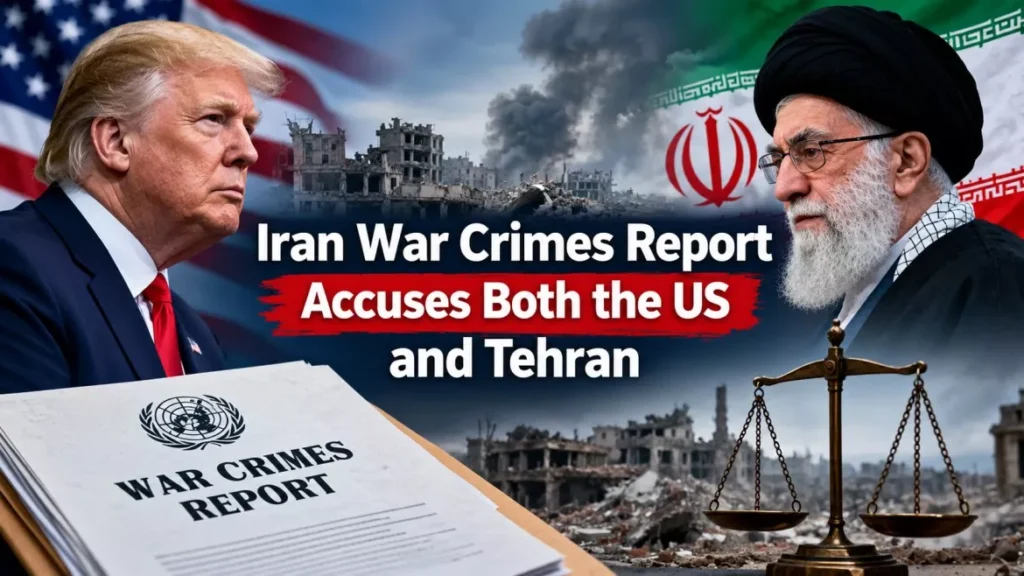

The Iran war crimes report published by the United Nations on 17 September 2026 accuses both the United States and the Iranian government. A UN fact-finding mission found reasonable grounds to believe US strikes on 28 February 2026 were indiscriminate, and concluded Iran’s crackdown on protests amounted to crimes against humanity. Washington rejects the report.
What the Mission Found Against the United States
The mission said it had reasonable grounds to believe the United States “committed the war crime of launching indiscriminate attacks” in two strikes on the same day.
| Location | Target as Described by the Mission | Weapon Cited | Deaths Reported by the Mission |
|---|---|---|---|
| Minab, Hormozgan province | Shajareh Tayyebeh Primary School | Tomahawk missiles | Over 150, including approximately 120 girls and boys |
| Lamerd, Fars province | Sports complex and residential area | Precision Strike Missiles dispersing tungsten pellets | 22 civilians |
Both strikes took place on 28 February 2026, the day the mission says the conflict between the United States, Israel and Iran began. The figures above are those given in the mission’s own statement. Totals published by news organisations for the two strikes combined have ranged from about 177 to about 180; Stars and Stripes reported the mission’s school figure as 157 killed including 123 children aged 13 or younger. The variation reflects different readings of the report, not different events.
On the school, the mission said the United States “failed in its obligation to do everything feasible to verify that it was a military objective”, citing child-oriented murals on the exterior walls, school signage and playground areas, according to Al Jazeera’s account of the report. It said the strike was directed at the school building “while being aware of a substantial risk of striking a civilian object”. On Lamerd, the mission said the sports complex was visibly separate from an adjacent Islamic Revolutionary Guard Corps compound.
What the Mission Found Against Iran
The same report makes findings against the Iranian government, and they occupy more of it than the findings against Washington.
The mission described widespread use of lethal force, mass killings and injuries and extensive arrests during protests across all 31 Iranian provinces, running from late 2025 into 2026. It concluded that these acts “amount to crimes against humanity — including murder, imprisonment, torture, and other inhumane acts”.
- Children killed: at least 221, some as young as two years old.
- Executions: at least 29 men executed between March and August 2026 after expedited trials, five of them in public, all in connection with the protests.
- At risk: more than 70 people said to face imminent risk of execution.
- Detentions: “Tens of thousands of people were deprived of their liberty in large-scale arbitrary arrests”, with torture and solitary confinement documented.
- Communications: an internet blackout lasting more than five months.
The mission said the true death toll is much higher than the figure of 3,038 killed reported by the Iranian government, as reported by Al Jazeera.
What “Reasonable Grounds to Believe” Means
This is the phrase that decides how much the report settles, and it is not the language of a courtroom.
“Reasonable grounds to believe” is an investigative threshold. It sits above speculation and below “beyond reasonable doubt”, the standard a criminal court applies before convicting anyone. A fact-finding mission assesses evidence; it does not adjudicate guilt.
What that means in practice is straightforward. The report is not an indictment. It is not an International Criminal Court arrest warrant. It is not a judgment, and no court has ruled on either set of allegations. It records what a panel of independent experts concluded from the evidence available to them.
The mission itself is not a UN agency staffed by UN employees. Its members are appointed by the President of the Human Rights Council, serve in their individual capacity, are unpaid and are independent of the United Nations Secretariat. The Council created the mission in November 2022 to examine violations connected to the protests that began that September, and has since extended and widened its mandate.
How Washington and Tehran Responded
Both governments named in the report rejected the findings that concerned them.
A US State Department official said the United States does not give credibility to the report, and said the Human Rights Council “pushes anti-American rhetoric and antisemitism” and “appeases repressive regimes”. White House spokeswoman Anna Kelly said the Council had “accomplished nothing for human rights” and said Iran was the only party in the conflict that had committed war crimes.
The Pentagon declined to comment on the report’s substance, saying: “Our investigation remains ongoing, and we have nothing to announce at the moment.” US Central Command had earlier denied carrying out the Lamerd strike and disputed the identification of the missiles used, according to Stars and Stripes. In June 2026, President Donald Trump said that “nobody” had intentionally attacked the school, citing a Pentagon investigation whose findings have not been published.
Iran’s government rejected the mission’s characterisation of its crackdown, blaming the unrest on “terrorists and rioters” backed by exiled opponents and by the United States and Israel.
What Is Agreed, What Is Claimed and What Is Unverified
The three categories are worth separating, because the report is being quoted on all sides.
- Broadly agreed: that strikes occurred at Minab on 28 February 2026 and that large numbers of civilians, including many children, were killed; that mass protests in Iran were met with force and that people were killed, detained and executed.
- Claimed by the mission and disputed: that the US strikes were indiscriminate and amount to a war crime, which Washington rejects; that Iran’s conduct amounts to crimes against humanity, which Tehran rejects.
- Unverified or unpublished: the Pentagon’s own investigation, which remains open and whose findings have not been released; the precise combined death toll, which varies between accounts; whether US Central Command or the mission is correct about which missiles struck Lamerd.
Earlier this month the UN Security Council voted on a separate referral concerning Iran, and shipping through the Strait of Hormuz has been disrupted by strikes on Iranian tankers. Those are distinct proceedings from this report.
What Happens Next
As of 19 September 2026, nothing in the report obliges any state to act, and no prosecution follows from it automatically.
The mission is mandated to present reports to the Human Rights Council in scheduled sessions, with further reporting due at the Council’s sixty-fourth session between February and April 2027 and its sixty-seventh session in 2028. Any criminal case would have to be brought by a court with jurisdiction, and no such case has been opened on the basis of this report. The mission has called for an immediate cessation of hostilities and for civilians to be protected.
Full details of the mission’s findings are set out in the United Nations’ own account of the report.
Frequently Asked Questions
What Does the Iran War Crimes Report Actually Say?
Published on 17 September 2026, it says there are reasonable grounds to believe the United States committed the war crime of launching indiscriminate attacks in two strikes on 28 February 2026, and that Iran’s crackdown on protests amounted to crimes against humanity.
Is the Report a Legal Finding of Guilt?
No. “Reasonable grounds to believe” is an investigative threshold, below the “beyond reasonable doubt” standard used by criminal courts. The report is not an indictment, an arrest warrant or a judgment, and no court has ruled on the allegations.
How Did the United States Respond?
It rejected the report. A State Department official said Washington gives it no credibility, the White House said the Human Rights Council had accomplished nothing for human rights, and the Pentagon said its own investigation remains ongoing.
Does the Report Criticise Iran as Well?
Yes. It concluded that killings, imprisonment and torture during the protest crackdown amount to crimes against humanity, citing at least 221 children killed and at least 29 men executed between March and August 2026. Iran’s government rejected those findings.
What Happens to the Report Now?
It goes to the UN Human Rights Council, which is a political body rather than a court. No prosecution follows automatically, and any criminal case would have to be brought by a court with jurisdiction.