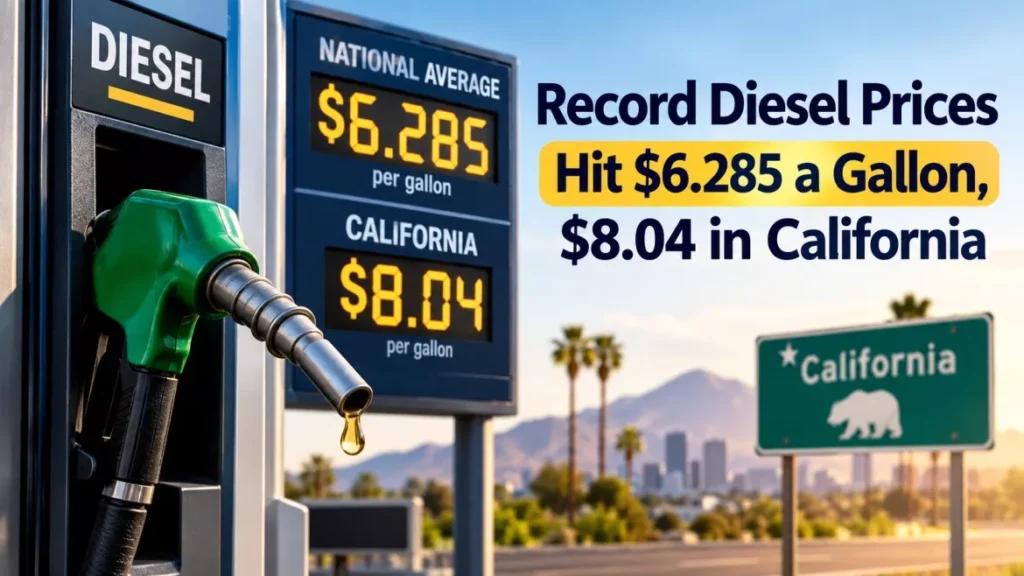

United States diesel prices have set a nominal record. The Energy Information Administration put the national average on-highway price at $6.285 a gallon in its survey for 14 September 2026, up from $5.967 a week earlier and $3.739 a year before. Record diesel prices are now feeding into freight surcharges.
Where Diesel Prices Stand as of 14 September 2026
The national figure is a survey average, not a price any single driver pays, and the spread across the country is more than two dollars a gallon. These are the readings from the Energy Information Administration, the statistical agency of the United States Department of Energy, for the week of 14 September 2026.
| Region | On-highway diesel, 14 September 2026 |
|---|---|
| United States average | $6.285 a gallon |
| Gulf Coast | $6.027 a gallon |
| Rocky Mountain | $6.066 a gallon |
| East Coast | $6.158 a gallon |
| Midwest | $6.250 a gallon |
| West Coast | $7.250 a gallon |
| California | $8.039 a gallon |
Two comparisons put the move in context. Diesel is up $2.546 a gallon, or about 68 percent, on the same week in 2025. Regular petrol, which the agency also surveys weekly, stood at $4.319 a gallon on 14 September 2026, up about 36 percent year on year — roughly half the diesel increase.
The previous nominal weekly high for US diesel was $5.810 a gallon in June 2022. On an annual-average basis the record still belongs to 2022, at $4.989 a gallon. All of these figures are nominal, meaning they are not adjusted for inflation; in inflation-adjusted terms the 2022 peak remains higher.
The readings are published weekly on a Monday and reflect the preceding week, so the agency’s weekly gasoline and diesel update is where the next national number will appear. The figures in this article apply to the United States only.
Why Diesel Costs So Much More Than Petrol Right Now
The gap between diesel and petrol comes from refining capacity rather than from the crude oil price. Diesel is a distillate — it is drawn from a heavier part of the crude barrel than petrol, and it competes for the same refining units as jet fuel and heating oil.
Three pressures have converged on that part of the barrel during 2026. Ukrainian strikes on Russian refineries have cut the volume of finished fuel Russia can export. Conflict involving Iran has constrained energy flows through Middle East shipping routes. Attacks on Saudi energy facilities in early September halted operations at some sites.
Readers following the supply side can see how those pressures built: this site covered the attacks on Saudi energy facilities that wounded 73 people and the collapse in traffic through the Strait of Hormuz to about ten ships a day.
Inventories reflect the squeeze. US distillate stocks stood at about 104.2 million barrels in early September and were roughly 13 percent below their five-year average. Reuters reported that American refinery utilisation reached 98 percent in the week ending 28 August 2026, the highest since 2018, and that the US diesel crack spread — the margin between crude and refined diesel — passed $100 a barrel for the first time in August. Those two readings come from a single news agency and have not been confirmed by the agency’s own publications.
How the Diesel Price Reaches Freight Bills and Shop Shelves
Most road freight contracts do not absorb a fuel price move; they pass it through by formula. The mechanism is mechanical, and it runs on the same weekly government number.
- The weekly index is published: The Energy Information Administration posts its national average on-highway diesel price each Monday.
- Carriers recalculate the surcharge: Less-than-truckload carriers typically reset their fuel surcharge on the Tuesday, reading the new figure against a published matrix.
- The surcharge is added per mile: On one commonly used broker table, assuming a $1.25 base and 6.0 miles per gallon, current diesel produces a surcharge of about 84 cents a mile, against 41 cents a year earlier. That calculation was reported by a freight industry publication rather than by a carrier or regulator.
- The cost lands on the shipper: On a 1,000-mile grain shipment, a 48-cent rail surcharge works out at about $480 a railcar, against roughly $190 at last year’s rate.
- It may or may not reach the shelf: Retailers can absorb the increase for a time, and freight already under contract will not reprice until renewal.
Refrigerated freight is the most exposed, because chilled trailers burn diesel to run the cooling unit as well as the truck. Rates for moving apples and pears out of the Yakima Valley in Washington state have reached a four-year high with the harvest only half finished, and the cost of moving produce out of California is reported to be 40 to 120 percent above a year ago.
What Record Diesel Prices Are Costing Farmers This Harvest
The clearest immediate effect is on farms, which use diesel directly and at volume. The timing is awkward: the American maize and soybean harvest is under way now.
- Combine fuel: One Midwestern grower, Drew Peterson, told reporters he expects to spend as much as $1,500 a day fuelling a single combine harvester, about double last season.
- Delivered price: Another grower, Wayne Gularte, said his cost had risen about 40 percent, from roughly $5 to roughly $7 a gallon.
- Cost per acre: Purdue University data cited in the same reporting put the year-on-year increase at about $11 an acre for maize and $7 an acre for soybeans.
Whether that reaches grocery prices, and when, is not settled. United States consumer food prices rose 2.7 percent in the year to August 2026, a figure that predates the sharpest part of the diesel move. Economists quoted in the reporting expect produce, dairy and meat to be the most exposed categories, because they travel refrigerated, but none put a date or a size on the effect.
What the Energy Information Administration Expects Next
The agency’s own forecast, published on 9 September 2026, does not assume prices stay here. It expects the annual average retail diesel price to be $5.07 a gallon in 2026 and $4.40 a gallon in 2027, with the distillate refining margin easing from $1.57 a gallon this year to $1.25 next year.
On stocks, the outlook is blunter. It states that “we forecast U.S. distillate fuel oil inventories will drop below 100 million barrels in September and will remain below the five-year (2021–2025) low through much of 2027”. The same edition put its Brent crude assumption at about $90 a barrel for the second half of 2026 and $74 a barrel for 2027.
A forecast is not a commitment, and the agency revises the outlook monthly. Its diesel projection for 2026 as a whole sits well below the current weekly reading, which implies an expectation that prices fall back over the remainder of the year rather than hold at $6.285.
What Is Still Unknown
- How long the refining squeeze lasts: No agency has forecast a date for distillate inventories to return to the five-year range.
- Whether food prices move: The size and timing of any grocery effect has not been quantified by any official body.
- Where the next reading lands: The following weekly national figure was not published at the time of writing.
- Whether the annual record falls: Beating the 2022 annual average of $4.989 a gallon depends on prices over the remaining weeks of 2026, and no agency has forecast that outcome.
Because diesel feeds directly into transport costs, the reading also matters to the broader inflation picture that central banks are watching; the site’s coverage of the August consumer price index set out where United States inflation stood before this move.
Frequently Asked Questions About Record Diesel Prices
What Is the Current US Diesel Price?
The Energy Information Administration put the United States average on-highway diesel price at $6.285 a gallon for the week of 14 September 2026, up from $5.967 the previous week. The figure is a national survey average and varies by region and station.
Are These Record Diesel Prices an All-Time High?
They are a nominal record. The previous nominal weekly high was $5.810 a gallon in June 2022. Adjusted for inflation, the 2022 peak was higher, and 2022 still holds the annual-average record at $4.989 a gallon.
Why Is Diesel More Expensive Than Petrol?
Diesel is refined from a heavier part of the crude barrel and competes for capacity with jet fuel and heating oil. Reduced Russian fuel exports, Middle East supply disruption and distillate inventories about 13 percent below their five-year average have tightened that part of the market more than the petrol market.
Which US State Has the Most Expensive Diesel?
Among the areas the agency reports separately, California was highest at $8.039 a gallon on 14 September 2026, against $6.027 a gallon on the Gulf Coast. State taxes and fuel specifications account for much of that difference.
Will Diesel Prices Push Up Food Prices?
No official body has quantified it. The Energy Information Administration forecasts a lower annual average diesel price for 2026 than the current weekly reading, and economists quoted in September 2026 reporting said refrigerated categories such as produce, dairy and meat are the most exposed, without giving a size or a date.