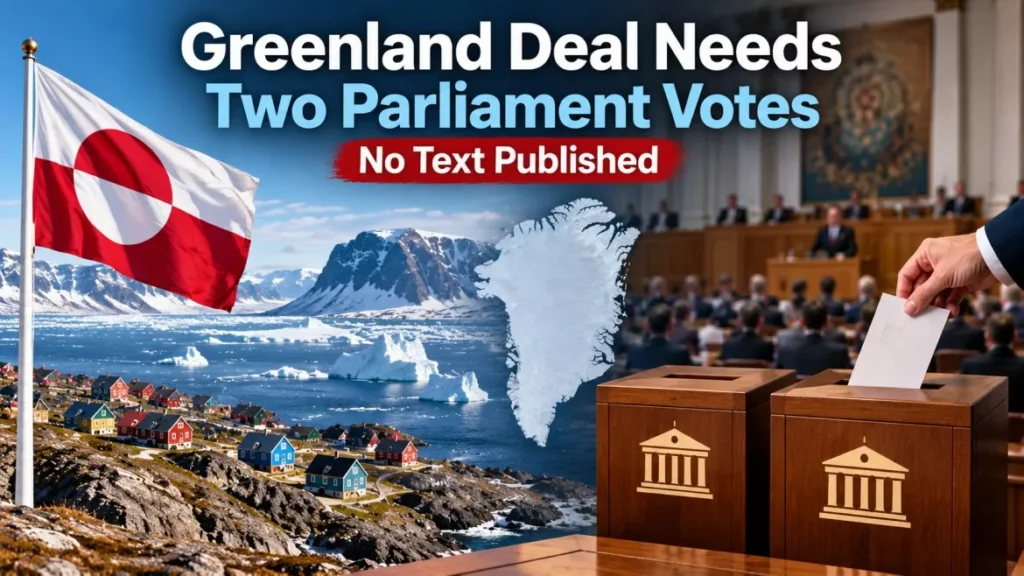

The United States, Denmark and Greenland have agreed a security arrangement expanding the American military presence in Greenland. President Donald Trump announced it on 18 September 2026; the three governments sign it in New York next week. The Greenland deal takes effect only after votes in Denmark’s and Greenland’s parliaments.
What the Greenland Deal Reportedly Contains
No government has published the text, so every account of the terms comes from official statements and briefings rather than from the document itself. On the points the three governments and the US State Department have described publicly, the arrangement covers five things.
- Access, basing and overflight: Permanent American rights to enter Greenland, operate from bases there and fly through its airspace.
- Expansion of facilities: Scope for the United States to enlarge its military footprint, which Trump said would begin “immediately”.
- A ban on non-NATO bases: No state outside the North Atlantic Treaty Organisation, the 32-member military alliance, may establish a base or station troops in Greenland.
- Investment screening: A mechanism intended to block Russian and Chinese investment in sensitive Greenlandic infrastructure.
- No transfer of ownership: The arrangement does not sell, cede or annex Greenland, and the three governments’ joint position rejects purchase or annexation.
Two further terms have been reported but not confirmed in any published document. Al Jazeera reported that the agreement would let the United States build military sites without Danish or Greenlandic sign-off, and NBC News and Al Jazeera both reported that it would remain binding if Greenland became independent. Neither point appears in the statements Copenhagen or Nuuk have issued.
Why Washington and Copenhagen Describe the Same Deal Differently
The two capitals have characterised the arrangement in terms that do not sit easily together. Trump described American “permanent control”; Denmark and Greenland described untouched sovereignty.
| Point | How Washington describes it | How Copenhagen and Nuuk describe it |
|---|---|---|
| What the US gains | “Permanent control over security, and all other needs, in Greenland” | Strengthened security co-operation in the Arctic and North Atlantic |
| Sovereignty | Not addressed in Trump’s announcement | The agreement “recognises the sovereignty and territorial integrity” of the kingdom |
| Greenlandic self-determination | Not addressed | Upholds “the right of the Greenlandic people to self-determination” |
| Duration | An “Infinite Life agreement”, per Trump; “forever”, per State Department officials | A binding agreement, with no public wording on duration |
| Cost to the US | “NO COST” | Not addressed |
Trump posted his announcement at 6:37pm Eastern Daylight Time on 18 September, and described it as an “Infinite Life agreement” at “NO COST” to the United States. He also wrote that no US adversary could “EVER have a base in Greenland, have a military presence in Greenland, or make sensitive investments in Greenland, without our express written approval.”
Danish Prime Minister Mette Frederiksen’s statement did not use the language of control. Greenland’s prime minister, Jens-Frederik Nielsen, said the arrangement strengthens the territory’s security and reflects Greenlandic interests. Danish Foreign Minister Lars Løkke Rasmussen wrote on Instagram, in remarks reported by Agence France-Presse, that “a period of uncertainty will hopefully be replaced by a binding agreement that strengthens security in the Arctic and the North Atlantic.”
Because the text is unpublished, it is not possible to say which characterisation the document supports, or whether its drafting allows both sides to keep their own reading. US Secretary of State Marco Rubio called it a “historic deal” that addresses American concerns “permanently and completely”.
Who Must Approve the Greenland Deal Before It Takes Effect
Signing the agreement will not bring it into force. Denmark’s prime minister’s office said national parliamentary procedures must follow, and those run through two legislatures.
- Signature by three governments: Scheduled for the week beginning 21 September 2026, on the margins of the 81st session of the United Nations General Assembly in New York. No exact day has been announced.
- A vote in the Folketing: Denmark’s 179-seat national parliament in Copenhagen must approve the agreement. No date has been set.
- A vote in the Inatsisartut: Greenland’s 31-seat parliament in Nuuk must also approve it. No date has been set.
- Entry into force: Only after those procedures are complete. No government has published a target date.
Whether the United States Congress must act is unresolved. Trump did not present the arrangement as a treaty, which in American practice would require the advice and consent of two-thirds of the Senate, and no US official has said publicly whether congressional approval will be sought.
What the United States Could Already Do in Greenland
Most of what the arrangement grants is an expansion of rights Washington has held for 75 years, not a new foothold. A 1951 defence agreement between the United States and the Kingdom of Denmark already gave American forces wide latitude in Greenland.
Under that agreement the United States may, in its operative wording, “control landings, takeoffs, anchorages, moorings, movements, and operation of ships, aircraft, and waterborne craft” in the defence areas it uses. It has maintained a presence on the island since the Second World War, and now operates Pituffik Space Base in the north-west, where Al Jazeera reported more than 100 American personnel are stationed.
Analysts quoted by Al Jazeera differed on how much changes. Mikkel Olesen said barring Russian and Chinese bases costs Denmark and Greenland little, because “the Danes and Greenlanders never wished for Russia or China to have bases in Greenland”. Richard Weitz said Trump “got pretty much everything he wanted, except formal annexation”. Imran Bayoumi said the genuinely new element would be a right to build unilaterally — which is one of the terms no government has confirmed.
What Is Agreed, What Is Claimed and What Is Unverified
This story rests almost entirely on statements, and it is worth separating them by how well established they are.
- Agreed by all three governments: That an arrangement on Arctic and North Atlantic security has been reached; that it will be signed in New York next week; that it does not transfer ownership of Greenland; that parliamentary approval in Copenhagen and Nuuk is required.
- Claimed by Washington alone: “Permanent control over security, and all other needs”; that the arrangement lasts forever; that it comes at no cost to the United States.
- Stated by Copenhagen and Nuuk alone: That the agreement recognises the kingdom’s sovereignty and territorial integrity and upholds Greenlandic self-determination.
- Reported but unconfirmed: A right to build military sites without local consent; survival of the agreement through Greenlandic independence; any provision on rare-earth or other mining rights.
- Not established: The full text; the duration clause, if any; whether the US Congress has a role; the dates of either parliamentary vote.
Greenland’s status is itself contested in public debate rather than settled by this announcement. Greenland, known in Greenlandic as Kalaallit Nunaat, is a self-governing territory within the Kingdom of Denmark, with control over most domestic matters and a legal route to independence it has not taken. Trump has previously said the United States should acquire the island; protesters in Nuuk have carried signs reading “Greenland is not for sale!”
What Happens Next
As of 20 September 2026, the Greenland deal has not been signed, its text has not been published, and neither the Folketing nor the Inatsisartut has voted. The next scheduled event is the signing in New York during UN General Assembly week.
Beyond that, the sequence depends on parliaments rather than on either government’s timetable. Imran Bayoumi, the analyst quoted by Al Jazeera and France 24, noted that any attempt to build new facilities without local agreement could produce legal and political conflict — and told France 24 that Trump’s earlier rhetoric had done lasting damage, saying “Americans really underestimate how damaging it was for the image of the United States in Europe.”
Readers following the ratification steps can watch the two parliaments’ own order papers, and the joint text if and when the three governments release it. The arrangement is one of several international commitments announced in recent weeks whose legal footing arrives after the announcement; the proposed Canada–EU associate membership has no basis in the European Union’s treaties, and the General Assembly’s endorsement of a new world map in September carried no obligation on any state to use it.
Frequently Asked Questions About the Greenland Deal
Is the Greenland Deal in Force?
No. As of 20 September 2026 it has not been signed, and after signature it requires approval by Denmark’s Folketing and Greenland’s Inatsisartut before it takes effect. No dates have been set for either vote.
Does the Deal Give the United States Ownership of Greenland?
No. The three governments’ joint position rejects purchase or annexation, and the arrangement is described as covering security co-operation, basing and overflight rather than sovereignty or governance.
When Will the Greenland Deal Be Signed?
Denmark’s prime minister’s office said the three governments will sign it in the week beginning 21 September 2026, alongside the 81st session of the United Nations General Assembly in New York. No exact day has been announced.
What Did the United States Already Have the Right to Do in Greenland?
A 1951 defence agreement with the Kingdom of Denmark already allowed American forces broad basing, overflight and movement-control rights, and the United States operates Pituffik Space Base on the island. The new arrangement expands those rights rather than creating them.
Has the Full Text of the Agreement Been Published?
No. No government had released the text as of 20 September 2026, which is why the reported terms differ between accounts and why some provisions remain unconfirmed.