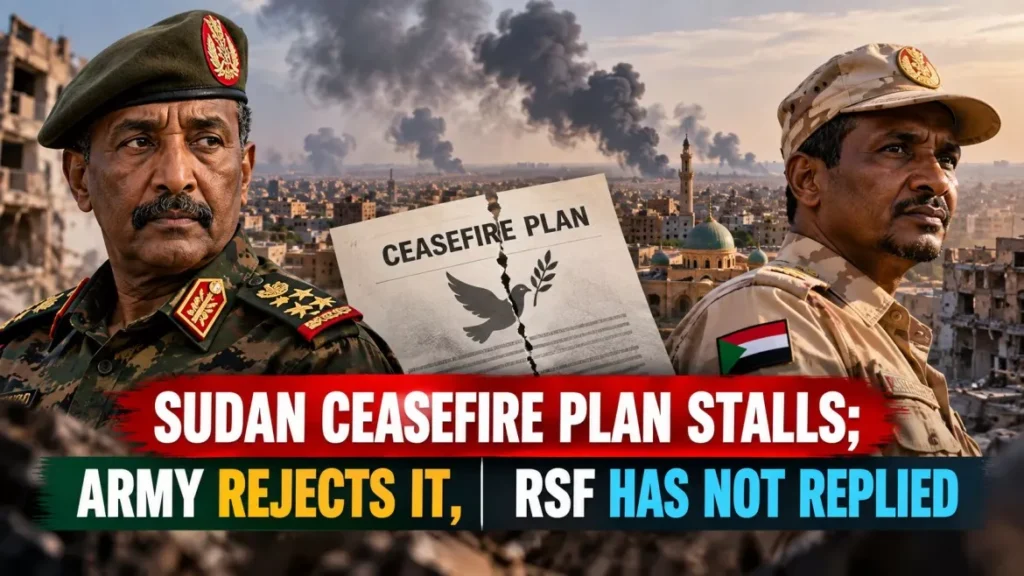

The Sudan ceasefire plan put forward by the United States has stalled. Sudan’s army-led government has rejected it, an adviser to the army chief alleging it would entrench a de facto partition, and the paramilitary Rapid Support Forces has made no recent public response. As of 2 October 2026, no truce is in force.
What the US Plan Proposes
The proposal is a staged one that begins with a 90-day humanitarian truce. It was put forward by Massad Boulos, the United States Senior Advisor for Arab and African Affairs, and the truce is intended to be followed by negotiations to end the war and to resume Sudan’s transition to civilian rule.
Fuller terms reported when the plan was circulated in July 2026 went further. The Saudi newspaper Asharq Al-Awsat reported then that it sought limited withdrawals and troop redeployments to open aid access, particularly in North Darfur and North Kordofan; a “unified national military accountable to an independent, elected civilian government”; and a United States-led coordination committee including the United Nations, the African Union and the Arab League, with a UN mechanism to oversee implementation.
The plan is backed by the group of mediators known as the Quad — the United States, Egypt, Saudi Arabia and the United Arab Emirates. The war it seeks to pause began in April 2023 between Sudan’s armed forces and the Rapid Support Forces, a paramilitary group that grew out of state-backed militias and now holds territory of its own.
Why the Army-Led Government Rejected It
The government’s objection is that the plan leaves the RSF in place. Amjad Farid, adviser to General Abdel Fattah al-Burhan on political and international affairs, told Reuters on 30 September 2026 that “Mr Boulos seems to be putting pressure on us to accept a de facto partitioning of the country similar to Libyan model.”
Speaking from the UN General Assembly in New York, Farid added that “the approach Mr Boulos continues to advance appears to accommodate the militia’s continued existence and preserve a place for it in Sudan’s political future.” The word “militia” is the government’s term for the RSF, not a neutral description.
The government says it did not simply refuse. It submitted proposed changes, the chief of which was an internationally monitored withdrawal of the RSF from urban areas rather than the phased, partial redeployment the plan envisages. Farid said the United States appeared to have ignored them.
Burhan himself has been blunt. Quoted on 29 September 2026, he said: “We will not backtrack on what we said: we do not want a visa to any country, nor do we want their permission,” and “Our goal is to eliminate this militia, no matter the cost.”
Where the Rapid Support Forces Stands
The RSF’s current position is the least documented part of the story. Reuters reported on 30 September 2026 that the group had not made any recent statements on the US proposal and that its leader had said its fighters intend to continue the war. That account rests on Reuters alone.
The RSF has accepted a truce before. When the Quad put a humanitarian truce to it in November 2025, the group said in a statement that it “affirms its agreement to enter into the humanitarian truce proposed by the Quad countries”, as reported at the time. No equivalent statement has been reported for the current proposal.
Separately, The Media Line reported on 1 October 2026 that the RSF has spent the past year seeking to establish a parallel government in Nyala, in southern Darfur. That is a single-outlet report.
Who Demands What
The two sides are not arguing about the length of the truce but about what happens to territory and to the RSF itself.
| Party | Core Demand | What It Rejects | Position As Of |
|---|---|---|---|
| United States and the Quad | Immediate 90-day truce, then talks on a permanent ceasefire and civilian rule | Preconditions that delay the truce | 30 September 2026 |
| Army-led government | Internationally monitored RSF withdrawal from urban areas | Phased or partial redeployment; any political role for the RSF | 1 October 2026 |
| Rapid Support Forces | No recent public position stated | Withdrawal from areas it holds, per earlier reporting | 30 September 2026 |
The Visa That Became Part of the Negotiation
A travel document turned into leverage. Burhan’s visa to attend the UN General Assembly in New York was withheld because he had not accepted the ceasefire proposal, a link reported from 23 September 2026 onwards and confirmed by Farid.
After the visa was refused, a planned meeting in Washington between Sudan’s delegation and Boulos was cancelled, according to Reuters. The effect was that the one scheduled opportunity to narrow the gap did not take place.
What Is Agreed, What Is Claimed and What Is Unverified
Very little in this dispute is settled, and the three categories are worth separating.
- Agreed by both sides: that Boulos circulated a plan beginning with a 90-day truce, and that the army-led government has not accepted it.
- Claimed by the government: that the plan amounts to pressure to accept de facto partition, and that its proposed amendments were ignored. The United States has not publicly accepted either characterisation.
- Claimed by the government, disputed in effect: that the RSF would retain a political future under the plan. The plan’s own reported text calls for a single national army under an elected civilian government.
- Unverified: the RSF’s current stance, which rests on one Reuters report; and the size and status of any parallel administration in Nyala.
No partition of Sudan has been agreed, recognised or implemented. “De facto partitioning” is the characterisation of one party’s adviser, not an outcome any party has endorsed.
The Humanitarian Position Behind the Talks
The figures are the reason the truce is being pressed at all. UN News reported on 25 September 2026 that 35 million people in Sudan require humanitarian assistance, 19 million face hunger and 13 million have been displaced.
Displacement and hunger totals for Sudan differ between UN updates and between the agencies compiling them, so a single figure quoted without its source and date should be treated with care. The pattern of under-funded appeals is not unique to Sudan; our report on Yemen displacement and aid funding set out a comparable shortfall.
What the plan would change in practice is access. The withdrawals it seeks in North Darfur and North Kordofan are framed as a means of opening aid corridors, which is why the dispute over whether withdrawal is phased or complete is a humanitarian question as much as a military one.
What Happens Next
Nothing is scheduled publicly. The cancelled Washington meeting has not been rescheduled on the record, the Quad has not announced a revised text, and neither party has set a date for a response.
Competing accounts of the same diplomacy have become a feature of this UN session, as our report on the US and Iran talks at the General Assembly also showed. Until either the plan is amended or one party moves, the position recorded here stands.
Frequently Asked Questions
Is There a Ceasefire in Sudan Right Now?
No. As of 2 October 2026 no truce is in force. The US ceasefire plan has been rejected by the army-led government and the Rapid Support Forces has not publicly responded to it.
How Long Is the Proposed Truce?
Ninety days. The plan proposes an immediate 90-day humanitarian truce, to be followed by negotiations on a permanent ceasefire and a return to civilian rule.
Who Proposed the Sudan Ceasefire Plan?
Massad Boulos, the United States Senior Advisor for Arab and African Affairs, on behalf of the Quad group of mediators: the United States, Egypt, Saudi Arabia and the United Arab Emirates.
Why Was Burhan’s UN Visa Withheld?
United States officials tied the visa for the UN General Assembly to his acceptance of the ceasefire proposal. He did not accept it, the visa was withheld, and a planned Washington meeting with Boulos was then cancelled.
Has Sudan Been Partitioned?
No. No partition has been agreed, recognised or implemented. The phrase “de facto partitioning” comes from an adviser to the army chief describing what he says the US plan would lead to, and the United States has not accepted that description.