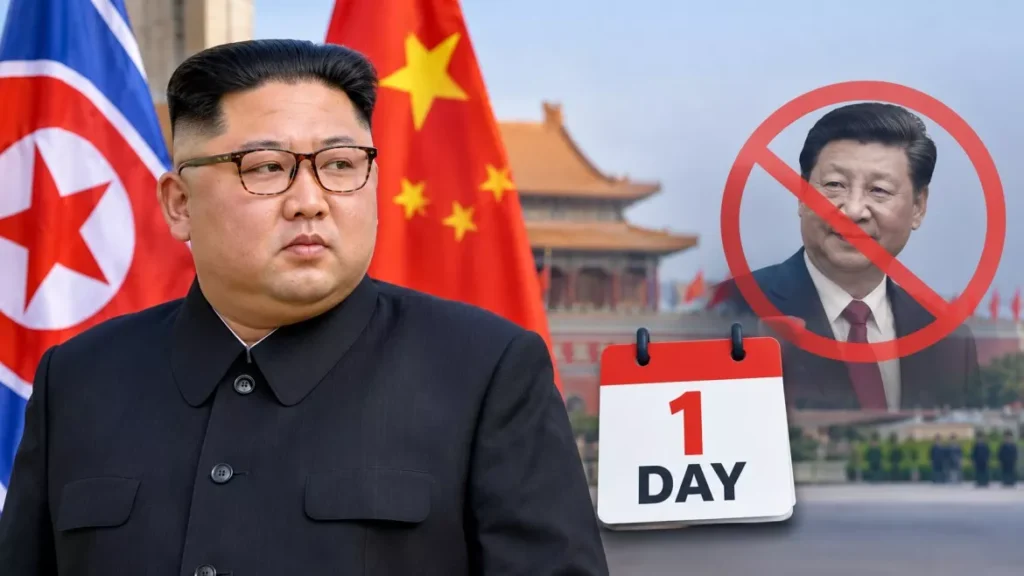

The Kim Jong Un China visit on 24 October 2026 lasted a single day and did not include President Xi Jinping. North Korea’s leader crossed the New Yalu River Bridge into the Chinese border city of Dandong and met Wang Huning, China’s fourth-ranked official. Xinhua reported that Kim returned home the same day.
Who Kim Met, and Who He Did Not
Kim met Wang Huning, a member of the Communist Party’s Politburo Standing Committee, who conveyed what Xinhua described as Xi Jinping’s “cordial greetings and best wishes”. That is a message relayed, not a meeting between the two heads of state.
Xinhua reported that Kim said North Korea “stands ready to work with China to carry forward their historical friendship and expand their practical cooperation”. Wang told Kim that China was ready to use the bridge’s opening to expand people-to-people exchanges and economic and trade cooperation.
Kim laid tribute at a Dandong memorial to the Chinese People’s Volunteer Army, the force China sent into the 1950–1953 Korean War, and toured a local car factory. The trip fell on the eve of the anniversary of China’s entry into that war.
Some early reports named Chinese Premier Li Qiang as meeting Kim. Li Qiang attended the bridge’s opening ceremony on 15 October, nine days earlier; the official Chinese account of the 24 October visit names Wang Huning. North Korean state media had not reported Kim’s trip as of 24 October.
The Bridge Opened on 15 October, Not on Kim’s Crossing
Several headlines described Kim as inaugurating the bridge. He did not. China and North Korea opened the New Yalu River Bridge on Thursday 15 October 2026 at a joint ceremony, and cargo trucks began crossing that day.
Li Qiang said the crossing would “vigorously promote” trade. North Korean Premier Pak Thae-song said it would “add fresh vigour” to economic cooperation. Neither leader was Kim, and Kim’s crossing nine days later was a separate event.
The bridge had stood finished and unused for twelve years. Construction began in 2011 and the Chinese side was completed in 2014. North Korea finished its connecting roads and customs buildings only in 2026, after repeated pauses that South Korean reporting links to strained relations, nuclear tests, sanctions and the pandemic border closure.
What the New Bridge Replaces
Until 15 October, all road and rail freight between Dandong and Sinuiju moved over a bridge built during the Second World War.
| Sino-Korean Friendship Bridge | New Yalu River Bridge | |
|---|---|---|
| Opened | 1943 | 15 October 2026 |
| Road capacity | Single-lane road plus a rail track | Four lanes |
| Vehicle weight limit | 20 tonnes maximum | Heavy cargo trucks and containers |
| Length | Shorter crossing at the narrow point | 3,026 metres, about 3 kilometres |
China’s estimate of the new bridge’s throughput is up to 20,000 vehicles and 50,000 passengers a day, a figure reported by the Seoul Economic Daily and not independently confirmed. The bridge is designed for two-way traffic around the clock.
What China–North Korea Trade Actually Looks Like
Two-way trade is recovering but remains less than half its 2013 level. All the figures below come from China’s General Administration of Customs, the agency that publishes the only official bilateral series.
- 2013: The peak year, at $6.45 billion.
- 2025: $2.74 billion, up 25% on the previous year.
- First half of 2026: About $1.5 billion, a rise of nearly 20% year on year.
The asymmetry matters more than the growth rate. China accounts for as much as 95% of North Korea’s official external trade. North Korea accounted for a little more than 0.04% of China’s $6.36 trillion total trade in 2025 — a rounding error in an economy whose third-quarter output figures run to hundreds of billions of dollars a month.
Whether the Bridge Will Change the Numbers
Specialists interviewed by news organisations in October do not agree, and the disagreement is about politics rather than road capacity.
Lu Chao of the Liaoning Academy of Social Sciences told Reuters that “the opening of the bridge has resolved a major bottleneck in China-North Korea trade logistics” and that bilateral trade “is likely to increase further”. Jae-woo Joo of Kyung Hee University told Al Jazeera the bridge could boost trade “tremendously”.
Others are unconvinced. Christopher Green of the International Crisis Group said “lack of cross-border transit routes is not the main obstacle” and that “the key is the politics of national security, not economics”. Phillip Park of the University of North Korean Studies in Seoul said the bridge “could facilitate trade and logistics, but it does not remove international sanctions”. Edward Howell of the University of Oxford expects trade to grow but said “economic engagement will be subject to political considerations”.
International sanctions on North Korea, imposed over its nuclear and missile programmes, restrict categories of goods regardless of how much road capacity exists between the two countries. A wider crossing does not alter what the sanctions cover.
What Is Agreed, What Is Claimed, and What Is Unverified
As of 25 October 2026 the record stands as follows.
- Agreed: The bridge opened on 15 October 2026; Kim crossed it into Dandong on 24 October; he met Wang Huning, visited a war memorial and a car factory, and returned the same day.
- Claimed by China: Kim’s remarks about expanding practical cooperation and Xi’s greetings come from Xinhua, the Chinese state news agency, and have not been issued by North Korea.
- Reported by a single source: South Korea’s Yonhap, citing an unnamed South Korean government official, reported Kim’s arrival route and his expected return. The 20,000-vehicle daily capacity rests on one report of a Chinese estimate.
- Unverified: Kim’s purpose. Analysts quoted across the coverage say it is too early to read his intentions, and no agreement, document or trade measure was announced.
- Not established: Any meeting or planned meeting between Kim and Xi Jinping. Reporting on prospects for a Kim meeting with the United States around next month’s APEC summit in Shenzhen is speculation attributed to officials, not a scheduled event.
Frequently Asked Questions
Did Kim Jong Un Meet Xi Jinping on This China Visit?
No. On the 24 October 2026 Kim Jong Un China visit he met Wang Huning, a member of the Communist Party’s Politburo Standing Committee, who passed on greetings from Xi Jinping. Xinhua’s account records no meeting between Kim and Xi.
When Did the New Yalu River Bridge Open?
It opened on 15 October 2026, at a joint ceremony attended by Chinese Premier Li Qiang and North Korean Premier Pak Thae-song. Cargo trucks began crossing the same day, nine days before Kim’s own crossing.
Why Was the Bridge Unused for Twelve Years?
Construction began in 2011 and the Chinese side was finished in 2014, but North Korea did not complete its connecting roads and customs facilities until 2026. South Korean reporting also cites strained relations, nuclear tests, sanctions and the pandemic border closure.
How Much Do China and North Korea Trade?
China’s General Administration of Customs recorded $2.74 billion in two-way trade in 2025 and about $1.5 billion in the first half of 2026. Both figures remain well below the 2013 peak of $6.45 billion.
Does the Bridge Affect Sanctions on North Korea?
No. International sanctions over North Korea’s nuclear and missile programmes restrict categories of goods, and a larger crossing does not change what they cover. Specialists quoted in October disagree over how much trade the bridge will add in practice.