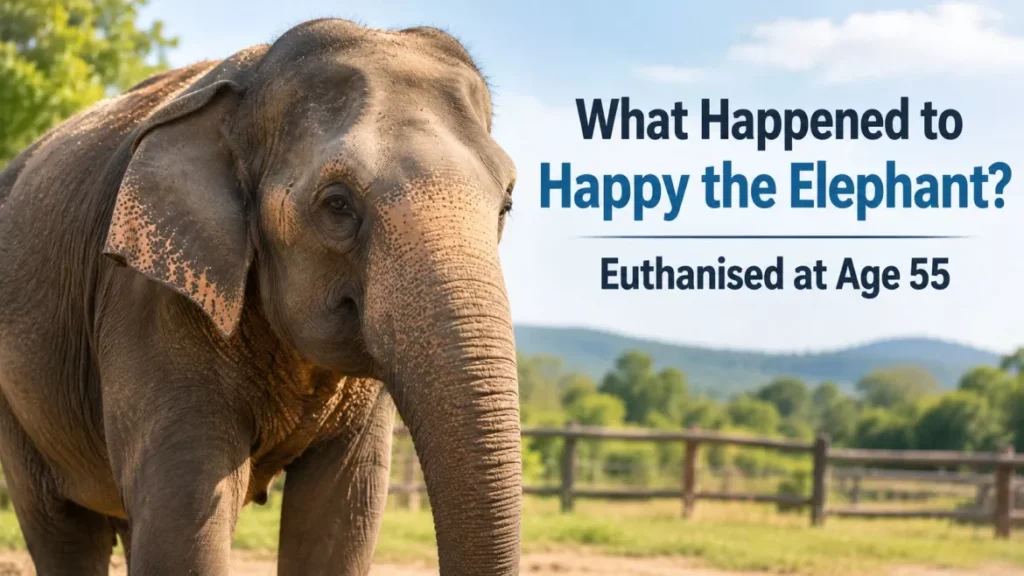

Happy the elephant was euthanised at the Bronx Zoo on 26 May 2026 at the age of 55. A necropsy on the Asian elephant, who was at the centre of a landmark American animal rights case, found several large, inoperable uterine tumours and arthritis. The zoo announced her death the following day.
Why Was Happy Euthanised?
Happy was euthanised after progressive, age-related conditions reached a point her care team judged untreatable.
In the weeks before her death, veterinary testing raised concerns about declining kidney or liver function. The zoo placed her in hospice care, providing pain management, nutritional support and hydration therapy, and gave her access to both the elephant barn and the outdoor yard so she could choose where to spend her time.
A necropsy carried out after her death found several large uterine tumours that would have been inoperable, along with arthritis the zoo described as expected at her age. Her veterinary team believes those conditions together drove her decline.
The decision was made by the zoo’s veterinary and animal care staff rather than its management. Craig Piper, interim Bronx Zoo director and executive vice president for the Wildlife Conservation Society’s zoos and aquarium, said in the zoo’s statement of 27 May 2026 that Happy “died peacefully surrounded by the keepers, curators, and veterinarians who have cared for her”.
Who Was Happy, and How Did She Reach the Bronx Zoo?
Happy was a wild-born Asian elephant who arrived at the Bronx Zoo in 1977 and lived there for the next 49 years.
Researchers believe she was born in Thailand around 1971 and was captured as a calf before being brought to the United States. She was held at a Florida facility alongside six other young elephants, all named after characters from Snow White and the Seven Dwarfs — which is where the name Happy came from.
She reached the Bronx in 1977 with another female, Grumpy. The zoo has said that neither it nor the Wildlife Conservation Society imported her, and that she had passed through several owners before arriving.
Keith Lovett, the zoo’s director of animal programs, described her as among the most responsive elephants in the zoo’s care, and said she was readily motivated by watermelon and strawberries.
Why Did Happy Live Alone for Two Decades?
From the mid-2000s, Happy lived separated by a fence from the Bronx Zoo’s other elephants after her companion Grumpy was fatally injured by them.
Grumpy was attacked and fatally wounded by Patty and Maxine, the zoo’s two other Asian elephants. A younger female brought in as a replacement companion for Happy also died soon afterwards.
After that, Happy could see, hear, smell and touch Patty and Maxine across a barrier but never shared space with them again. Maxine later died, leaving Patty as the zoo’s only other elephant.
No new companion was ever brought in, and that was a matter of policy rather than circumstance. In 2006 the Bronx Zoo announced it would wind down its elephant programme over time and stopped acquiring elephants; the Wildlife Conservation Society said in July 2026 that the commitment “remains unchanged today”.
The zoo has consistently argued that Happy received attentive care and space that supported natural behaviours, and that uprooting her after decades in the Bronx would have harmed her wellbeing. Animal welfare groups disputed that: Born Free USA, announcing her death, described her final years as two decades of solitude.
What the Mirror Test Proved, and What It Did Not
In a 2006 study, Happy became the first elephant shown to recognise herself in a mirror.
The research was published in the Proceedings of the National Academy of Sciences by Joshua Plotnik, Frans de Waal and Diana Reiss. The team installed a large mirror in the elephant yard, big enough for the animals to approach it, touch it and look behind it.
Happy was then marked with a visible white X above one eye and an identical mark on the other side of her head that was invisible except under black light. She touched the visible mark repeatedly — more than a dozen times — while standing at the mirror, and ignored the mark she could not see. Because the visible X was placed where she could not have observed it directly, touching it indicated she understood the reflection was her own.
What the study did not establish is that elephants as a species are self-aware. Patty and Maxine were tested alongside Happy and neither touched either mark across two runs, so one of three subjects passed. Before 2006 the ability had been demonstrated mainly in humans, great apes and dolphins; Eurasian magpies, cleaner wrasse and beluga whales have since been reported to pass versions of the test.
Why a Court Was Asked to Declare Happy a Person
The Nonhuman Rights Project petitioned for a writ of habeas corpus in 2018, arguing Happy was unlawfully confined and should be transferred to a sanctuary.
A Bronx trial court rejected the petition in 2020 and an appellate court upheld that decision. On 14 June 2022 the New York Court of Appeals, the state’s highest court, ruled 5-2 in the zoo’s favour.
Chief Judge Janet DiFiore wrote for the majority that habeas corpus exists to protect the liberty of human beings from unlawful confinement and so did not extend to Happy. The majority warned that a ruling the other way would have what it called an enormous destabilising impact on modern society, and would call into question pet ownership, the use of service animals and other forms of animal work.
Judges Rowan Wilson and Jenny Rivera dissented. Wilson pointed to the historical use of habeas corpus to contest the detention of enslaved people; Rivera focused on Happy’s cognitive abilities and her lost opportunity to live an autonomous life.
The case was the first of its kind in the English-speaking world to reach a court that senior, and the reasoning has since been applied elsewhere. In January 2025 the Colorado Supreme Court unanimously rejected a similar petition the same group brought for five African elephants at Cheyenne Mountain Zoo, holding that expanding legal rights for animals is a job for legislatures rather than courts.
Did Happy Ever Reach a Sanctuary?
No. Happy spent 49 years at the Bronx Zoo and died there, and the 2022 ruling closed the legal route to moving her.
The zoo maintained throughout the litigation that a transfer would have been worse for her than staying, given her age and the length of time she had spent in the same place. No relocation was ever agreed or attempted.
What Happens to Patty, the Last Bronx Zoo Elephant?
Patty, aged 57, is now the zoo’s only elephant, and the Bronx Zoo is reviewing whether to move her to a sanctuary.
Patty has lived at the Bronx Zoo since 1973, longer than Happy did. In a statement dated 7 July 2026, the Wildlife Conservation Society said its elephant care team had visited the Elephant Sanctuary in Tennessee, an accredited facility in Hohenwald covering roughly 3,000 acres, and had discussed options with colleagues at other accredited institutions. Relocation, it said, is one option under consideration and no decision has been made.
The society listed the factors it is weighing:
- Transport risk: moving a geriatric elephant carries medical risk, and loading depends on months of voluntary training she would have to cooperate with.
- Social acceptance: Patty has bonded with some elephants and not others, so there is no guarantee a new herd would accept her.
- Veterinary continuity: she currently receives round-the-clock care geared to an ageing animal.
- Sanctuary reality: the society noted that some geriatric elephants at sanctuaries are housed individually anyway, for medical or behavioural reasons.
- Timescale: preparing any move would take 12 months or more.
Piper said the decision would rest on Patty’s individual needs and not on “public pressure or applying ‘a one size fits all’ for Patty’s care”. Christopher Berry, executive director of the Nonhuman Rights Project, has publicly urged the zoo to send her to a sanctuary.
The Bronx Zoo is not the only major institution winding down a flagship animal programme. Zoo Atlanta’s giant pandas returned to China in 2024 when the zoo’s long-running loan agreement expired, ending an attraction that had run for a quarter of a century.
As of 23 October 2026, the Bronx Zoo has announced no decision on Patty, and the 7 July 2026 statement remains the most recent verified public update. Whatever is decided, Patty is the end of the line: the zoo’s 2006 commitment means no further elephants will be brought to the Bronx.
Happy’s Life and Legal Fight: Key Dates
| Date | Event |
|---|---|
| About 1971 | Happy is born, researchers believe in Thailand, and is later captured as a calf |
| 1973 | Patty arrives at the Bronx Zoo |
| 1977 | Happy arrives at the Bronx Zoo with Grumpy |
| 2006 | The mirror study is published; the zoo announces it will wind down its elephant programme |
| 2018 | The Nonhuman Rights Project files its habeas corpus petition |
| 2020 | A Bronx court rejects the petition and an appellate court affirms |
| 14 June 2022 | The New York Court of Appeals rules 5-2 for the zoo |
| 26 May 2026 | Happy is euthanised at 55 |
| 7 July 2026 | The zoo confirms it is reviewing a sanctuary move for Patty |
Frequently Asked Questions
How Old Was Happy the Elephant When She Died?
She was 55. Researchers place her birth at about 1971, which means she lived roughly 49 of those years at the Bronx Zoo.
Was Happy Ever Declared a Legal Person?
No. New York’s highest court ruled 5-2 on 14 June 2022 that habeas corpus protects human beings and could not be used on her behalf.
Which Bronx Zoo Elephant Passed the Mirror Test?
Happy was the only one. Patty and Maxine were tested with her in the same 2006 study and neither touched the mark on their heads.
How Many Elephants Are Left at the Bronx Zoo?
One. Patty, aged 57, has been there since 1973 and became the sole remaining elephant when Happy died.
Will the Bronx Zoo Bring In More Elephants?
No. The zoo announced in 2006 that it would conclude its elephant programme over time, and the Wildlife Conservation Society reaffirmed that position in July 2026.