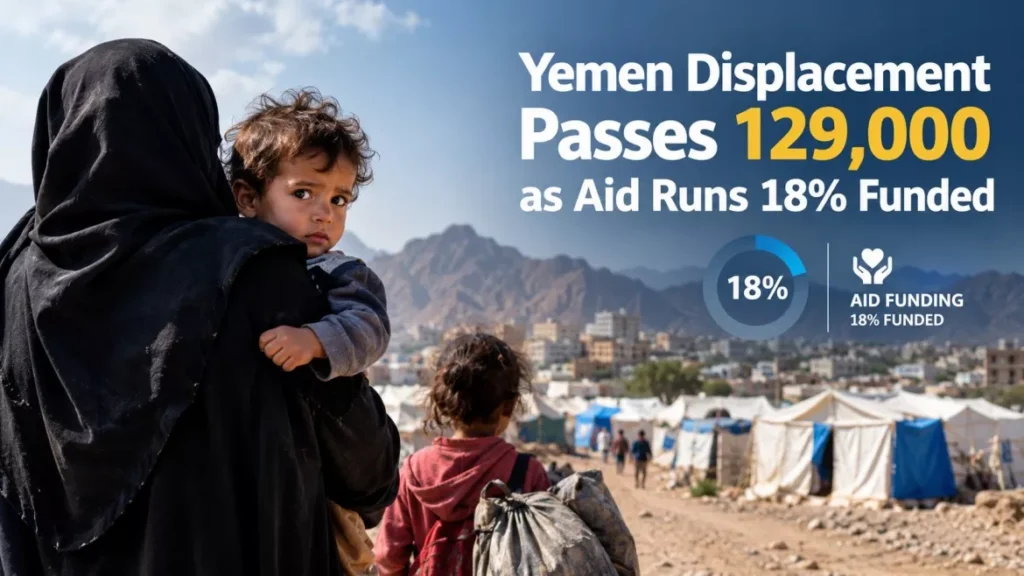

Yemen displacement reached 129,438 people on 21 September 2026, according to the International Organization for Migration’s tracking, up from 118,086 three days earlier. Most of those uprooted are in Taiz governorate in the country’s south-west. The United Nations refugee agency’s Yemen response for 2026 is 18 per cent funded.
Where the Displaced People Are
Four governorates account for almost all of the new displacement, and one of them holds well over half. The figures below are the IOM count as of 21 September 2026 and were reported by UN News; they change every few days.
| Governorate | People displaced | Share of the total |
|---|---|---|
| Ta’iz | 73,494 | About 57 per cent |
| Lahj | 33,828 | About 26 per cent |
| Aden | 8,946 | About 7 per cent |
| Al Hodeidah | 8,244 | About 6 per cent |
The count rose by 11,352 in the three days to 21 September. Earlier in the month the IOM recorded more than 112,000 people displaced within two weeks across Aden, Hudaydah, Abyan and Ta’iz. The United Nations refugee agency, UNHCR, has said internal displacement could exceed 230,000 if the fighting continues.
This is displacement on top of displacement. UN News reported UNHCR’s pre-escalation figure as nearly 4.8 million Yemenis displaced by a decade of conflict, economic collapse and environmental disaster; UNHCR briefings reported by Al Jazeera and the legal news service JURIST on 22 September put the pre-escalation total at 5.2 million. The two figures have not been reconciled publicly.
The Crossings to Djibouti and the Horn of Africa
More than 3,100 people had crossed the Bab al-Mandab Strait to Djibouti since the escalation began, as of 21 September 2026. Hundreds more reached Somaliland and Puntland.
- Entry points: Arrivals come mainly through Obock, Khor Angar, Moulhoule and Godoria on Djibouti’s coast.
- Pace: UNHCR reported more than 2,400 sea crossings in a single four-day period.
- Who is arriving: More than 60 per cent of arrivals are women, children and older people, according to UNHCR.
- What is expected: UNHCR and its partners are planning for more than 10,000 arrivals in Djibouti, and expect numbers to climb after mid-October, when sea conditions improve.
Bab al-Mandab, also written Bab el-Mandeb, is the strait between Yemen and Djibouti that connects the Red Sea to the Gulf of Aden. It is roughly 30 kilometres wide at its narrowest point, which is what makes the crossing possible in small boats and also what makes it one of the world’s most sensitive shipping passages.
How Little of the Response Is Funded
Both sides of the emergency are running on a fraction of what agencies say they need. The percentages below are UNHCR’s own figures for its 2026 requirements, as reported on 22 September 2026.
- Yemen operation: 18 per cent funded for 2026.
- Djibouti operation: 15 per cent funded, with an appeal for $13.5 million to cover registration, reception and protection for arrivals.
Abdusattor Esoev, the IOM’s chief of mission in Yemen, described the position bluntly in a Geneva briefing on 18 September: “Our resources are very, very, very limited and our stocks will be depleted very soon.” UNHCR says 22.3 million people in Yemen — more than half the population — require humanitarian assistance in 2026, a figure set before this escalation.
Why UN Aid Cannot Reach Houthi-Controlled Areas
Money is not the only constraint. The United Nations says it cannot operate in the areas the Houthi movement controls, which is where a substantial share of the population lives.
Alessandra Vellucci, Director of the UN Information Service in Geneva, said delivery of UN humanitarian assistance in Houthi-controlled areas had become “untenable”, with UN personnel detained and UN premises occupied. “As of today, 73 UN personnel remain arbitrarily detained by the Houthi de facto authorities, some of them since 2021,” she said, according to UN News on 18 September 2026. Five former UN personnel and dozens of staff from non-governmental organisations, civil society groups and diplomatic missions also remain detained.
Nine health facilities in Ta’iz, Lahj and Al Hodeidah have been damaged, closed or attacked. UNFPA, the UN sexual and reproductive health agency, reported more than 2,700 displaced pregnant women, of whom about 300 were due to give birth within two weeks of the 21 September count.
What Is Agreed, What Is Claimed and What Is Unverified
Reporting from Yemen separates into three categories, and conflating them is how contested claims harden into accepted fact. This is the position as of 25 September 2026.
| Claim | Source | Status |
|---|---|---|
| 129,438 people displaced by 21 September | IOM tracking, via UN News | Agreed; UN-recorded and dated |
| Houthi forces seized Mocha and the remaining Red Sea coastline | UN Security Council briefing, 15 September | Agreed by the UN and both sides |
| Government forces repelled overnight attacks on the Hejat al-Abd pass on the Taiz-Aden road on 24 September | Yemen’s internationally recognised government, reported by Reuters | Government claim; not independently confirmed |
| Saudi Arabia intercepted Houthi ballistic missiles on 24 September | Saudi-led coalition | Coalition claim; not independently confirmed |
| More than 700 people killed in the latest fighting | United Nations, via Reuters | UN figure; a breakdown between combatants and civilians has not been published |
| Hundreds of combatant casualties from government air strikes | Cited at the UN Security Council, 15 September | Described as unconfirmed in the Council record |
| Drones that struck a Saudi pipeline on 12 September were launched from Iraqi territory | Raised by Council members | Contested; no attribution established |
Khaled Khiari, Assistant Secretary-General for Political and Peacebuilding Affairs, told the Security Council on 15 September that “the situation in and around the Bab al-Mandab Strait has become increasingly volatile,” according to the Council’s own meeting record. At that briefing the UN put displacement at about 125,000 since early September and documented 40 civilian casualties during the month, more than half of them women and children.
UN Spokesperson Stéphane Dujarric said on 21 September: “We reiterate our condemnation of the continued Houthi cross-border attacks against Saudi Arabia, including the attempt to target Riyadh.” Yemen’s representative told the Security Council his government would regain control and prevent threats to navigation. Saudi Arabia’s representative accused the Houthi movement of rejecting settlement proposals. Several Council members said Iran continues to supply weapons; that remains contested, and no enforcement mechanism was agreed.
Why the Strait Matters Beyond Yemen
The fighting sits on a shipping chokepoint, which is why a Yemeni displacement crisis registers on global markets. Houthi forces have advanced along the Red Sea coast towards Bab al-Mandab, having taken Mocha earlier in September — a development this site covered when Mokha port fell and the UN logged 11,400 displaced households.
Cross-border attacks have reached Saudi Arabia, including damage to Saudi cities on 14 September and a drone strike on the East-West Pipeline on 12 September, both raised at the Security Council. An earlier attack on Saudi oil infrastructure this month wounded 73 people as Brent crude touched $99 a barrel. Energy and freight prices are being shaped by the same conflict that is moving people across the strait, at a time when the Strait of Hormuz is also disrupted.
What Happens Next
Hans Grundberg, the UN Special Envoy for Yemen, was in Muscat for talks with Omani officials and Houthi representatives as of 21 September 2026. No ceasefire, timetable or negotiating framework has been announced. The Security Council has not agreed a new resolution on the escalation, and the questions left open at its 15 September meeting — how to enforce the existing arms embargo, and whether dialogue or a military response should take priority — were unresolved. UNHCR’s planning assumption of more than 10,000 arrivals in Djibouti and more than 230,000 displaced inside Yemen are projections, not recorded figures.
Frequently Asked Questions
How Many People Has the Yemen Displacement Crisis Uprooted?
The International Organization for Migration recorded 129,438 people displaced as of 21 September 2026, up from 118,086 on 18 September. UNHCR has said the total could exceed 230,000 if fighting continues.
Which Part of Yemen Is Worst Affected?
Ta’iz governorate in the south-west, which accounted for 73,494 of the 129,438 displaced as of 21 September 2026 — about 57 per cent of the total.
Where Are Yemenis Fleeing To?
More than 3,100 people had crossed the Bab al-Mandab Strait to Djibouti by 21 September 2026, arriving mainly at Obock, Khor Angar, Moulhoule and Godoria. Hundreds more reached Somaliland and Puntland.
Why Can the UN Not Deliver Aid Across Yemen?
The UN Information Service in Geneva said on 18 September 2026 that delivery in Houthi-controlled areas had become “untenable”, citing 73 UN personnel arbitrarily detained by the Houthi de facto authorities and the occupation of UN premises.
Is There a Ceasefire in Yemen?
No. As of 25 September 2026 no ceasefire has been announced. The UN Special Envoy, Hans Grundberg, was holding talks in Muscat with Omani officials and Houthi representatives.