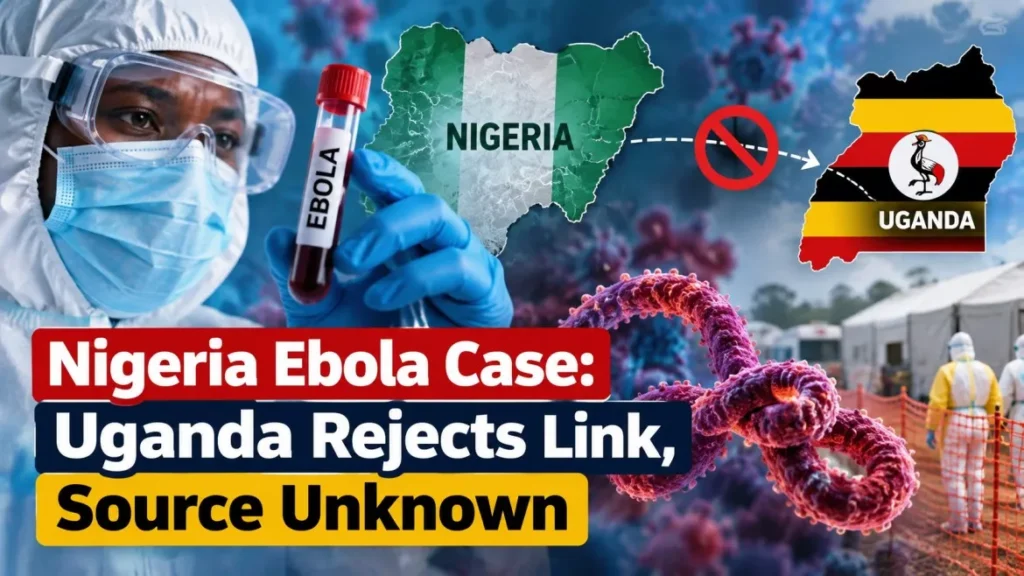

The Nigeria Ebola case was confirmed in Abuja on 20 October 2026, the country’s first in more than a decade. The patient is a woman who flew in from Uganda via Addis Ababa on 5 October. Nigeria is the fourth African country reached, and the source of her infection is unknown.
What Is Confirmed About the Nigeria Ebola Case
One case, no deaths, and a response already activated. The following sequence is consistent across Nigerian government statements, the World Health Organization and wire reporting by the Associated Press and Reuters.
- 5 October 2026: the woman arrives in Abuja from Uganda, routed through Addis Ababa.
- 7 October 2026: symptoms begin, roughly two days after arrival.
- 11 October 2026: she seeks care at a private health facility in Abuja with malaria-like symptoms.
- 19 October 2026: she is tested for Ebola, after officials learn of her recent travel to Uganda.
- 20 October 2026: laboratory tests confirm Ebola. She remains in isolation receiving care.
Muhammad Ali Pate, Nigeria’s coordinating minister of health and social welfare, announced the confirmation at a press conference in Abuja. The Nigeria Centre for Disease Control and Prevention activated its incident management system and opened a 24-hour toll-free reporting line on 6232.
The strain is Bundibugyo virus, one of the orthoebolavirus species, the same one driving the outbreak that began in the Democratic Republic of the Congo in May 2026. Genetic sequencing to confirm the match to the Congolese strain was still under way as of 23 October 2026.
Where the Accounts Disagree
How the woman was infected is contested, and the parties involved describe her journey differently.
| Account | What it says | Who said it |
|---|---|---|
| Nationality | Not disclosed | Nigerian authorities |
| Nationality and route | A Nigerian woman who only transited Uganda while on a business trip to the Democratic Republic of the Congo | Uganda’s health ministry |
| Identity | A Uganda-born spouse of a diplomat posted in Abuja | Al Jazeera, 22 October 2026 |
| Travel to the Congo | No validated information that she had been to the Democratic Republic of the Congo | Africa CDC |
| Travel outside Uganda | The information received included no travel outside Uganda | Pavel Ursu, WHO representative in Nigeria |
Uganda has pushed back directly. Its health ministry said that “travel through Uganda does not establish that infection occurred here”, and government spokesman Alan Kasujja called it “preposterous” to link Uganda to the Nigerian case on the basis that she had holidayed there.
Africa CDC has offered one possible thread. Wessam Mankoula, who heads its emergency preparedness and response department, said the first Nigerian case and Kenya’s first case both departed Entebbe on 3 October, and that a possible encounter between them is under investigation. Jean Kaseya, the agency’s director general, likewise said travel to the Congo was not validated.
Patrick Otim, a WHO emergency response manager, said the source of infection remains unknown and that investigators are reviewing the Abuja health facilities she visited. None of these accounts has been reconciled, and no party has produced a confirmed exposure event.
The Thirteen Days Before Diagnosis
Twelve days passed between the onset of symptoms on 7 October and the Ebola test on 19 October, and thirteen before confirmation.
She presented with malaria-like symptoms, which overlap heavily with early Ebola in the region, and testing followed only once her travel history came to light. Nigerian authorities have not said whether the health declaration form used at points of entry flagged her arrival.
The delay matters for the contact count. Most of the 44 contacts identified are healthcare workers, according to Pate, which reflects the days she spent seeking care before the infection was recognised.
How Many Contacts, and Who They Are
Nigeria is monitoring 44 identified contacts, with more being added as tracing continues.
WHO said on 21 October 2026 that the 44 are under monitoring, that authorities are intensifying efforts to find others who may have been exposed, and that infection prevention and control measures are being reinforced at the facility where she sought care. WHO is supplying personal protective equipment and supporting case investigation and contact tracing.
One Kenyan outlet reported that tracing had expanded past 120 contacts. That figure has not appeared in Nigerian government statements or in WHO material, and it should be treated as unconfirmed.
Where the Outbreak Stands Across Countries
The United States Centers for Disease Control and Prevention counted 9,735 confirmed cases and 4,690 confirmed deaths across all affected countries as of 21 October 2026.
| Country | Confirmed cases | Confirmed deaths |
|---|---|---|
| Democratic Republic of the Congo | 9,704 | 4,687 |
| Uganda | 20 (plus 1 probable) | 2 (plus 1 probable) |
| Kenya | 9 | 1 |
| Nigeria | 1 | 0 |
| France | 1 | 0 |
| Total | 9,735 | 4,690 |
Figures are as published by the US CDC for 21 October 2026, and they move daily. Earlier readings differ because they were taken earlier: WHO’s disease outbreak notice of 8 October reported 8,728 confirmed cases and 4,205 confirmed deaths as of 6 October, with a crude case fatality ratio of 48.2%.
Uganda was declared free of the disease at the end of August 2026, which is why WHO now describes active or recent transmission in three countries rather than four. France confirmed a single case in late June 2026, in a doctor returning from the Congo, who was isolated in a specialist hospital.
Inside the Congo, the outbreak has reached eight provinces, most recently Nord Ubangi on the border with the Central African Republic. Ituri remains the epicentre. The site previously reported the toll at 3,510 deaths in mid-September and cases at 8,067 by the end of that month.
What WHO Officials Said This Week
WHO’s Africa office used an online briefing on Thursday 22 October 2026 to reframe the outbreak as regional rather than national.
Mohamed Janabi, WHO regional director for Africa, said: “We are facing a more complex outbreak landscape.” He also said that “Ebola does not wait. It follows movement, exploits gaps and tests the strength of our health systems”, and that the disease is now a regional concern rather than confined to one place.
Anne Ancia, WHO’s country representative in the Congo, described community resistance to accepting help in Mangina, in North Kivu’s Beni territory, an area she called insecure. Reporting from the briefing put deaths there at about 15 a day in the preceding week, and said roughly six in ten deaths in the Congolese outbreak have occurred outside health centres.
In Kenya, health ministry director general Patrick Amoth said all 135 contacts of the country’s first patient had been traced and accounted for. Kenya’s nine cases form a single cluster, with six confirmed between 14 and 17 October among relatives and health workers already in quarantine.
Why Bundibugyo Is Harder to Fight
There is no licensed vaccine and no specific treatment for Bundibugyo virus disease.
WHO states plainly in its disease outbreak notice that “no approved vaccines or specific treatments currently exist for BVD”, while noting that early supportive care improves survival. Ervebo, the vaccine licensed against Zaire ebolavirus, is not approved for this strain, and Otim said no preliminary data yet exists on whether it offers cross-protection.
Two research tracks are running. A WHO technical advisory group reported on prioritising candidate vaccines on 31 July 2026, and enrolment in a clinical trial to identify effective treatments began on 2 July 2026.
The outbreak’s speed is part of why it has drawn this level of attention. The US CDC describes it as the second-largest Ebola outbreak on record, and says it passed 1,000 confirmed cases within 40 days of response activation, against roughly 235 days for the 2018 Congolese outbreak.
What WHO Has and Has Not Recommended
WHO advises against restricting travel to, or trade with, affected countries, and has issued no such recommendation during this outbreak.
It has instead asked countries in the region to maintain a high level of readiness as the Congolese outbreak evolves. WHO determined on 17 May 2026 that the outbreak constituted a public health emergency of international concern, according to the European Commission’s public health service, a designation that triggers coordinated international action rather than border closures.
Individual governments set their own travel guidance separately. The US CDC currently lists Ituri and Nord-Kivu provinces at its highest level, advising against all travel; Haut-Uele and Tshopo at the next level down; the Congo and Uganda at enhanced precautions; and Kenya at usual precautions. A travel notice is advice to travellers, not a restriction on movement or trade.
What Happens Next
- Sequencing: genetic results are expected to confirm whether the Nigerian case matches the Bundibugyo strain circulating in the Congo.
- Contact monitoring: Nigeria’s 44 identified contacts are followed through the incubation period; Kenya has used a 21-day isolation window for its contacts.
- Source investigation: Africa CDC is examining whether the Nigerian and Kenyan index cases crossed paths at Entebbe on 3 October; no conclusion has been published.
- Case counts: the CDC and WHO figures above are dated readings and will change; neither body has set a date for the next formal situation report.
Nigeria Ebola Case: Frequently Asked Questions
How Many Ebola Cases Does Nigeria Have?
One confirmed case and no deaths, as of 23 October 2026, according to the US CDC’s count for 21 October. It is Nigeria’s first Ebola case in more than a decade.
Where Was the Patient Infected?
Not established. WHO says the source remains unknown, Africa CDC says there is no validated information that she travelled to the Democratic Republic of the Congo, and Uganda’s health ministry disputes any suggestion that she was infected there.
Which Countries Have Active Cases?
The Democratic Republic of the Congo, Kenya and Nigeria have active or recent cases of Bundibugyo virus disease. Uganda was declared free of the disease at the end of August 2026, and France recorded one case in June 2026.
Is There a Vaccine for This Strain?
No. WHO states that no approved vaccines or specific treatments exist for Bundibugyo virus disease. Whether Ervebo, licensed against a different Ebola species, offers cross-protection is not yet known.
Has WHO Restricted Travel to Affected Countries?
No. WHO advises against any restriction of travel to, or trade with, affected countries, and has asked regional governments to maintain readiness instead. Individual countries, including the United States, issue their own travel notices.
How Large Is the Wider Outbreak?
The US CDC counted 9,735 confirmed cases and 4,690 confirmed deaths as of 21 October 2026, almost all of them in the Democratic Republic of the Congo. The CDC describes it as the second-largest Ebola outbreak on record.