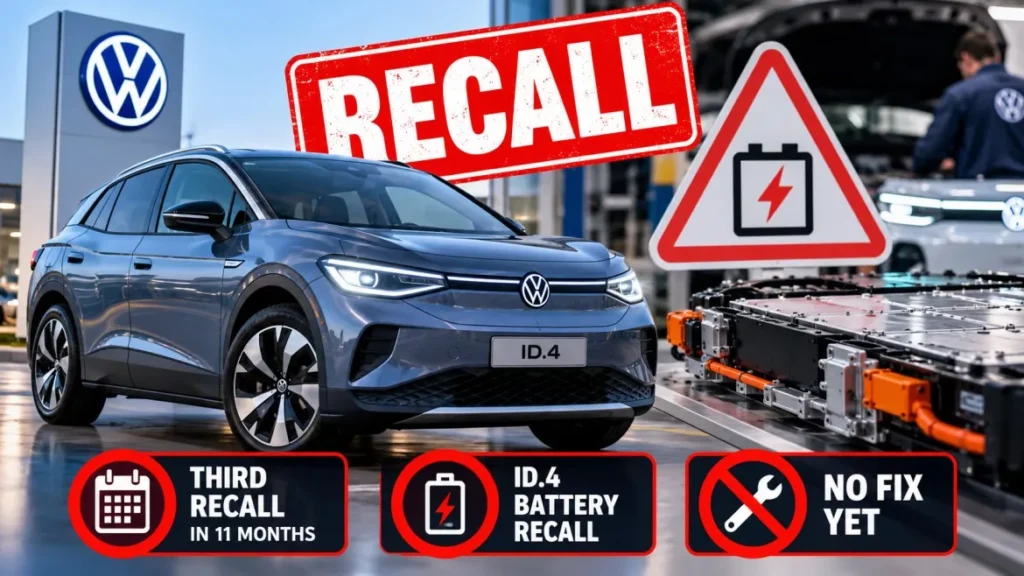

A VW ID.4 battery recall covers 22,524 electric SUVs in the United States because the high-voltage battery can catch fire. It spans 2023 to 2026 model years built up to 1 February 2025, and owners must charge no higher than 80 percent. Volkswagen filed it on 1 October 2026 and says the cause is unknown.
Which ID.4s Are Covered
The recall applies to 2023 through 2026 model-year ID.4 crossovers built between 1 January 2023 and 1 February 2025. Volkswagen Group of America, the Auburn Hills, Michigan arm of the German carmaker, says it drew up the list from vehicle assembly records, high-voltage battery traceability data, supplier production records and available vehicle charging data.
Cars outside that group either use cells made outside the suspect production range or have charging records complete enough to show the car stayed below the threshold Volkswagen defined.
| Item | Detail |
|---|---|
| NHTSA campaign number | 26V630 |
| Volkswagen recall number | 93EX |
| Vehicles involved | 22,524 |
| Model years | 2023 to 2026 ID.4 |
| Build dates | 1 January 2023 to 1 February 2025 |
| Estimated share with the defect | 0.1 percent |
| Battery cell supplier | SK Battery America Inc., Commerce, Georgia |
| Battery part numbers | 11K.915.599.A, 11K.915.599.D, 11K.915.592.D |
| Final remedy | Under development, no date given |
Why Volkswagen Drew the Line at 80 Percent
Volkswagen does not know why the batteries fail. Its safety report to the National Highway Traffic Safety Administration, the US vehicle safety regulator, states that the root cause is unknown, however in certain high-voltage batteries within the affected vehicle population, certain charging profiles combined with a state of charge over 80% may trigger thermal propagation within the high-voltage battery. Thermal propagation is the chain reaction in which one overheating battery cell sets off its neighbours.
The filing puts the share of recalled cars that actually carry the defect at 0.1 percent, which works out to roughly 23 of the 22,524 vehicles. Volkswagen also recorded 22 claims in the United States between 18 January 2024 and 7 August 2026. The report does not describe any injuries.
The company reached that conclusion in stages. On 17 June 2026, during a review of high-voltage battery thermal events in the field, early data pointed to a possible link with specific isolation-resistance values and DC-charging ratios, and the Volkswagen Product Safety Committee ordered a field study of complete battery systems from cars left out of earlier battery recalls. The committee saw the results on 21 September, asked the cell supplier for more detail on production measures and a possible clean date, and decided on 23 September to run a voluntary recall.
How the 80 Percent Cap Actually Reaches Your Car
For most owners, the cap is a manual setting, not something Volkswagen switches on. The company says every affected owner will receive a warning sticker to place at specific points in the car as a reminder not to charge the battery above 80 percent.
Only some cars get the limit applied for them. Depending on the vehicle’s configuration and whether it has active online connectivity, Volkswagen says some vehicles may be configured to cap the maximum state of charge at 80 percent. The filing does not say how many cars qualify, or when those configurations go out.
Volkswagen points owners to the charging section of the vehicle handbook for how to set a charge limit, and asks anyone who drives the car to read it. That matters in a shared household: a cap one driver sets at the charger can be overridden by the next person at the screen.
What This Recall Does Not Require
This campaign carries no instruction to park outside and no instruction to stop driving. NHTSA’s entry for 26V630 flags neither a “do not drive” nor a “park outside” advisory, and the Volkswagen filing leaves both consumer-advisory boxes unticked.
That is worth stating plainly, because Volkswagen’s earlier ID.4 battery recall of December 2025 did carry those restrictions, and some reports on the new recall have repeated them. Under campaign 25V836, owners of 629 cars were told to park outside immediately after charging, not to charge indoors overnight, and to avoid Level 3 DC fast chargers as well as capping the battery at 80 percent. None of the DC-charging or parking instructions appear in the 2026 campaign.
There is also no reimbursement plan attached, because the affected cars are still inside the New Vehicle Limited Warranty period. Recall work itself is free.
Three ID.4 Battery Recalls in Eleven Months
This is the third US safety recall over the ID.4’s high-voltage battery since December 2025, and the three campaigns together cover 67,034 cars. Because the model-year ranges overlap, a single car can sit in more than one, which is why the VIN lookup matters more than the model year.
| Campaign | Filed with NHTSA | Vehicles | Model years | Issue and remedy status |
|---|---|---|---|---|
| 25V836 (VW 93EV) | 3 December 2025 | 629 | 2023 to 2024 | Misaligned electrodes in battery cell modules; modules replaced as needed, letters mailed 11 February 2026 |
| 26V030 (VW 93EA) | 21 January 2026 | 43,881 | 2023 to 2025 | Battery may overheat; software update and battery replacement as needed, letters mailed 18 March 2026 |
| 26V630 (VW 93EX) | 1 October 2026 | 22,524 | 2023 to 2026 | Thermal propagation above an 80 percent charge; remedy still under development |
Only the newest of the three has no repair. Owners whose cars fall under the January 2026 campaign have a fix available now and can book it, since dealers there update the battery software and replace the battery where needed. Other carmakers have moved faster on recent electric-vehicle faults: the Volvo EX30 recall began repairs as it was announced, and the Toyota C-HR EV recall shipped a software remedy.
What Volkswagen Has Confirmed in Europe, and What It Has Not
A second, separate recall is being prepared in Europe. A Volkswagen spokesperson confirmed on 16 October 2026, in response to a Handelsblatt report, that the company is preparing a recall in Germany covering several thousand electric cars, and said internal quality checks found that some high-voltage battery cells did not meet quality requirements. Volkswagen attributes that to production faults at suppliers within a limited period, and says a fire cannot be ruled out in extreme cases.
The model list is not confirmed. Handelsblatt reported that the ID.3, ID.4, ID.7, ID. Buzz and the Cupra Born built from 2023 to 2025 are involved; Volkswagen has not confirmed those models publicly, and that list rests on a single outlet. Figures circulating for the number of cars in Germany also come from secondary reports rather than from Volkswagen or the regulator.
Three things Volkswagen has said about the European action make it different from the US one. It recommends the same 80 percent limit, but says the limit will be lifted for cars that pass a battery inspection at a service centre. It says a faulty battery module would not necessarily need replacing and might be repairable with a software update. And it is preparing the recall with the relevant authorities, which means the terms can still change.
Volkswagen has not publicly linked the European cells to SK Battery America, the supplier named in the US filing.
Dates That Matter
As of 18 October 2026, the US recall has no repair and no repair date; only the interim 80 percent limit is in force.
- 6 October 2026: Dealers were notified and the affected VINs became searchable on NHTSA’s website.
- 16 October 2026: Volkswagen confirmed it is preparing a separate recall in Germany; the action had not yet appeared in the Federal Motor Transport Authority’s database, and a recall in the United Kingdom was reported to be under way.
- 27 November 2026: Interim owner letters are due to be mailed in the United States, warning of the safety risk. They are not the repair notice.
- No date set: The permanent remedy. A second letter follows once it exists.
Frequently Asked Questions
Can I Still Drive My ID.4?
Yes. The VW ID.4 battery recall carries no “do not drive” and no “park outside” advisory. Volkswagen’s instruction is to limit charging to 80 percent until the repair has been carried out.
How Do I Check Whether My Car Is Included?
Run your 17-character VIN through NHTSA’s recall lookup, where these VINs have been searchable since 6 October 2026, or call Volkswagen customer service on 1-800-893-5298 and quote recall 93EX.
What Happens if I Charge Past 80 Percent?
Volkswagen’s filing says certain charging profiles combined with a charge above 80 percent may trigger thermal propagation in the battery, which can cause a fire. It also estimates that only 0.1 percent of the recalled cars carry the defect, and it has not identified the root cause.
Will the Repair Cost Me Anything?
No. Safety recall work is carried out free of charge. Volkswagen is not offering a reimbursement plan under this campaign because the affected cars are still within the New Vehicle Limited Warranty period.
Is the European Recall the Same Campaign?
No. The German action Volkswagen confirmed on 16 October 2026 is separate from US campaign 26V630 and is still being prepared with regulators. Its 80 percent limit can be lifted for individual cars once a service centre inspects the battery and finds no fault.
Does This Affect the ID. Buzz or ID.7?
Not in the United States. The US recall covers the ID.4 only. Handelsblatt reported that the ID.3, ID.7, ID. Buzz and Cupra Born are in the European action, but Volkswagen has not confirmed that list.