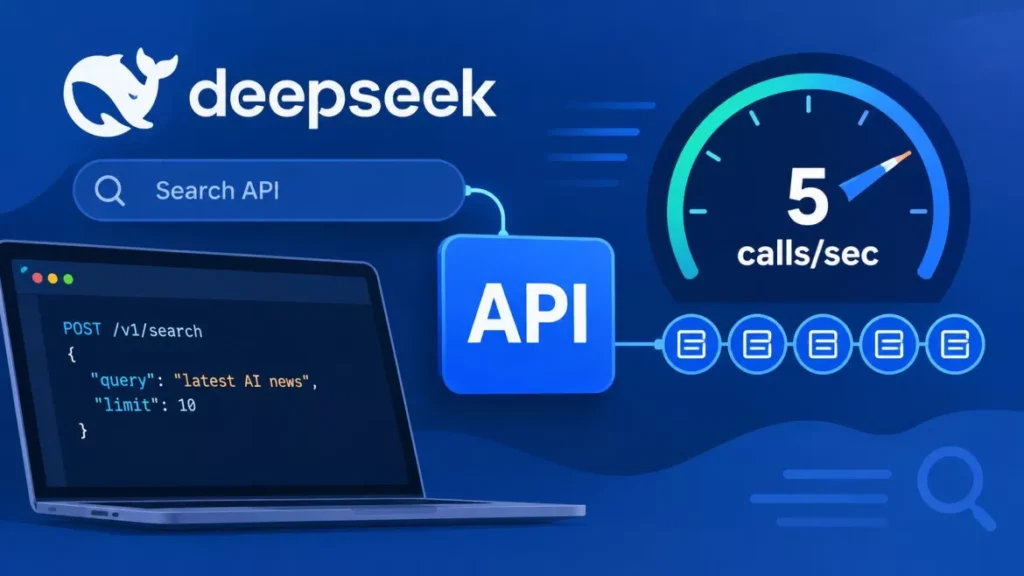

The DeepSeek search API opened to all developers on 17 October 2026, alongside an upgrade to the V4.1 Flash model. Two endpoints went live, one for web search and one for fetching a page as Markdown, each at $0.75 per 1,000 successful requests. Calls through supported harnesses are free until 1 November 2026.
What DeepSeek Shipped on 17 October
DeepSeek, the Hangzhou-based AI company behind the DeepSeek chatbot and the V4 model family, published two things in the same changelog entry. The first is a model refresh: V4.1 Flash became DeepSeek-V4.1-Flash-1017, and the web and app versions were updated with it. The second is the opening of the search infrastructure that already powered those products.
The changelog describes the engine behind the new endpoints as an AI-native general-purpose search engine that indexes hundreds of billions of web pages. DeepSeek says it supports multilingual search and filters SEO spam, what it calls GEO manipulation, and low-quality AI-generated content. None of those claims has been independently measured.
What the Two Endpoints Do
Both take a POST request with a DeepSeek API key as a bearer token, and both are addressed under the same API host as the models.
- Search: POST /v1/tools/search finds web pages for a query and returns structured results. The query runs from 1 to 128 characters, and count sets how many results come back, from 1 to 50, with a default of 10. Page text is returned only if need_content is set to true.
- Fetch: POST /v1/tools/fetch retrieves one web page and returns its content as Markdown. The URL may be up to 8,192 characters, must be HTTP or HTTPS, and may not carry an embedded username or password.
Search accepts the operators a search engine user would recognise: site: and -site:, a leading minus to exclude a term, quoted exact phrases and negated exact phrases, lang: with comma-separated language codes, and after: and before: for dates.
What a Result Actually Contains
Each search result arrives as a structured object rather than a scraped blob, and two of its fields are sized for different consumers.
| Field | What it holds |
|---|---|
| snippet | About 100 to 200 characters, intended for display in a user interface |
| summary | About 600 to 800 characters, intended to be read by a model |
| content | The page text, present only when need_content is true |
| rerank_score | A relevance score from 0 to 3 |
| authority | A source-authority tier from 0 to 4, where -1 means unknown |
| date | Publication date in UTC, in RFC 3339 format, or null |
| title, url, site_name, site_icon | Identifying detail for the page and its publisher |
That split matters in practice: an agent can pass the 600-to-800-character summaries to a model without a second fetch, and show the short snippets to the person watching. Fetch returns only a title and the Markdown content.
What You Pay, and What You Do Not
As of 18 October 2026, neither endpoint is charging per request. The guide states that search and fetch are each $0.75 per 1,000 successful requests, billed per successful request rather than by tokens or by the number of results returned, and that per-request billing starts at 00:00 Beijing time on 1 November 2026. That is 16:00 UTC on 31 October 2026, so developers outside Asia should diary the earlier date.
The billing rule is narrower than the headline price suggests. Only an HTTP 200 response that carries results is billed, which means an empty result list, a timeout and a failure all cost nothing. The number of results in a successful call does not change its price either, so a call returning the maximum 50 costs the same as one returning three.
Usage through DeepSeek Harness, Claude Code and Codex is free for now. The free window is the part worth acting on, because an agent loop that currently runs at no marginal cost acquires one at the end of the month.
Five Requests a Second Is the Real Ceiling
Price is not the binding constraint on a busy agent. Each of search and fetch has a 5 requests-per-second limit per account, and requests above it receive HTTP 429. Fetch carries a further per-domain rate limit, which DeepSeek has not quantified.
At five searches a second, a fleet of agents that each fire a search per reasoning step shares the same small allowance, and the 429s arrive long before the bill does. DeepSeek’s guidance on errors is to wait and retry on 408, 429 and 5xx responses, to top up the account balance on a 402, and not to retry other 4xx errors without changing the request itself. Error bodies follow the same format as OpenAI’s, with statuses from 400 to 504.
What Changed in V4.1-Flash-1017
For anyone already calling the model, almost nothing changes. The model is still reached as deepseek-flash, and DeepSeek says the API calling method and pricing remain unchanged from the September release, which cut prices when V4.1 Flash arrived on 10 September 2026. The company says task runtime and output length were both reduced, and that the model was tuned for DeepSeek Harness, Tencent CodeBuddy and WorkBuddy, advising an upgrade to DeepSeek Harness 0.2.1-rc.1 or later.
The changelog publishes eleven benchmark results for the new snapshot.
| Benchmark | Score |
|---|---|
| BabyVision (with tools) | 92.5 |
| Chartography (with tools) | 83.0 |
| DeepSWE v1.1 | 77.0 |
| Apex Bench v1.1 | 72.1 |
| NL2Repo-Bench | 68.2 |
| Automation-Bench v1.0.6 | 60.5 |
| ZeroBench-main (with tools) | 51.0 |
| HLE (without tools) | 42.6 |
| Terminal-Bench 4.0 | 42.3 |
| Agents’ Last Exam | 35.4 |
| ProgramBench | 29.1 |
One caveat applies to all of them. The changelog presents the figures as a comparison with the previous V4.1 but publishes no prior-version scores beside them, so the table shows where the new snapshot lands, not how far it moved. Coverage that reports the DeepSWE score as an improvement is inferring the direction rather than citing a baseline.
What to Settle Before 1 November
- Count the calls, not the tokens: one search plus three fetches in a single agent turn is four billable requests once the window closes, regardless of how much text comes back.
- Decide on need_content: leaving it false keeps responses small and still returns the model-sized summary, and it does not change the price.
- Handle 429 deliberately: with 5 requests a second per endpoint, retry logic matters more than cost control.
- Upgrade the harness: DeepSeek asks for DeepSeek Harness 0.2.1-rc.1 or later for the new model.
What DeepSeek Has Not Said
The index figure appears in the changelog but nowhere in the API guide, which gives no index size, no list of supported languages and no description of how the spam and AI-content filtering works, despite those being the engine’s main selling points. The per-domain fetch limit is unquantified. Nothing has been said about whether the free harness window extends past 1 November, or what happens to agents mid-run when it ends.
The licence for the new model snapshot is also unstated in the changelog. Secondary coverage reports that the V4.1-Flash-1017 weights are published under an MIT licence on Hugging Face and ModelScope, consistent with the September release, but DeepSeek’s own entry does not say so. For comparison with how rivals price agent tooling, Google has still not named a price for its Gemini agent, while OpenAI and Anthropic have both cut API prices this year.
Frequently Asked Questions
How Much Does the DeepSeek Search API Cost?
$0.75 per 1,000 successful requests, charged separately for search and for fetch. Per-request billing begins at 00:00 Beijing time on 1 November 2026, which is 16:00 UTC on 31 October 2026.
Which Calls Are Free?
Requests that fail, time out or return an empty result list are not billed at all. Separately, calls made through DeepSeek Harness, Claude Code and Codex are free until billing starts.
What Is the Difference Between Search and Fetch?
Search takes a query and returns up to 50 ranked results with scores, snippets and summaries. Fetch takes one URL and returns that page’s content as Markdown.
Are There Rate Limits?
Yes. Each endpoint allows 5 requests per second per account, and anything above that returns HTTP 429. Fetch has an additional per-domain limit that DeepSeek has not published.
Do I Need to Change My Model Calls for V4.1-Flash-1017?
No. The model is still addressed as deepseek-flash, and DeepSeek says the calling method and pricing are unchanged. Users of DeepSeek Harness are asked to move to version 0.2.1-rc.1 or later.