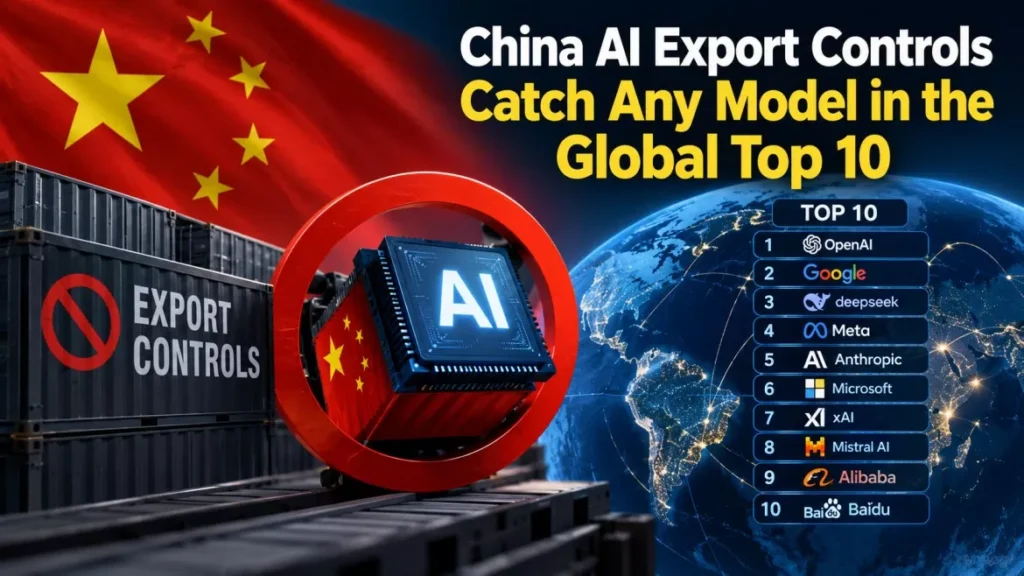

China AI export controls began operating on 16 October 2026, when the Ministry of Commerce started requiring exporters to register technology transfers before they happen. A draft revision published the same day would add 40 technologies to the export catalogue, 23 of them artificial intelligence. Comments close on 15 November 2026.
What the Draft Adds to the Catalogue
The draft is Announcement No. 48 of 2026, issued jointly by the Ministry of Commerce, known as MOFCOM, and the Ministry of Science and Technology. It proposes additions to the Catalogue of Technologies Prohibited or Restricted from Export, the list that decides whether a Chinese technology may leave the country at all, may leave with a licence, or needs no permission.
| Field | Technologies added | Examples named |
|---|---|---|
| Artificial intelligence | 23 | Large-model core technology, AI agents, computing clusters, information processing, chip design |
| Photovoltaics | 12 | Polysilicon, wafer and cell manufacturing, plus core production equipment |
| Biomedicine | 5 | Pathogenic microorganisms, cell and gene therapy, small nucleic acid drugs |
| Total | 40 | 14 proposed for prohibition, 26 for restriction |
A prohibited technology cannot be exported. A restricted one can, but only with an export licence. Everything not on the catalogue stays free to export, and MOFCOM’s spokesperson said most AI technology remains in that category.
The Three Tests That Put a Model Under Licence
A Chinese large model falls into the restricted category if it meets any one of three tests, not all three. The restriction reaches the model’s core technology: its weights, key checkpoints, underlying source code, architecture, training optimisation and inference acceleration methods.
- Training compute: the annex sets a threshold measured in floating-point operations used to train the model.
- Parameter count: the annex sets a parameter threshold above which the core technology is restricted.
- World-leading capability: a model whose capabilities rank among the global top 10 in public evaluations at the time of export.
The third test is the one with no size floor. The draft defines world-leading as placing in the global top 10 across public assessments of comprehensive performance, specialised capabilities, global call volume, safety and training efficiency, judged when the export happens rather than when the model was built. A small, efficient model that ranks highly is caught; a very large one that ranks nowhere may not be.
Two further AI entries turn on data rather than size. A separate restricted item covers large models trained on China’s “important data”, and a prohibited item covers models that provide services after being trained on “core data”, with an exemption where such data makes up only trace amounts, defined as 0.1 percent, under listed conditions.
What Counts as Exporting a Model, and What Does Not
The spokesperson set out a single principle: the question is whether restricted-category technology moves from inside China to abroad. On that basis, serving a model to foreign users is not an export, while installing it on foreign infrastructure is.
- Outside the controls: giving overseas users access through API calls, an app or website, a software-as-a-service product, or lightweight deployment on an end user’s own device.
- Inside the controls: localised deployment of a restricted large model overseas.
- Inside, but eligible for easier treatment: deployment on a company’s own overseas cloud, which MOFCOM says may qualify for automatic licensing.
That distinction is why a Chinese chatbot available worldwide today is not, on the ministry’s reading, affected. It also leaves one case unaddressed: a model hosted by a third-party foreign cloud or sold through a foreign marketplace sits between the two columns, and neither the annex nor the spokesperson’s answers say which way it falls.
Which AI Items Are Banned Outright
Fourteen of the 40 technologies are proposed for outright prohibition, and the AI entries among them are mostly about offensive security and state-sensitive systems rather than commercial models.
- Malicious code: AI-driven generation and mutation of malicious code, with numeric attack-success thresholds attached.
- Evasion tools: adaptive evasion, runtime modification and automated generation of antivirus-evading variants.
- Core-data models: large models that serve users after training on China’s core data.
- Sensitive agents: high-performance AI agents built for critical information infrastructure, national defence and core government affairs.
- Cross-border deepfake detection: detection systems for cross-border data security meeting a 95 percent accuracy and recall standard.
The restricted list is broader and more commercial. It includes AI-assisted vulnerability discovery, voiceprint recognition, translation for Chinese and minority languages, design technology for 2.5D and 3D AI chips and for 3D flash memory, and AI computing clusters, where a large-scale cluster is defined as more than 10,000 accelerator cards. Chinese accelerator programmes such as Huawei’s Ascend 960 and the state AI chip cluster plan sit in the territory this list describes.
Registration Starts Now, Including Deals Already Under Way
The catalogue revision is a draft, but the registration duty is not. From 16 October 2026 until the revised catalogue takes effect, anyone exporting a listed technology must register it beforehand through MOFCOM’s unified business system, in the technology trade management module. Exporters are expected to assess for themselves whether they fall inside the scope.
Four kinds of transaction need registering: transferring ownership of a technology to an overseas party; licensing a domestically held technology for overseas use; a change of ownership or actual control that puts a domestic technology under an overseas entity; and any further case MOFCOM designates. Export of the listed photovoltaic key and core equipment must be registered too.
The provision with the widest reach is the one covering work in progress: exports that have already begun but are not complete fall inside the registration scope. A licensing deal signed in September and still being delivered is caught, which is the part most likely to surprise companies that read the announcement as a future-dated proposal.
Where Open Source Sits
Publication remains a way out. Technology already in the public domain through open-source release or academic publication is stated to be outside the scope of export management, so weights that are already public do not become licensable because the model would otherwise qualify.
For new releases, MOFCOM lists open-sourcing among the cases eligible for automatic licensing, alongside overseas computing centres, overseas chip fabrication services, joint research using overseas resources and international standards work. The spokesperson’s description amounts to registering and exporting rather than waiting for approval, which is a lighter process than a conventional licence but not the same as being unregulated.
What Beijing Says It Is Doing
MOFCOM’s spokesperson said the revision is a routine part of technology trade management, carried out as it has been since 2001, and that it is not targeting any specific country, region or entity. The stated aims for the AI entries are keeping artificial intelligence under human control and preventing misuse by malicious or non-state actors, including attacks on critical infrastructure.
The ministry also said it continues to support transnational operations and international technological cooperation, and that its position on this is unchanged. Framing of the measures as a response to United States restrictions comes from outside commentary, not from the announcement. China and the United States have been discussing technology channels separately, including a bilateral AI hotline that excludes chip export curbs.
What Is Still Unconfirmed
The two numeric thresholds in the large-model entry are the weakest part of the public record. The parameter figure was not legible in the published annex as reviewed for this article; a figure of about 2 trillion parameters has circulated in secondary coverage, including a Dealroom news brief, and is not confirmed by the official text. The training-compute figure is similarly unverified in English-language reporting.
Three other points remain open. The prohibited and restricted split of 14 and 26 should be treated as provisional, because the comment process can move items. The treatment of third-party cloud hosting is unaddressed. And the annex has not been published in an English version, so thresholds quoted in English coverage are translations.
What Happens Next
As of 18 October 2026, the registration requirement is live, the catalogue revision is open for comment, and no date has been given for the final catalogue taking effect.
- 16 October to 15 November 2026: the comment window. Submissions go by email to [email protected], by fax to +86-10-65197565, or by post to MOFCOM’s Bureau of Industry, Security, Import and Export Control in Beijing, marked for the catalogue consultation.
- After 15 November 2026: MOFCOM and the Ministry of Science and Technology review comments on the added technologies, their indicators, the control measures and the facilitation measures. No publication date has been announced for the final text.
- Until the revised catalogue takes effect: the interim registration duty continues to apply, including to exports already in progress.
Frequently Asked Questions
Do China’s AI Export Controls Stop Foreigners Using Chinese Models?
No. MOFCOM’s spokesperson said providing a restricted large model to overseas users through API calls, apps, websites, software-as-a-service products or lightweight on-device deployment does not fall within large-model export management.
Are Open-Weight Chinese Models Now Restricted?
Weights already released publicly are outside the scope, because technology already in the public domain through open source or academic publication is excluded. New open-source releases are listed as eligible for automatic licensing rather than a full licence application.
Is the Export Catalogue Already in Force?
Not yet. The 40 additions are a draft open for public comment until 15 November 2026. The separate interim registration requirement, however, applied from 16 October 2026.
What Makes a Large Model “World-Leading” Under the Draft?
Ranking among the global top 10 in public evaluations at the time of export, measured across comprehensive performance, specialised capabilities, global call volume, safety and training efficiency. Meeting that test alone places the model’s core technology in the restricted category.
Does This Cover AI Chips as Well as Models?
Yes, on the design side. The restricted list includes design technology for 2.5D and 3D AI chips and for 3D flash memory, along with AI computing cluster technology, where clusters above 10,000 accelerator cards are treated as large-scale.