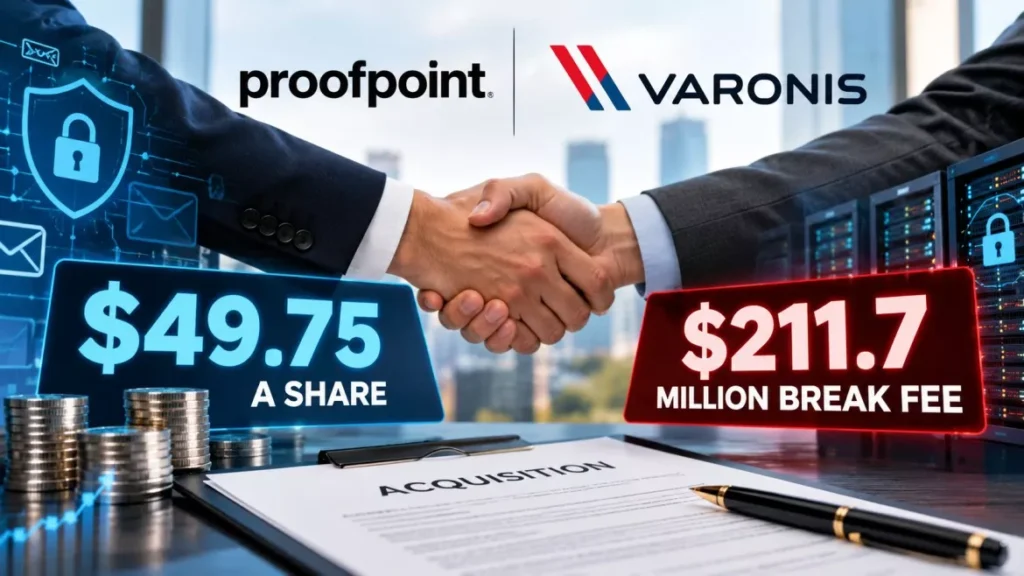

The Proofpoint Varonis acquisition will pay Varonis shareholders $49.75 a share in cash, valuing the deal at about $6.3 billion. The two companies signed the merger agreement on 15 October 2026 and expect to close in the first half of 2027. Until then, Proofpoint says customer contracts, pricing and support do not change.
The Terms, in Numbers
The transaction is a take-private: Varonis, listed on Nasdaq in the United States, will become a wholly owned subsidiary of Proofpoint and its shares will stop trading when the merger completes. Proofpoint is owned by the private equity firm Thoma Bravo, which took it private in 2021. These are the terms as filed on 15 October 2026.
| Term | Figure |
|---|---|
| Price per Varonis share | $49.75 in cash, without interest |
| Transaction value | About $6.3 billion |
| Premium to 22 June 2026 close of $32.71 | 52% |
| Premium to 1 September 2026 close of $42.35 | 17% |
| Valuation multiple, as of 30 June 2026 | About 53x trailing free cash flow, 8.4x trailing revenue |
| Break fee payable by Varonis | $211,700,000 |
| Reverse break fee payable by Proofpoint | $423,300,000 |
| Outside date | 11:59 p.m. New York time, 15 July 2027 |
| Expected completion | First half of 2027 |
The two premium figures are measured against different dates for a reason. Proofpoint’s announcement uses 22 June 2026 as the last full trading day before initial rumours of a sale, and 1 September 2026 as the last trading day before further media speculation. The 52% figure therefore describes the move since before the market knew anything; the 17% figure describes what shareholders gain over a price that already had takeover speculation in it.
A break fee, also called a termination fee, is the sum one side owes if it walks away in defined circumstances. Here Varonis would owe $211.7 million and Proofpoint would owe $423.3 million, the latter payable in cases such as a failure to close once conditions are met and Varonis has confirmed it is ready. Reuters reported the equity value of the deal as $5.71 billion, a lower figure than the $6.3 billion headline because the larger number reflects the whole transaction rather than the value of the shares alone.
What Changes for Customers Before Closing
Nothing, on Proofpoint’s own account. Its customer-facing notice states plainly: “Your products, contracts, pricing, and support remain unchanged,” and says renewal terms stay as agreed. Proofpoint customers are told “Your account team remains unchanged”, while Varonis customers are told “Your Varonis team remains your point of contact.”
Two further points matter for anyone running either product. The companies say they “operate independently and do not share customer data” until the transaction closes. And on the roadmap, the notice is unambiguous: “No product decisions have been made,” with specific plans to be shared after completion.
That is a statement of present intent, not a contractual guarantee to any individual customer, and it covers the period before closing only. What happens to pricing and packaging after completion has not been set out.
What Still Has to Happen Before the Deal Closes
Five conditions are listed in Varonis’s filing with the United States Securities and Exchange Commission, and the deal cannot complete until each is met.
- Shareholder approval: Holders of at least a majority in voting power of the outstanding Varonis shares entitled to vote must adopt the merger agreement. Chief executive and co-founder Yaki Faitelson, who beneficially owned about 0.67% of the shares, signed a support agreement on 15 October 2026 to vote in favour.
- United States antitrust clearance: The waiting period under the Hart-Scott-Rodino Act, which requires large deals to be notified to United States antitrust agencies before completion, must expire or be terminated.
- Foreign regulatory clearance: Approval is needed under certain specified foreign regulatory laws. The filing does not name the jurisdictions.
- No prohibiting order: No governmental body may have an order in force blocking the merger.
- No Material Adverse Effect: Nothing may have happened since signing that amounts to a Material Adverse Effect, a defined contractual standard for a serious deterioration in the business.
If the merger has not completed by 11:59 p.m. New York time on 15 July 2027, either side may terminate, subject to a three-month extension to obtain regulatory approvals. The 8-K filed by Varonis on 15 October 2026 sets out these terms, including both break fees. The acquiring entities are Proofpoint, Inc. and Vail Merger Sub, Inc., affiliates of funds advised by Thoma Bravo, L.P.
Because a shareholder vote is required here, the timetable is longer than in deals structured to avoid one, as happened when Bumble went private without a shareholder vote.
How Proofpoint Is Paying for It
Thoma Bravo is providing committed equity financing and has secured debt financing commitments, according to Proofpoint’s announcement of 15 October 2026, which also confirms the $49.75 price and the $32.71 reference close. The Ontario Teachers’ Pension Plan has agreed to invest in Proofpoint in connection with the transaction.
Bloomberg reported, citing people familiar with the matter, that Proofpoint has locked in $1.25 billion of financing and appointed JPMorgan Chase and UBS to lead a later sale of that debt in the high-yield bond market, where borrowers rated below investment grade raise money at higher interest rates. That figure comes from unnamed sources rather than a filing, and Proofpoint’s own announcement confirms only that debt commitments exist.
The borrowing context is not trivial. Earlier in 2026 Proofpoint pushed out the maturity of roughly $5 billion of existing debt in what lenders call an amend-and-extend, under which most lenders agreed to extend by two years. Reporting on that process said it raised Proofpoint’s annual interest bill by about $60 million and that lenders extracted around 40 changes to the loan documentation, including a provision barring the company from moves that strip collateral from existing creditors. Lenders were described as citing concerns about artificial intelligence and software valuations.
What Varonis Brings for the Price
Varonis sells software that finds sensitive data across an organisation, shows who can reach it and flags unusual access. Its most recent published results, for the second quarter of 2026, give the business behind the valuation.
- SaaS annual recurring revenue: $726.0 million, up 52% year on year, or 25% excluding conversions. Annual recurring revenue, or ARR, is the annualised value of subscription contracts.
- Conversions: Much of the headline growth is existing customers moving from on-premise licences to cloud subscriptions rather than new business, which is why the company reports both figures.
- Revenue: $180.0 million for the quarter, against $152.2 million a year earlier.
- Renewals: A SaaS renewal rate above 90%.
- Full-year guidance: SaaS ARR of $819.0 million to $850.0 million for 2026, growth of 28% to 33%.
These are the figures as reported in late July 2026 and they predate the deal. At 8.4 times trailing revenue, the price is a full one by the standards of recent software take-privates, where premiums have often been far thinner: the Baldwin Group take-private paid 9.6% above the last close.
Where the Products Overlap, and What Analysts Dispute
The two companies meet in data security posture management, or DSPM, the practice of mapping where sensitive data sits and how exposed it is. Varonis built that capability itself; Proofpoint acquired its way in through Normalyze in November 2024. Varonis also brings data access intelligence and user and entity behaviour analytics, which profiles normal behaviour to spot anomalies, and which Proofpoint lacked.
Analysts are not agreed on the value. Fernando Montenegro of Futurum called it a sensible pairing and as much a customer acquisition as a capability purchase, noting that about half of Varonis accounts already use Proofpoint, so cross-selling mainly targets Proofpoint’s larger base. KuppingerCole framed the fit as Proofpoint owning the person and the message and Varonis the data and the permission.
Forrester was more sceptical. In a note by analysts Heidi Shey, Jess Burn and Madelein van der Hout, it wrote that “for email and collaboration security buyers, Proofpoint’s acquisition of Varonis adds little capability”, and that Varonis’s Interceptor technology “now becomes one more detection stack to reconcile” with Proofpoint’s recent consolidation of its email modules. Forrester advised security chiefs to keep flexibility until integration is proven, favouring shorter contract terms or written commitments on migration terms, and to hold Proofpoint to a published integration roadmap through 2027.
Proofpoint’s stated ambition, in chief executive Sumit Dhawan’s words, is that “AI agents are increasingly accessing sensitive information and taking action across systems”, making this “a defining step in Proofpoint’s evolution into a cybersecurity platform built for the future of AI.” Faitelson said the transaction is “an excellent outcome for the company and our shareholders”. The combined business would serve more than 16,000 enterprises.
Frequently Asked Questions
What Is the Proofpoint Varonis Deal Worth?
Proofpoint is paying $49.75 a share in cash, valuing the transaction at about $6.3 billion. Reuters put the equity value at $5.71 billion. The agreement was signed on 15 October 2026 and Proofpoint expects to complete in the first half of 2027.
Will Varonis or Proofpoint Prices Change Before the Deal Closes?
Proofpoint’s customer notice says products, contracts, pricing and support remain unchanged and that renewal terms stay as agreed until completion. It also says no product decisions have been made and that specific plans will be shared after the transaction closes.
What Premium Are Varonis Shareholders Getting?
It depends on the reference date. The price is 52% above the $32.71 close on 22 June 2026, the last full trading day before sale rumours, and 17% above the $42.35 close on 1 September 2026, after further media speculation.
What Happens if the Deal Falls Through?
Varonis would owe a termination fee of $211.7 million in specified circumstances, and Proofpoint a reverse termination fee of $423.3 million, for instance if it failed to close once conditions were satisfied. Either party may terminate if the merger has not completed by 15 July 2027, subject to a three-month extension for regulatory approvals.
Does Varonis Stock Keep Trading?
Yes, until completion. Varonis shares continue to trade on Nasdaq while the deal is pending and will stop trading once the merger closes, at which point Varonis becomes a wholly owned subsidiary of Proofpoint.