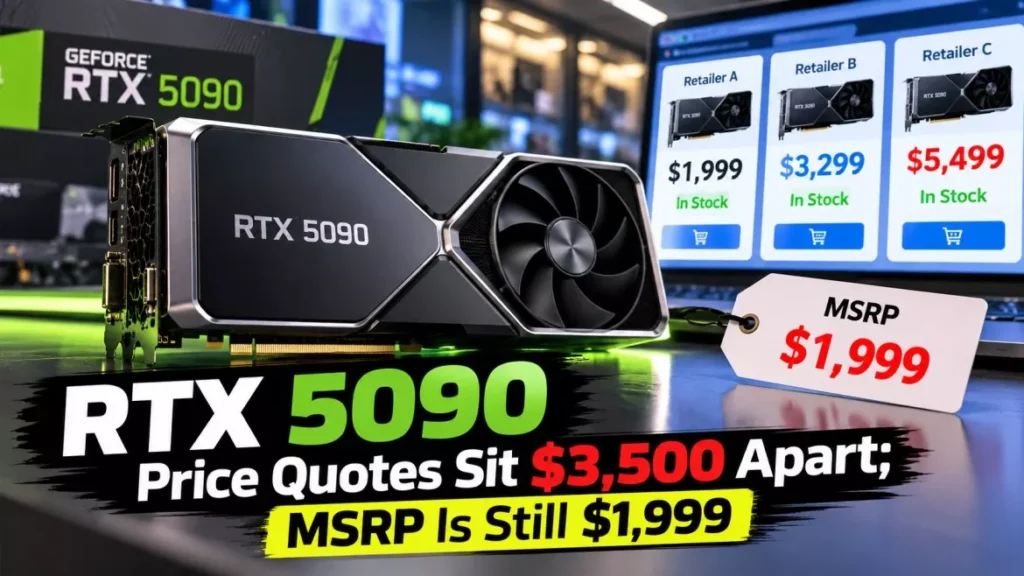

RTX 5090 price quotes now sit about $3,500 apart, from $4,999 to roughly $8,500, against a $1,999 list price. Nvidia’s Jeff Fisher told Taiwanese media in Taipei on 16 October 2026 that the card has not been discontinued. He conceded that supply chain capacity is constrained.
What Nvidia Actually Said
Nvidia’s statement was a denial of discontinuation and nothing more. It contained no production volumes, no restock date and no comment on pricing.
Jeff Fisher, Nvidia’s Senior Vice President of Personal Computing, spoke to Taiwanese reporters after the RTX Spark launch party in Taipei on Friday 16 October 2026. In the translation carried by Hardware Busters, he said that supply chain capacity “is indeed somewhat constrained, but NVIDIA is going all out to get products to market”, and that the card “has definitely not been discontinued”. The Taiwanese outlet 4Gamers reported the remarks, and Taiwan’s Central News Agency corroborated them independently, according to Notebookcheck.
That answers one question and leaves the one buyers care about untouched. A card can be in production and still be unbuyable at list price, which is the position the GeForce RTX 5090 has been in for weeks. Notebookcheck reports that Nvidia removed the card from the model selection on its own marketplace, and that the US retailer Micro Center marked several models “Not Carried”.
What an RTX 5090 Costs Right Now
There is no single current price, and the figures in circulation differ by more than the cost of a whole gaming PC. The table below gives each figure with the source that published it and the date it was observed, because the headline numbers quoted elsewhere are often weeks old.
| Figure | Where | Source and as-of date |
|---|---|---|
| $1,999 | Nvidia list price | Launch MSRP, unchanged |
| About $4,999 | US street price | Capital and Compute tracker, observed 1 September 2026 |
| $4,999 new | B&H, United States | BestValueGPU, checked 13 October 2026 |
| About $7,300 | Newegg listings shipping from overseas | Hardware Busters, 17 October 2026 |
| About $8,500 | Amazon third-party sellers | Tom’s Hardware figure cited by Hardware Busters, 17 October 2026 |
| €6,499.90 (about $7,000) | France | Cowcotland tracker, 16 October 2026, up €500 in a week |
Notebookcheck’s own assessment is that prices are “well north of $5,000 regardless of region”. Best Buy pages have effectively no stock, so they produce no usable price at all.
Why the Figures Disagree
The spread exists because the trackers are not measuring the same thing, not because any of them is wrong. Three differences account for most of the gap.
- New retail versus third-party resale: A $4,999 figure from a retailer such as B&H is a first-party sale. The $8,500 Amazon figure is a third-party seller’s asking price, which is a listing rather than a completed transaction.
- Observation date: The Capital and Compute page carries an “Updated October 16, 2026” line, but its RTX 5090 street price is dated 1 September 2026 and its RTX 5070 figure dates from 10 August 2026. A price tracker’s update stamp is not the same as the date of the price it shows.
- Region: The French figure of €6,499.90 converts to roughly $7,000 before local tax differences, and it rose €500 in the week to 16 October 2026. Regional stock is thinner in some markets than others, so a global average hides a lot.
The practical reading is that a genuinely new RTX 5090 from a mainstream US retailer has been costing around $5,000 — two and a half times list — and that anything above that is a resale asking price rather than a shelf price. Nobody is selling the card at $1,999.
What Is Driving the Price
The verifiable pressure is memory, and it comes from the memory makers themselves rather than from Nvidia. The RTX 5090 carries 32GB of GDDR7 on a 512-bit interface, which makes it the most memory-hungry consumer card Nvidia sells.
Micron Technology, the Boise-based memory manufacturer, used its fiscal fourth-quarter earnings call on 30 September 2026 to describe a shortage with no end date attached. Chief executive Sanjay Mehrotra said the company expects “memory and storage supply demand conditions to be much tighter in fiscal 2027 and 2028 than they were in 2026”, and in the question session added: “As we noted, in calendar 2027 as well as 2028, we see demand exceeding supply.” He also said that “more than 75% of our output is already committed for 2027”, and that Micron does not have line of sight to when supply and demand will return to balance.
Mehrotra was talking about memory in general, not graphics cards specifically; the transcript’s only GPU reference is to high-bandwidth memory for data-centre parts. But the effect reaches consumer hardware through component cost, and it is already visible elsewhere in the PC market, where memory has risen to roughly 40% of a PC’s bill of materials. Nvidia’s own small-form-factor AI machine shows the same pattern, with the 64GB DGX Spark priced at $4,999, above what the 128GB model launched at.
Supply-chain reports add a second pressure, but at a lower confidence level. AMD reportedly told board partners that GDDR6 prices rose with effect from 1 October 2026; as of 10 to 11 October, no equivalent GDDR7 notice from Nvidia had been reported. Neither company has confirmed either move publicly.
What Is Reported but Not Confirmed
The claim that started the discontinuation rumour has not been confirmed by anyone on the record. It is worth separating it from Fisher’s statement, which was on the record.
The reporting holds that Nvidia stopped allocating GB202 dies — the chip inside the RTX 5090 — to board partners, redirecting them to higher-margin RTX Pro workstation cards. PC Games Hardware reported that multiple sources confirmed an end to new GB202 allocations for GeForce cards. Nvidia has not addressed the allocation question, and Fisher did not explain why the marketplace listing disappeared or why it returned.
Also unconfirmed: that the next generation of gaming cards slips to 2028 because of memory supply, and the specific per-card kit price increases attributed to Nvidia in supply-chain reports from July 2026. These come from secondary coverage of Asian supply-chain sources and have not been verified by Nvidia or its partners. The RTX Spark platform Fisher was in Taipei to launch is, by contrast, shipping — the Surface Laptop Ultra built on it starts at $2,599.
Status as of 19 October 2026
As of 19 October 2026, Nvidia says the GeForce RTX 5090 remains in production, the list price is still $1,999, and the card is not purchasable at that price from Nvidia or from mainstream US retailers in any quantity. No restock date has been given, and no price change has been announced.
Micron’s guidance points the other way from any near-term relief: tighter memory supply through calendar 2027 and 2028, with more than three-quarters of next year’s output already sold. On that basis, a return to list pricing is not something Nvidia has promised or that the component market currently supports.
Frequently Asked Questions
Is the RTX 5090 Discontinued?
No. Jeff Fisher, Nvidia’s Senior Vice President of Personal Computing, said on 16 October 2026 that the card has definitely not been discontinued and that it continues to ship. Nvidia has not published production volumes or a restock date.
What Is the RTX 5090 Price Today?
The list price is $1,999 and has not changed. New retail stock has been tracked at around $4,999 in the United States in mid-October 2026, while third-party resale listings have reached about $8,500 on Amazon and roughly $7,300 on Newegg.
Why Is the RTX 5090 So Expensive?
The card uses 32GB of GDDR7, and memory is in short supply. Micron’s chief executive said on 30 September 2026 that demand will exceed supply through 2027 and 2028, with more than 75% of the company’s 2027 output already committed.
Should I Expect the Price to Fall Soon?
Nothing announced points that way. Nvidia has not signalled a price change or a restock date, and Micron says it cannot see when memory supply and demand will return to balance.
Why Do Price Trackers Show Such Different Numbers?
They measure different things on different dates. Some report first-party retail prices, some report third-party asking prices, and a page updated today may be showing a figure observed six weeks ago.