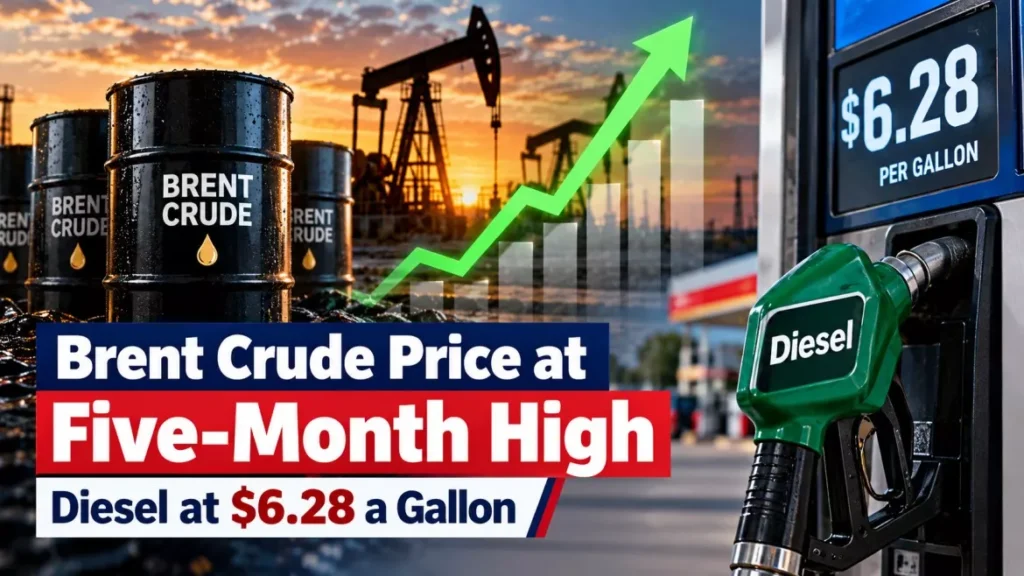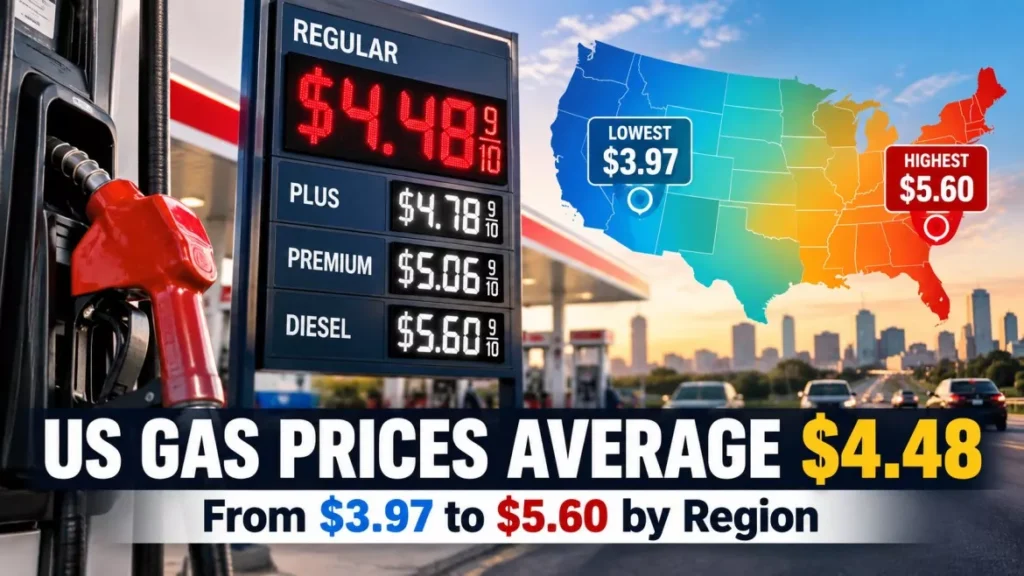

US gas prices averaged $4.48 a gallon for regular gasoline on 24 September 2026, a record for that point in the year. The figure comes from the American Automobile Association, the motoring organisation that publishes a daily national average. Regional averages in the federal weekly survey ran from $3.97 on the Gulf Coast to $5.60 on the West Coast.
What Drivers Are Paying, and When Each Number Was Taken
Four different numbers circulate in coverage of American fuel costs, and they measure different things at different moments. Fuel prices move daily, so a figure without its date and its source cannot be checked.
| Figure | Reading | As of | Published by |
|---|---|---|---|
| National average, regular gasoline | $4.48 a gallon | 24 September 2026 | American Automobile Association |
| National average, regular gasoline | $4.478 a gallon | Week of 21 September 2026 | US Energy Information Administration |
| National average, on-highway diesel | $6.529 a gallon | Week of 21 September 2026 | US Energy Information Administration |
| Brent crude, the global oil benchmark | $104.46 a barrel | 11:00 US Eastern Time, 28 September 2026 | ICE benchmark, as reported by Fortune |
All prices are in United States dollars and apply to the United States market. Brent crude is a global benchmark quoted per barrel, not a retail price; a barrel of crude is not a gallon of finished fuel, and the two move on different timetables because refining, distribution, taxes and local retail margins sit between them.
The Energy Information Administration’s weekly survey put the national regular gasoline average at $4.478 a gallon in the week of 21 September 2026, up 15.9 cents on the previous week, with diesel up 24.4 cents at $6.529. Diesel had already set records earlier in the month.
Why the National Average Is Not What You Pay
A national average is an arithmetic midpoint, not a typical bill. The federal survey’s regional figures for regular gasoline in the week of 21 September 2026 spanned $1.63 a gallon:
- Gulf Coast: $3.972 a gallon.
- East Coast: $4.285 a gallon.
- Midwest: $4.386 a gallon.
- Rocky Mountain: $4.510 a gallon.
- West Coast: $5.600 a gallon.
Within each of those regions, individual states and individual filling stations diverge further, because state fuel taxes, blend requirements and transport distances differ. A driver on the Gulf Coast and a driver in California are not experiencing the same price event, and neither is paying the national average.
AAA also publishes a comparison outside liquid fuel: public electric vehicle charging held steady at 42 cents per kilowatt-hour in its late-September reading, unchanged while petrol rose.
What Is Pushing Prices Up
AAA attributed the increase to “lingering volatility in the Strait of Hormuz and the high cost of crude oil”. Autumn normally brings American pump prices down as summer driving demand fades and cheaper winter blends arrive; this year the direction has reversed.
Brent crude stood at $104.46 a barrel at 11:00 US Eastern Time on 28 September 2026, up 1.66% on the previous business day, 15.25% over one month and 55.15% over one year, according to Fortune’s daily reading. The immediate trigger cited in market coverage was the rejection of Iran’s latest proposal on reopening the Strait of Hormuz, the channel through which a large share of seaborne crude moves. The terms of that proposal, and the conditions attached to it, were set out earlier in the week.
Whether crude stays at this level is not known, and no forecast here is offered. What is on the record is that the increase in pump prices has so far lagged the increase in crude, as it usually does.
What the Official Inflation Data Already Shows
Fuel was the largest single contributor to the most recent American inflation reading. In the Consumer Price Index for August 2026, released by the Bureau of Labor Statistics on 11 September 2026, the gasoline index accounted for over one third of the monthly all-items increase.
- All items: up 3.4% over the 12 months to August 2026.
- Energy index: up 16.3% over the same 12 months.
- Gasoline: up 27.4% over 12 months and 3.9% over the month, seasonally adjusted.
- Fuel oil: up 10.1% over the month.
That reading predates the late-September increase. The August survey was taken before pump prices reached $4.48, so the effect of the past three weeks has not yet appeared in any published inflation figure.
When the Next Official Readings Land
Two scheduled releases will update the picture, and both are published by United States federal agencies on fixed timetables.
- Weekly fuel survey: the Energy Information Administration publishes its national and regional retail gasoline and diesel averages each week, giving the next reading after the week of 21 September.
- September Consumer Price Index: scheduled for Wednesday 14 October 2026 at 08:30 US Eastern Time. This is the first official inflation reading that will capture the late-September increase.
The September index carries a second consequence. September is the final month of the quarter used to calculate the annual Social Security cost-of-living adjustment, so the 14 October release completes that calculation as well as the inflation reading. The arithmetic and the assumptions involved were examined here earlier in September.
Drivers and households looking for the authoritative current figure should use the Energy Information Administration’s own weekly page or AAA’s own daily average rather than a price cited in an undated article.
Frequently Asked Questions
What Are US Gas Prices Right Now?
The American Automobile Association put the national average for regular gasoline at $4.48 a gallon on 24 September 2026. The Energy Information Administration’s weekly survey for the week of 21 September 2026 put it at $4.478 a gallon. Both figures are United States national averages and both move.
Is $4.48 a Gallon a Record?
AAA said it is the highest the national average has ever been for that point in the year. AAA also said September 2026 was tracking towards a monthly record average of $4.30 a gallon, above the previous September high of $3.83 in 2023.
Why Are US Gas Prices Rising in Autumn?
AAA attributed the rise to volatility in the Strait of Hormuz and the high cost of crude oil. Pump prices usually fall in autumn as summer driving demand ends, so the direction this year runs against the seasonal pattern.
Which US Region Has the Cheapest Gasoline?
In the federal weekly survey for the week of 21 September 2026, the Gulf Coast had the lowest regional average at $3.972 a gallon and the West Coast the highest at $5.600 a gallon.
When Will the Next US Inflation Figure Be Published?
The Consumer Price Index for September 2026 is scheduled for Wednesday 14 October 2026 at 08:30 US Eastern Time. It is the first official inflation reading covering the late-September rise in fuel prices.