
Iran has put a Strait of Hormuz reopening on the table for the seventh day after the United States accepts a set of conditions. Foreign Minister Abbas Araghchi set out the plan to reporters in New York on 25 September 2026, after mediators passed it to Washington. The United States has not accepted it.
What Iran Has Proposed
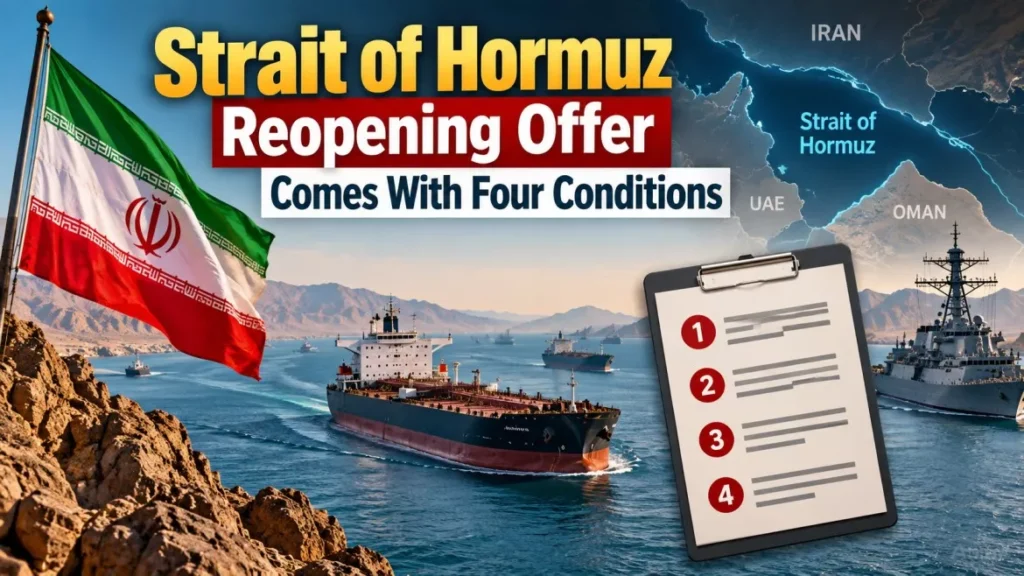
The plan is a sequence, not a simultaneous exchange, and Iran wants the United States to move first. As reported by Al Jazeera, the steps Iran has asked for are:
- Fighting stops on all fronts, including Lebanon.
- The United States lifts its naval blockade of Iranian ports.
- The United States waives sanctions on Iranian oil exports.
- The United States releases frozen Iranian assets. The New York Times, cited by Al Jazeera, put the figure at a minimum of about $12 billion; Iran has not published a figure of its own.
On the seventh day after those steps, Iran says the strait reopens. Talks on its nuclear programme would follow.
“The moment they accept this plan, from the next day, this timetable can start, and after seven days, the strait will be open,” Araghchi said. He also described the terms as unchanged from an earlier agreement: “The conditions we have asked the U.S. to meet are nothing new, nothing more than what was already in the Islamabad MOU, which was signed by the U.S. president.”
Published accounts of the document differ. The National reported that the roadmap runs to a region-wide ceasefire of up to 60 days, a phased rather than immediate reopening, and a timetable for wider negotiations. The text of the proposal has not been made public, and neither government has released it.
What Washington Has Said
The United States has not agreed to the sequence, and has not said it will move first.
Secretary of State Marco Rubio said the meeting earlier in the week should not be described as a “major breakthrough”, while indicating Washington remains open to diplomacy and that military options stay available. State Department spokesman Tommy Pigott said President Donald Trump holds the stronger negotiating position. An unnamed White House official told CNN the discussions were “positive and constructive” but that the administration would not rush into a deal.
Trump has ruled out lifting the blockade before Iran demonstrates what he called sufficient goodwill. In his own address to the General Assembly he accused Iran of waiting for United States election results and said the Islamic Republic would be annihilated without an agreement.
Who Has to Move First
The deadlock is a sequencing dispute, and both sides have stated it plainly.
| Question | Iran’s stated position | United States’ stated position |
|---|---|---|
| Who acts first | Washington lifts the blockade and sanctions, then the strait reopens on day seven | Iran shows goodwill first; no concessions before that |
| Nuclear talks | Only after the strait reopens | Open to diplomacy, no sequence conceded |
| Status of the June agreement | Still the reference point for the conditions | Declared over on 7 July 2026 |
Mohsen Rezaei, secretary of Iran’s Supreme National Security Council, put the Iranian line as: “Until our conditions are met, the Strait of Hormuz will not be opened and we will not negotiate.” President Masoud Pezeshkian said: “We do not wish to continue. It’s America that must choose whether it wants to end this or not.” Parliament speaker Mohammad Bagher Ghalibaf has said there will be no reopening until every condition is met. These are official Iranian statements, not agreed terms.
What 80 Countries Asked For at the UN
A separate demand came from the floor of the General Assembly on 24 September 2026. Bahrain’s Foreign Minister Abdullatif bin Rashid Al Zayani read a joint statement backed by about 80 countries, including Gulf Arab states and major Western powers, calling for the strait to reopen urgently and for vessels to pass safely without tolls, conditions or what the signatories called illegal charges.
The statement condemned what its backers described as Iran’s continuing attacks on neighbouring countries and disruption of international trade, and criticised Houthi strikes on Saudi Arabia and in the Red Sea. It reaffirmed support for Security Council Resolution 2817, adopted in March 2026, which condemned attacks the Council attributed to Iran against seven neighbouring states. Iran rejects that characterisation of its actions. The earlier Security Council referral passed against Tehran’s objection.
A note on names: the waterway is internationally known as the Strait of Hormuz, and the sea it connects to is called the Persian Gulf at the United Nations and the Arabian Gulf by Gulf Arab states. The joint statement used the latter.
What Is Actually Moving Through the Strait
Diplomacy aside, the measurable position as of 24 September 2026 is that traffic remains a fraction of normal.
- Recent daily transits: 10 commodity vessels passed through on the most recent day counted, according to Maritime Activity Reports on 24 September 2026.
- Ten-day average: about 17 vessels a day on the same count.
- Pre-war baseline: about 125 large commercial vessels a day before the war began on 28 February 2026, carrying roughly 20% of the world’s daily crude oil and liquefied natural gas supply.
- Earlier reading: about 10 ships a day in early September 2026.
Those counts come with a caveat that matters. The World Trade Organization’s Strait of Hormuz trade tracker, built on vessel-tracking data with AXSMarine and last updated on 21 September 2026, recorded crude oil, liquefied natural gas and fertiliser shipments near zero through most of July and August 2026 — but also noted that transits by tankers with their transponders switched off increased over the same period. Visible traffic counts may therefore understate what is actually moving.
Oil has stayed expensive through the dispute, with Brent crude trading around $105 a barrel on 25 September 2026. Crude prices move continuously and that is a single reading, not a level.
How the Talks Got Here
- 28 February 2026: the war involving the United States, Israel and Iran begins; transits through the strait collapse.
- March 2026: the Security Council adopts Resolution 2817.
- 17 June 2026: the Islamabad memorandum of understanding sets a 60-day negotiating window, a halt to military operations, United States waivers for Iranian oil exports and the restoration of maritime traffic, with nuclear stockpile questions deferred.
- 7 July 2026: Trump declares that agreement over.
- Week of 21 September 2026: Araghchi and United States envoy Steve Witkoff meet in New York; the two sides give differing accounts of the meeting.
- 24 September 2026: about 80 countries demand the strait reopen; Israeli Prime Minister Benjamin Netanyahu tells the Assembly the Iranian government will fall.
- 25 September 2026: Araghchi sets out the seven-day plan publicly.
What Is Agreed, What Is Claimed and What Is Unverified
Agreed by both sides: that Araghchi and Witkoff met in New York in the week to 25 September 2026, that a proposal has been passed to Washington, and that no agreement has been concluded.
Claimed by Iran: that the strait will reopen on the seventh day if the four conditions are met, and that the conditions are identical to the June memorandum. Washington has neither confirmed the terms nor accepted them.
Claimed by the signatories of the joint statement: that Iran is attacking neighbouring states and levying illegal charges on shipping. Iran disputes this account of its conduct.
Unverified: the text of the proposal, which has not been published; the exact value of the frozen assets at issue, reported by a single newspaper; whether any ceasefire element runs to 60 days, which appears in some accounts and not others; and the true volume of cargo crossing the strait, given the increase in transits by vessels not broadcasting their position.
Strait of Hormuz Reopening: Frequently Asked Questions
Has the Strait of Hormuz Reopened?
No. As of 25 September 2026 the strait remains closed to normal commercial traffic, with about 17 vessels a day passing on a ten-day average against a pre-war figure of roughly 125.
What Are Iran’s Conditions for Reopening the Strait?
As set out by Foreign Minister Abbas Araghchi on 25 September 2026: fighting stops on all fronts, the United States lifts its naval blockade, waives sanctions on Iranian oil and releases frozen Iranian assets. Iran says the strait then reopens on the seventh day.
Has the United States Agreed to the Plan?
No. Washington has said it is open to diplomacy but will not make concessions before Iran acts, and President Donald Trump has ruled out lifting the blockade first.
Why Does the Strait of Hormuz Matter to the World Economy?
Before the war began on 28 February 2026 the strait carried about 125 large commercial vessels a day and roughly 20% of the world’s daily crude oil and liquefied natural gas supply, which is why disruption there moves energy prices globally.
What Was the Islamabad Memorandum of Understanding?
An agreement dated 17 June 2026 between the United States and Iran that set a 60-day negotiating window, a halt to military operations, United States waivers for Iranian oil exports and the restoration of shipping through the strait. Trump declared it over on 7 July 2026; Iran still treats its terms as the reference point.