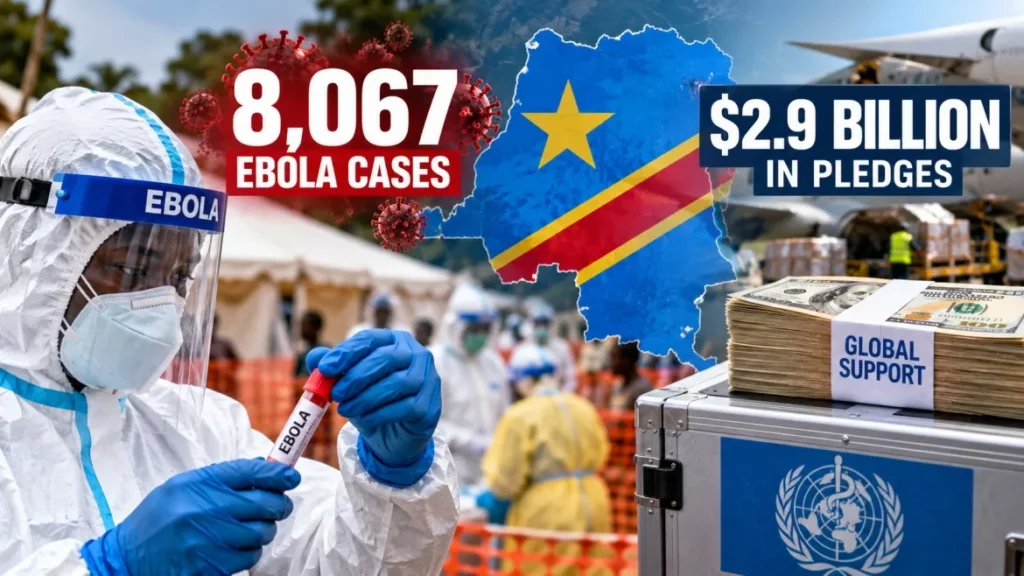

DRC Ebola cases have passed 8,000. The Democratic Republic of the Congo’s national public health institute reported 8,067 confirmed cases and 3,901 deaths on 28 September 2026, a case fatality ratio of 48.4%. Donors have pledged US$2.9 billion to the response, and one affected province reports no remaining stock of the experimental vaccine.
Where the Outbreak Stands
Two official counts are current, and they differ because they were taken five days apart. Both come from bodies that publish their own figures, and neither supersedes the other.
| Source | Confirmed cases | Deaths | Case fatality ratio | As of |
|---|---|---|---|---|
| DRC national public health institute | 8,067 | 3,901 | 48.4% | 28 September 2026 |
| World Health Organization | 7,890 | 3,799 | 48.1% | 23 September 2026 |
The WHO’s Disease Outbreak News published on 25 September 2026 also recorded 1,966 recoveries. A case fatality ratio is the share of confirmed cases that ended in death; at roughly 48% it means that slightly fewer than half of the people confirmed to have the disease have died of it.
This is the largest and deadliest Ebola epidemic recorded in the DRC. The WHO has said the outbreak is far from over and that it could exceed the 2014 to 2016 West Africa epidemic, which killed more than 11,000 people across Guinea, Liberia and Sierra Leone. The site’s earlier status report, when the confirmed death toll stood at 3,510, was published on 16 September 2026.
Which Provinces Are Affected
The outbreak covers seven of the DRC’s 26 provinces. As of 23 September 2026 the WHO recorded 63 affected health zones, of which 48 across six provinces had reported cases in the previous 21 days — the measure used to judge where transmission is still active.
- North Kivu: includes the urban centres of Beni, Butembo and Katwa.
- Ituri: where the outbreak was first identified.
- South Kivu, Haut-Uélé, Bas-Uélé and Sud-Ubangi: subsequently affected.
- Tshopo: 43 cases including 15 deaths, across seven of its 23 health zones.
WHO’s regional emergency director for Africa has said the response needs to move from the large urban centres of Beni, Butembo and Katwa in North Kivu towards the province’s remote villages, because distances are long and referral into the urban treatment centres takes time.
The WHO’s published risk assessment rates the risk as very high within the DRC, high for bordering countries, and low for the rest of the African region and at global level.
What Has Been Pledged, and by Whom
US$2.9 billion had been mobilised as of 23 September 2026, according to Africa CDC, the African Union’s public health agency. The figure was totalled after a G20+ foreign ministers’ meeting hosted by the United States in New York during the UN General Assembly.
| Donor | Pledged |
|---|---|
| United States | $887 million |
| European Union / European Commission | $568 million |
| World Bank | $433 million |
| Pandemic Fund | $221 million |
| CEPI | $196 million |
| Germany | $127 million |
| African countries | $110 million |
| United Kingdom | $105 million |
All figures are in United States dollars and are cumulative pledges rather than money disbursed. Africa CDC drew that distinction itself: its director general, Dr Jean Kaseya, said the agency must be able to trace every dollar from commitment through to disbursement and implementation.
The most recent increments sit inside those totals rather than on top of them. The United States announced an additional $267 million on 23 September 2026 at the UN General Assembly, which took its cumulative figure to $887 million. The European Union announced a further €7.5 million on Saturday 26 September 2026, which Africanews reported was intended both to support the immediate response and to build longer-term surveillance capacity.
A pledged total is not the same as a funded plan. A comparable gap has been visible in the Yemen response, which was running at 18% funded earlier this month.
Where the Response Is Falling Short
Supply and capacity failures were reported in two provinces on the same day the case total passed 8,000. DRC authorities described a complete shortage of stocks of the experimental Bundibugyo vaccine in Tshopo, and low capacity to treat cases at health centres in Ituri.
Contact tracing is holding up better. The WHO recorded 26,980 of 32,342 identified contacts under follow-up in the 24 hours to 23 September 2026, a monitoring rate of 83.4%.
Al Jazeera reported that a ruling party official was killed after speaking about prevention measures on local radio in Butembo, which it presented as an indication of community distrust of the official response. That account is from a single outlet and has not been independently confirmed here.
Why There Is No Approved Vaccine for This Strain
The outbreak is caused by Bundibugyo virus, one of the Orthoebolavirus species, and the WHO states that no approved vaccines or specific treatments currently exist for Bundibugyo virus disease. The licensed Ebola vaccines were developed against the Zaire species, which is a different virus.
Two things are under way. The DRC launched a test vaccination programme during September 2026 to assess whether vaccines designed for other Ebola species offer any protection against Bundibugyo, and the WHO has indicated that trials of three candidate vaccines should begin by October or November 2026, according to Africanews. Neither has produced a licensed product, and no approval date has been announced.
What Is Agreed, What Is Claimed and What Is Unknown
The figures in this story come from different bodies with different reporting dates, and the distinctions matter.
- Agreed: the virus species, the seven affected provinces, the absence of an approved vaccine, and the case and death counts as each body published them.
- Published by one body only: the 8,067 and 3,901 figures are the DRC institute’s, reported on 28 September 2026; the WHO’s own most recent published figures are the 23 September set.
- Pledged, not disbursed: the US$2.9 billion is Africa CDC’s tally of commitments as of 23 September 2026, and Africa CDC has itself called for traceability of disbursement.
- Unknown: when the outbreak will peak, whether a Bundibugyo vaccine will be licensed, and how much of the pledged money has reached the response.
Readers following the outbreak will find the authoritative current counts in the WHO’s Disease Outbreak News items and in the DRC public health institute’s own situation reports.
Frequently Asked Questions
How Many DRC Ebola Cases Are There?
The DRC’s national public health institute reported 8,067 confirmed cases and 3,901 deaths on 28 September 2026. The World Health Organization’s most recent published figures, as of 23 September 2026, were 7,890 confirmed cases and 3,799 deaths.
Which Ebola Strain Is Causing the DRC Outbreak?
Bundibugyo virus, one of the Orthoebolavirus species. The WHO states that no approved vaccines or specific treatments exist for Bundibugyo virus disease.
How Many Provinces Are Affected?
Seven of the DRC’s 26 provinces: North Kivu, Ituri, South Kivu, Haut-Uélé, Bas-Uélé, Sud-Ubangi and Tshopo. As of 23 September 2026 the WHO recorded 63 affected health zones, 48 of them with cases in the previous 21 days.
How Much Money Has Been Pledged?
Africa CDC put total pledges at US$2.9 billion as of 23 September 2026, led by the United States at $887 million and the European Union at $568 million. Those are commitments rather than confirmed disbursements.
Is There a Risk to Other Countries?
The WHO’s published assessment rates the risk as very high within the DRC, high for bordering countries, and low for the rest of the African region and at global level.