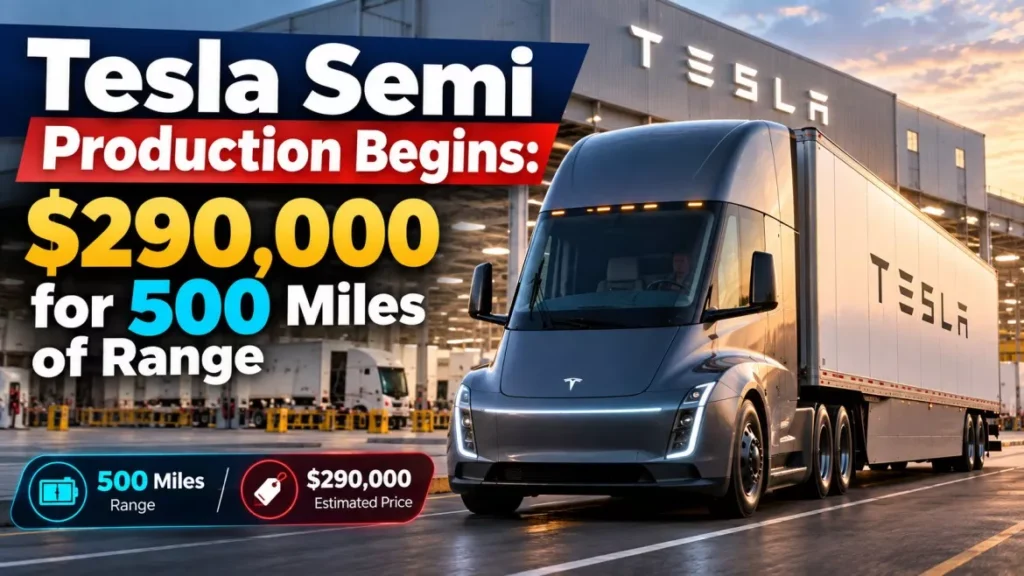

Tesla has started volume production of the Semi electric truck. The company launched the line on the evening of Thursday 24 September 2026 at a 1.8-million-square-foot plant in Sparks, Nevada, sized for 50,000 trucks a year. Tesla Semi production begins nine years after the truck was unveiled.
What the Two Versions Cost and How Far They Go
There are two US variants, and the difference between them is one battery sub-pack, 175 miles and about $30,000.
| Standard Range | Long Range | |
|---|---|---|
| Range at 82,000 lb gross | About 325 miles | About 500 miles |
| Price before incentives | About $260,000 | About $290,000 |
| Battery sub-packs | Two | Three |
| Peak charging | 800 kW | 1.2 MW |
| Charge time | Not separately stated | 60% of the pack in 30 minutes |
Tesla quotes energy consumption of about 1.7 kWh per mile. A third variant built to European specification runs down the same line, and Tesla has not announced a European on-sale date or price.
The prices are roughly 60 per cent above the $180,000 figure Tesla floated in 2017. They are still below the average price of an electric Class 8 truck in the United States, by about $145,000 on the comparison Tesla showed at the event.
What Changed From the 2017 Prototype
Almost every major system was rebuilt, and the truck came out around 1,000 pounds lighter.
- Battery cells: the production truck uses Tesla’s own 4680 cells instead of the partner-supplied 2170 cells in the prototypes, in packs of 14 modules per sub-pack.
- Drive axle: steel-caged rotors replace carbon-sleeved ones, with bar-wound stators shared with the Cybertruck, cutting about 175 pounds from the axle.
- Steering: hydraulic power steering is gone, replaced by electric power steering, which Tesla says is a first for a heavy-duty truck.
- Lubrication: the drive unit now uses a single oil, rated for more than 250,000 miles, where the original design used three.
- Thermal system: a heat-pump arrangement Tesla calls the Megamanifold handles cabin climate and battery cooling together.
- Windows: the non-opening pop-out panes of the concept are gone in favour of roll-down glass.
The last one drew the frankest line of the night. Dan Priestley, who runs the Semi programme, told the audience: “We fully admit we were wrong about the windows…we needed a roll-down window.”
Where You Can Actually Charge It
This is the constraint that decides whether a 500-mile truck is useful, and the network is barely built.
Tesla’s public Megacharger network stood at three open sites as of August 2026, all of them in California: Ontario, which opened in March 2026 at 750 kW, and Bloomington and Vernon, each with six stalls at 1.2 MW, which opened in July and August. Tesla also runs charging at its own Nevada plant and at a site in Carson, California.
The plan is much larger. Tesla has identified 66 Megacharger locations across 15 states, led by Texas with 19 and California with 16, and has said it aims to have 46 stations running by early 2027. The map shown at the event concentrated sites in California, Texas and the East Coast, with gaps across the Mountain West and the Plains.
For a fleet, that arithmetic matters more than the range figure. A 500-mile truck with three public charging sites in one state is a regional vehicle, not a long-haul one, until the corridor sites open.
Who Has Already Ordered
Trucks at the event carried the logos of PepsiCo, DHL, US Foods, ABF, Einride, IMC Logistics and WattEV, and the largest order landed two days before the launch.
On 22 September 2026, the ZET SCALE alliance named Tesla as primary supplier for 2,500 battery-electric Class 8 trucks, with Kenworth, Volvo and RIDE as secondary suppliers. ZET SCALE — Zero-Emission Truck Shipper-Carrier Alliance Leading Electrification — was set up by Catalyst Mobility, the freight non-profit formerly called CALSTART, with the Smart Freight Centre, and is backed by shippers including Microsoft and PepsiCo. The alliance says it is aiming at more than 10,000 trucks over time.
That single order would roughly double the number of electric Class 8 trucks on US roads, which stood at about 2,500 before it. Michael Berube, chief executive of Catalyst Mobility, framed the point of the alliance bluntly: “You can have good technology and still not have a market.”
Einride placed a separate 500-truck order in August 2026. Tesla has not published a delivered-unit total; reporting from the event put roughly 880 first-generation Semis already with customers.
The Running-Cost Case Tesla Is Making
Tesla’s argument is that the fuel gap pays back the purchase price, and the numbers it showed are its own.
At the event Tesla put diesel at roughly $0.80 per mile at 7 miles per gallon against electricity at $0.20 to $0.30 per mile on transportation rates. It also claimed the existing Semi fleet has run at over 98 per cent uptime during 2026 and that the truck “requires almost no maintenance”, citing the removal of hydraulic fluid and the extended drive-unit oil interval.
None of those figures has been independently audited, and the electricity rate a given fleet pays depends entirely on its utility contract and how much it charges at peak. Treat them as vendor claims, not as verified operating costs.
What Tesla Has Not Said
As of 26 September 2026, Tesla has confirmed the factory, the capacity, the variants and the start of deliveries, and has left several things open.
- Actual output: 50,000 a year is the plant’s design capacity, not a production forecast. Tesla has not said how many trucks it expects to build in 2027.
- Europe: a European-specification truck is being built, but no on-sale date, price or market list has been given.
- Delivered volumes: Tesla has not published a running delivery figure for the production truck.
- Elon Musk: Tesla’s chief executive did not attend the launch in person and appeared in a pre-recorded video segment instead. Tesla gave no reason.
The first high-volume truck came off the line in April 2026, five months before the launch event, so the ramp has had a head start. Whether it reaches anything like 1,000 trucks a week will be visible in Tesla’s quarterly production reports, not in event slides. The company’s recent record on shipping vehicles it has demonstrated is mixed: the Cybercab is under investigation with only 45 cars running in Austin, and the Model S was discontinued earlier this month.
Frequently Asked Questions
How Much Does the Tesla Semi Cost?
About $260,000 for the Standard Range version and about $290,000 for the Long Range version, before incentives, according to figures given at the launch event on 24 September 2026.
What Is the Tesla Semi’s Real Range?
Tesla quotes about 325 miles for the Standard Range truck and about 500 miles for the Long Range truck, both at a gross combined weight of 82,000 pounds. Actual range varies with load.
How Long Does a Tesla Semi Take to Charge?
The Long Range version charges at up to 1.2 megawatts and recovers 60 per cent of its battery in about 30 minutes. The Standard Range version peaks at 800 kilowatts.
Where Are the Tesla Megachargers?
Three public sites were open as of August 2026, all in California: Ontario, Bloomington and Vernon. Tesla has identified 66 locations across 15 states and aims for 46 stations by early 2027.
Can You Buy a Tesla Semi in Europe?
Not yet. A European-specification version is built on the same line in Nevada, but Tesla has not announced a European price, on-sale date or market list.
How Many Tesla Semis Are on the Road?
Tesla has not published an official figure. Reporting from the launch event put roughly 880 first-generation trucks with customers before volume production began.