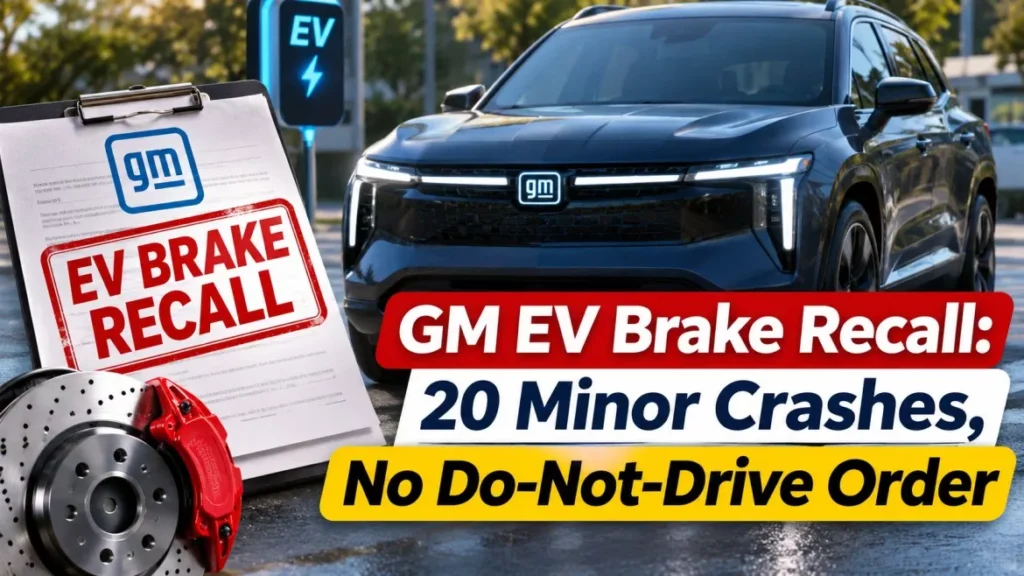

General Motors is recalling 67,380 electric vehicles because brake software can briefly cut braking at low speed. The recall covers 2023–2027 Cadillac Lyriq, 2024–2027 Chevrolet Blazer EV, 2025–2026 Cadillac Celestiq and 2026–2027 Cadillac Vistiq models. The GM EV brake recall was filed with US regulators on 29 October 2026; owner letters follow on 14 December.
Which GM EVs Are Affected
Four model lines are covered, and the Cadillac Lyriq accounts for about two-thirds of the total. GM, the Detroit carmaker that owns Cadillac and Chevrolet, listed thirteen separate model-year groups in its filing with the National Highway Traffic Safety Administration (NHTSA), the US vehicle safety regulator.
| Model | Model years | Vehicles |
|---|---|---|
| Cadillac Lyriq | 2023–2027 | 44,585 |
| Cadillac Vistiq | 2026–2027 | 18,802 |
| Chevrolet Blazer EV | 2024–2027 | 3,911 |
| Cadillac Celestiq | 2025–2026 | 82 |
| Total | — | 67,380 |
Not every car in those model years is included. For the Lyriq and the Blazer EV, GM restricted the recall to vehicles built with performance all-wheel drive, which the company identifies by the option code X0E. On the Blazer EV that drivetrain is sold only on the SS and PPV trims, so other Blazer EV versions are not part of the campaign. GM says the fault is unique to performance all-wheel-drive cars.
The Lyriq figures are heavily weighted towards the two oldest model years:
- 2023: 474 vehicles, built between 14 December 2022 and 28 April 2023.
- 2024: 22,819 vehicles, the single largest group in the recall.
- 2025: 11,926 vehicles.
- 2026: 9,322 vehicles.
- 2027: 44 vehicles.
What Goes Wrong With the Brakes
The brake system control module, the computer that manages braking, can misread how fast the wheels are turning and release brake pressure for a moment. GM describes the result in its filing as a “temporary loss of braking at low speeds following a specific sequence of events”, and adds that “normal brake function returns on the next brake press”.
That sequence is narrow and oddly ordinary. The brakes have to be pressed lightly, at low speed, during a sharp turn, while the car crosses a bump or dip — GM gives the end of a driveway as its example. The momentary release and reapplication of the pedal is what confuses the software’s slip calculation.
Two details in GM’s Part 573 report to NHTSA did not reach most coverage of the recall. The company puts the “estimated percentage with defect” at 100 per cent, meaning it expects every one of the 67,380 cars to carry the faulty software rather than a small share of them. And in the section where manufacturers must identify any warning a driver would get, GM entered nothing: there is no dashboard light or chime that precedes the fault.
What Drivers Should Do Now
GM has not told owners to stop driving. On the filing’s consumer advisory line, neither the “Do Not Drive” nor the “Park Outside” box is marked, which are the two warnings regulators use when a defect makes a car unsafe to use or to keep in a garage.
As of 8 November 2026, the recall is open, dealers have the software, and owner letters are not due to be posted until 14 December 2026. Owners who do not want to wait five weeks can act now:
- Check the VIN: the 17-character vehicle identification number has been searchable against this campaign on NHTSA’s recall site since 29 October 2026.
- Quote the campaign number: NHTSA lists it as 26V717 and GM as N262570900; a dealer can match either.
- Call the brand directly: Cadillac owners can reach customer service on 1-800-333-4223 and Chevrolet owners on 1-800-222-1020.
- Book the update or accept it remotely: the work is free either way, and GM has a general reimbursement plan on file for anyone who has already paid for a related repair.
How the Software Fix Reaches Your Car
GM has classified the remedy as both an over-the-air and a workshop update, and which one an owner gets depends on a condition the company states plainly but most reports left out. The wireless update is offered only to cars capable of receiving software remotely whose owners have already accepted GM’s over-the-air terms and conditions. Everyone else takes the car to a dealer, at no charge. The trade publication Autoevolution reports the update takes no more than 20 minutes; GM’s filing does not give a duration.
NHTSA has flagged the campaign as a phased recall, meaning the fix does not become available to every model year at once. Kelley Blue Book and Fox television stations have both reported that the software is not yet ready for 2023 and 2024 Lyriqs — between them 23,293 cars, or roughly a third of the recall. GM’s filing does not confirm or deny that, and the company has not published a separate schedule for those two model years. Owners of repeat-recalled electric cars have faced longer waits before: a third VW ID.4 battery recall in 11 months was announced in October with no remedy available at all.
GM has already closed the hole on the production line. Corrected software went into 2027 Chevrolet Blazer EV production on 8 August 2026, 2026 Cadillac Lyriq production on 7 September 2026 and 2027 Cadillac Vistiq production on 21 October 2026. The Celestiq was corrected for the 2027 model year, with no date given.
Why Some Lyriqs Are Being Recalled a Second Time
Thousands of these cars were recalled for a brake software fault once already, in August 2024. That campaign, numbered 24V589, covered 21,469 all-wheel-drive 2023 and 2024 Lyriqs whose anti-lock braking system could release brake pressure on its own, and it was also fixed with a software update.
The new recall exists because that fix did not cover every case. On 10 April 2026 a GM technical expert filed an internal report through the company’s Speak Up for Safety programme about a 2024 Lyriq that had struck a garage at low speed. The car had already received the 24V589 software. GM’s own testing reproduced the fault, traced it to performance all-wheel-drive cars the earlier remedy had not addressed, and opened a new product investigation on 18 August 2026. Its Safety Field Action Decision Authority voted to run a recall on 22 October 2026.
Cars already covered by 24V589 that have performance all-wheel drive are folded into the new campaign, and GM says the single new software update fixes both conditions. Anyone who had the 2024 repair done still needs this one.
What the Complaint Record Shows
GM found 24 field complaints it considers potentially related to the fault, drawn from legal claims, its regulatory reporting data and owner questionnaires filed with NHTSA. Twenty of those involved minor accidents, and two of the twenty carried allegations of minor injuries. The complaints reached GM between 28 February 2024 and 11 June 2026, which means reports were arriving for more than two years before the recall was filed.
Software faults that affect how a car drives have produced several recalls of this size in 2026. A Toyota C-HR EV recall in September covered 8,521 cars that could lose drive power, and a Jeep recall of 201,976 SUVs came down to a tyre-pressure monitoring error.
A Separate Federal Brake Investigation Is Still Open
This recall is not the larger GM brake matter that regulators have been examining since the summer, and the two are easy to confuse. In August 2026, NHTSA’s Office of Defects Investigation upgraded its inquiry into GM’s eBoost electronic brake booster to an engineering analysis, numbered EA26006, covering an estimated 1,164,820 vehicles. Investigators cited 745 incident reports after removing duplicates, and 22 crashes or fires.
That inquiry concerns loss of brake assist, which GM has linked to fractures in a part called the eBoost spindle, and it includes Honda and Acura models built by GM in a joint venture. An engineering analysis is a stage of investigation, not a recall, and no campaign covering those 1.16 million vehicles has been announced.
Frequently Asked Questions
Does the GM EV Brake Recall Cost Anything?
No. Federal law requires the manufacturer to correct a safety recall free of charge, and GM is supplying the brake software update at no cost whether it is delivered wirelessly or by a dealer.
Which Cadillac Lyriq Model Years Are Included?
Model years 2023 through 2027, but only cars built with performance all-wheel drive. That is 44,585 Lyriqs out of the 67,380 vehicles in the campaign.
Can I Keep Driving the Car Before the Update?
GM has issued no do-not-drive or park-outside advisory for these vehicles. The company describes the fault as a brief loss of braking at low speed that clears when the driver presses the pedal again, and it reported 20 minor accidents out of 67,380 cars.
How Do I Find Out Whether My Car Is on the List?
Enter the vehicle identification number on NHTSA’s recall lookup, which has carried this campaign since 29 October 2026, or call Cadillac or Chevrolet customer service and quote recall 26V717.
Will the Fix Arrive Over the Air Automatically?
Only for cars that can take wireless updates and whose owners have accepted GM’s over-the-air terms and conditions. Everyone else needs a dealer visit, and reports suggest 2023 and 2024 Lyriq owners may wait longer for the software to be released.