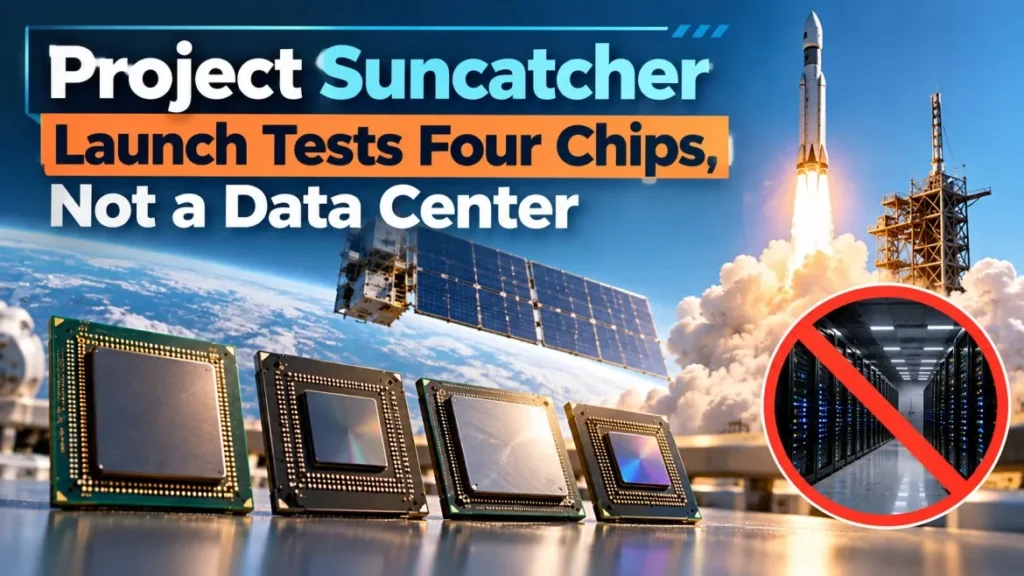

Google will launch its first Project Suncatcher satellite on 1 October 2026. The spacecraft, named MVP, carries four Trillium-generation TPUs, roughly the computing power of one data-center server, and flies on SpaceX’s Transporter-18 rideshare from Vandenberg Space Force Base. The Project Suncatcher launch is a hardware survival test, not an orbital data center.
What Is Actually on Board
One satellite, four chips, and about as much compute as a single rack-mounted server.
| Item | Detail |
|---|---|
| Satellite | MVP, built on a platform supplied by Planet |
| Payload | Four Google Tensor Processing Units, Trillium generation |
| Compute | Roughly equivalent to one data-center server |
| Rocket | SpaceX Falcon 9, Transporter-18 rideshare |
| Site | Space Launch Complex 4E, Vandenberg Space Force Base, California |
| Scheduled | 1 October 2026, 18:18 GMT |
| Orbit | Sun-synchronous low Earth orbit |
| Co-passengers | 130 payloads on the same mission |
Planet, the Earth-imaging company that already operates one of the largest commercial satellite fleets, supplies the bus that provides power, pointing and communications. Google put the chips into an existing spacecraft rather than wait for the purpose-built pair, which is why this flight arrives months before the originally stated timetable.
As of 26 September 2026 the launch is scheduled, not flown. Rideshare dates move for weather, range availability and any of the other 129 payloads, so treat 1 October as a target.
What Google Already Proved on the Ground
The chips survived shaking, heat and a proton beam before anyone agreed to fly them.
Google subjected the hardware to the sustained acceleration of a launch, which it puts at up to 10 times the force of gravity, with individual TPU chips facing 50 to 100 g. Cooling was tested in a thermal vacuum chamber that reproduces both the temperature swings and the absence of air.
The radiation work is the most quantified part. Google ran AI workloads on Trillium TPUs inside a proton beam at the Crocker Nuclear Laboratory at the University of California, Davis. In its published research, Google reports that the Trillium v6e part showed irregularities only after a cumulative dose of 2 krad(Si), against an expected five-year mission dose of 750 rad(Si) — a margin of roughly 2.7 times.
That is why Google describes this first flight in modest terms: “This first launch is about seeing what works, identifying points of failure, and applying those findings to future missions.”
What This Flight Cannot Settle
A single satellite cannot test the thing the whole concept depends on, which is satellites talking to each other by laser.
Suncatcher only works if spacecraft flying a few hundred metres apart can move data between them fast enough to behave as one machine. Google’s figure for that link — “800 Gbps each-way transmission (1.6 Tbps total) using a single transceiver pair” — comes from a bench demonstration on the ground. Nothing on MVP can reproduce it, because there is no second satellite to aim at.
Three other questions stay open after this flight:
- Heat rejection at scale: in vacuum there is no air or water to carry heat away, so waste heat can only be radiated. Four chips is not a test of that problem at data-center density.
- Serviceability: a failed TPU or a degraded solar panel in orbit cannot be swapped out the way a rack component can.
- Sheer numbers: Travis Beals, the Google manager leading the project, has estimated that matching a single one-gigawatt terrestrial data center would take around 10,000 satellites. For comparison, the entire Starlink constellation took years to reach that order of magnitude.
The laser cross-link gets its test in 2027, when Planet flies the purpose-built pair. Planet says the two prototypes are meant to “test the viability and performance of Google’s TPUs in the harsh environment of space, and the ability of two such spacecraft to work in concert, flying in tandem with high bandwidth cross link communications”, targeting a launch by early 2027.
The 81-Satellite Design Behind the Test
The end state Google has described is a tight formation of 81 satellites acting as one computer.
In its research, Google sets out an illustrative cluster with a radius of one kilometre, in which the distance between next-nearest-neighbour satellites oscillates between roughly 100 and 200 metres. The satellites would hold that formation continuously and exchange data over free-space optical links — lasers through vacuum — rather than radio, which loses too much signal over the distances involved.
Holding station that precisely is itself an unsolved control problem, and Google has published work on using machine-learning models to manage the formation. None of that flies on 1 October either.
Why Orbit Instead of Nevada
The argument is sunlight: a solar panel in the right orbit is never in shadow for long.
Google says that in the right orbit a solar panel “can be up to 8 times more productive than on earth”, because it avoids night, cloud and atmospheric losses. That is the whole economic case, and it only pays off if getting mass to orbit becomes cheap enough.
Google’s own threshold is explicit. If launch prices fall below roughly $200 per kilogram by the mid-2030s, it argues, running compute in orbit becomes roughly comparable to the reported energy costs of an equivalent terrestrial data center. Not cheaper — comparable. Jeff Bezos, whose Blue Origin has its own orbital ambitions, has put the crossover as much as 20 years away.
Terrestrial solar and battery costs are also falling, so orbit is chasing a moving target. Google is not claiming otherwise; it has framed Suncatcher as a research moonshot since it unveiled the concept on 4 November 2025.
Who Else Is Trying This
Google is not alone, and the competition is the reason a research project suddenly has hardware on a rocket.
SpaceX has floated orbital compute built around Starlink hardware, and the startup Starcloud has been flying its own AI payloads. SpaceX’s launch cadence is the shared dependency for all of them, including the Starship test programme that would eventually be needed to move the tonnage an orbital cluster implies. Falcon 9 rideshare, at a published entry price of $350,000 for up to 50kg, is what makes a four-chip experiment affordable today.
Frequently Asked Questions
When Is the Project Suncatcher Launch?
It is scheduled for 1 October 2026 at 18:18 GMT, on a SpaceX Falcon 9 flying the Transporter-18 rideshare mission from Vandenberg Space Force Base in California. Rideshare launch dates commonly slip.
How Many AI Chips Are Going Up?
Four Trillium-generation Google TPUs, aboard a single satellite named MVP. Together they have roughly the computing power of one data-center server.
Is This an AI Data Center in Space?
No. It is a test of whether the chips survive launch, radiation and the thermal environment. Google describes the mission as identifying points of failure for future flights.
When Will the Laser Links Be Tested?
In 2027, when Planet flies two purpose-built satellites designed to fly in tandem and communicate by high-bandwidth cross-link. The 1 October flight carries only one spacecraft, so no cross-link test is possible.
What Would Make Orbital Compute Economic?
Google’s stated threshold is launch costs below about $200 per kilogram by the mid-2030s, at which point it says orbital operation becomes roughly comparable to the energy costs of an equivalent data center on the ground.