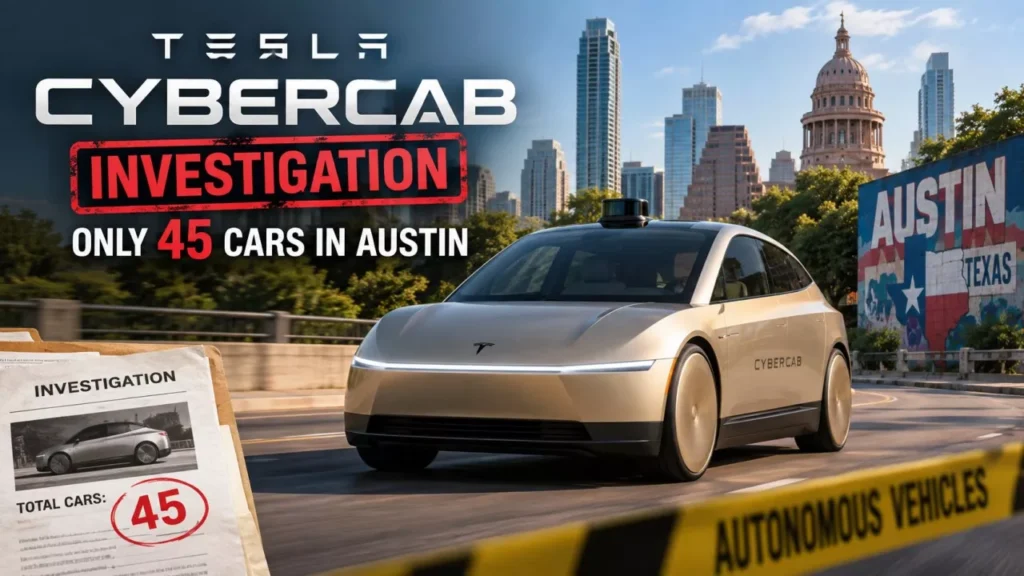

Federal regulators opened a Tesla Cybercab investigation on 3 September 2026, auditing how the company certified a two-seat robotaxi built with no steering wheel, pedals or mirrors. The National Highway Traffic Safety Administration numbered the audit AQ26002 and set its scope at about 1,000 vehicles. Paid rides in Austin are continuing while it runs.
What the Tesla Cybercab Investigation Actually Covers
The audit is about paperwork, not driving. NHTSA, the United States agency that writes and enforces federal vehicle safety rules, is reviewing the engineering data and the internal process Tesla used when it declared the Cybercab legal to sell and operate.
In the United States, carmakers are not licensed by a regulator before a vehicle reaches the road. They self-certify: the manufacturer itself declares that a model meets every applicable Federal Motor Vehicle Safety Standard, or FMVSS, and NHTSA checks afterwards. That system works cleanly for a conventional car. It gets complicated for a vehicle that removes the parts many of those standards assume exist.
Tesla told the agency it had self-certified the Cybercab as compliant with all applicable standards. According to NHTSA’s stated scope, the audit will examine the process and technical data Tesla relied on, and specifically the extent to which Tesla’s certification depended on deciding that certain standards simply do not apply to a vehicle without manual controls.
Several standards are written around a human driver — rules covering brake pedal force, mirror fields of view, windshield defrosting and driver controls. The question the audit poses is whether a company can declare those inapplicable on its own judgement.
What the audit is not: a review of how well the Cybercab drives. Regulators are not assessing whether Tesla’s Full Self-Driving software navigates Austin streets safely. That is a separate track of federal scrutiny, and it is not what AQ26002 opened.
Only 45 Cybercabs Are Registered, Not 1,000
The figure of roughly 1,000 vehicles has been widely reported as the number of Cybercabs on Austin’s streets. It is not. It is the investigation population — NHTSA’s estimate of the vehicles the audit could ultimately cover, which is standard practice when the agency opens a file.
Vehicle registration data reported by Reuters puts the real number far lower: 45 Cybercabs registered in Texas as of the morning of 4 September 2026, out of about 420 Tesla autonomous vehicles registered in the state. The rest of Tesla’s Austin robotaxi fleet is made up of Model Y cars, which do have steering wheels and pedals and are not part of this audit.
The gap matters for two reasons. A reader in Austin is far less likely to be matched with a Cybercab than the coverage suggests. And the scale of the regulatory question is smaller today than the headline number implies — though Tesla has said it plans to expand the service gradually to more vehicles and more locations.
Can You Still Book a Cybercab in Austin?
Yes. As of 8 September 2026, Cybercab rides are still available in Austin, Texas, and NHTSA has not ordered Tesla to stop the service or pull vehicles off the road. An audit query does not suspend anything by itself.
The sequence of the launch was compressed. Tesla held an invitation-only Cybercab event in Austin on 3 September 2026 and put the first cars on public streets that day, with early rides going to shareholders and invited guests. Bookings opened to the general public across the city at 5 p.m. local time on 4 September, according to Not a Tesla App, which tracks the service. NHTSA opened the audit the same week the service began.
How the service works in practice:
- Rides are booked through Tesla’s Robotaxi app, which shows a fare estimate and a wait time before you confirm.
- Service is limited to a geofence — a mapped boundary the cars will not drive outside. Not a Tesla App reported the Austin robotaxi area at roughly 264 square miles after a recent expansion north along Interstate 35 and Highway 183.
- The Cybercab seats two. There is no steering wheel, no pedals and no mirrors, so a passenger cannot take over.
- Tesla has not published a fixed fare table for the Cybercab. Riders reported fares climbing over the first weekend as demand rose.
Tesla did not immediately respond to requests for comment from ABC News or other outlets when the audit was reported.
What NHTSA Can and Cannot Do in an Audit Query
An audit query is an information-gathering step, not a penalty. It sits at the lower end of the agency’s enforcement ladder, and most coverage of this story has skipped what it actually enables.
Under an audit query, NHTSA can demand documents, test data and the reasoning behind a manufacturer’s compliance decisions. It cannot, at this stage, fine Tesla, order a recall or ground the fleet. Those powers exist further along: if the agency concludes a vehicle does not meet a standard that applies to it, it can escalate to a formal defect or non-compliance proceeding, which is where recalls and civil penalties live.
So the practical risk to Tesla is not an immediate shutdown. It is a finding that some FMVSS the company waved away do in fact apply — which would leave the Cybercab needing either an engineering change, a formal exemption, or a rule change.
The rule change is not hypothetical. The United States Department of Transportation proposed in June 2026 to remove manual-control requirements, including brake pedals, for vehicles designed to operate without a human driver. That proposal has not been finalised. If it is completed, much of what the audit is probing could become moot.
How the Zoox Case Sets the Timeline
There is a direct precedent, and it took years. Zoox, the autonomous vehicle company owned by Amazon, self-certified its purpose-built robotaxi — a four-passenger shuttle with no manual controls — in 2022. NHTSA opened an audit query into that certification, and the matter was not resolved until 2026.
On 30 July 2026, NHTSA granted Zoox a temporary exemption covering eight federal motor vehicle safety standards, allowing commercial operation in Las Vegas, Nevada. The exemption is capped at up to 2,500 vehicles a year and runs for two years, with conditions requiring Zoox to report crashes and incidents where a vehicle stops inappropriately on a road.
The two situations are not identical, and the comparison is worth setting out plainly:
| Zoox | Tesla Cybercab | |
|---|---|---|
| Route taken | Self-certified, then sought an exemption | Self-certified, no exemption sought |
| NHTSA action | Audit query, resolved 2026 | Audit query AQ26002, opened 3 September 2026 |
| Outcome so far | Temporary exemption, 30 July 2026 | Under review |
| Standards involved | Eight FMVSS waived | Not yet determined |
| Volume permitted | Up to 2,500 vehicles a year | No federal cap; self-certification claimed |
| City | Las Vegas, Nevada | Austin, Texas |
The key difference is procedural. Zoox asked permission and accepted a cap. Tesla asserted that permission was not needed. That is the argument the audit will settle, and the Zoox timeline suggests it is measured in months or years rather than weeks.
Tesla’s broader pivot toward autonomy has been visible for some time; the company discontinued the Model S and Model X earlier in 2026 as it redirected resources.
The Cybercab’s First Trip Outside the United States
While the audit proceeds, Tesla is showing the Cybercab abroad. Tesla Japan announced on 5 September 2026 that it will display the vehicle publicly in Japan for the first time, describing it in its own announcement as a two-seat vehicle designed from scratch for driverless taxi use, without a steering wheel or pedals.
The Cybercab Japan Tour dates published by Tesla Japan cover four venues:
- Tokyo, Aoyama — 11 to 14 September 2026
- Osaka, Grand Front Osaka — 17 to 20 September 2026
- Nagoya, Noritake — 22 to 23 September 2026
- Tokyo, Shinjuku — 26 to 28 September 2026
These are static displays. Tesla Japan is not offering rides, and it announced no Japanese launch date, sale date or pricing. The company said mass production has begun in the United States, with vehicles to be deployed progressively as Robotaxi service cars.
A Japanese deployment would face a physical obstacle before a regulatory one. Japan drives on the left, and the current Cybercab is built for left-hand-drive markets, so a right-hand-drive variant would be needed.
What Is Still Unconfirmed
Several things being repeated about this story are not established:
- Tesla’s response. The company had not issued a public statement on AQ26002 as of 8 September 2026.
- Which standards are in dispute. NHTSA has not published a list of the specific FMVSS it believes may apply.
- Any deadline. No date has been given for Tesla to respond or for the audit to conclude.
- Exact fares. Base and per-mile rates circulating online come from rider reports, not from Tesla.
- Expansion plans. Tesla has said it will expand to more vehicles and cities, but has named no city and no date.
Status as of 8 September 2026: Audit Query AQ26002 is open, Cybercab rides continue in Austin, no suspension or recall has been ordered, and no federal deadline has been made public.
Frequently Asked Questions
What Is the Tesla Cybercab Investigation About?
NHTSA is auditing how Tesla certified that the Cybercab meets federal safety standards, given that the vehicle has no steering wheel, pedals or mirrors. The audit reviews Tesla’s paperwork and engineering data, not the quality of its self-driving software.
Are Cybercab Rides Suspended?
No. As of 8 September 2026, rides continue in Austin and NHTSA has not ordered Tesla to stop. An audit query is an information-gathering step and does not halt a service on its own.
How Many Cybercabs Are Actually on the Road?
Registration data reported by Reuters showed 45 Cybercabs registered in Texas in early September 2026. The figure of about 1,000 that appears in many reports is NHTSA’s estimate of the vehicles the audit could cover, not a count of cars in service.
Could Tesla Be Forced to Recall the Cybercab?
Not at this stage. An audit query cannot compel a recall or impose a fine. If NHTSA later concludes that standards Tesla treated as inapplicable do apply, it can escalate to a non-compliance proceeding, which can lead to a recall.
Where Can I Ride a Cybercab?
Only in Austin, Texas, booked through Tesla’s Robotaxi app and limited to a mapped service area. The Cybercab is being displayed in Japan during September 2026, but those are exhibitions and no rides are offered.
How Long Could the Investigation Take?
There is no published deadline. The closest precedent is Zoox, which self-certified a robotaxi without manual controls in 2022 and did not receive a federal exemption until 30 July 2026.