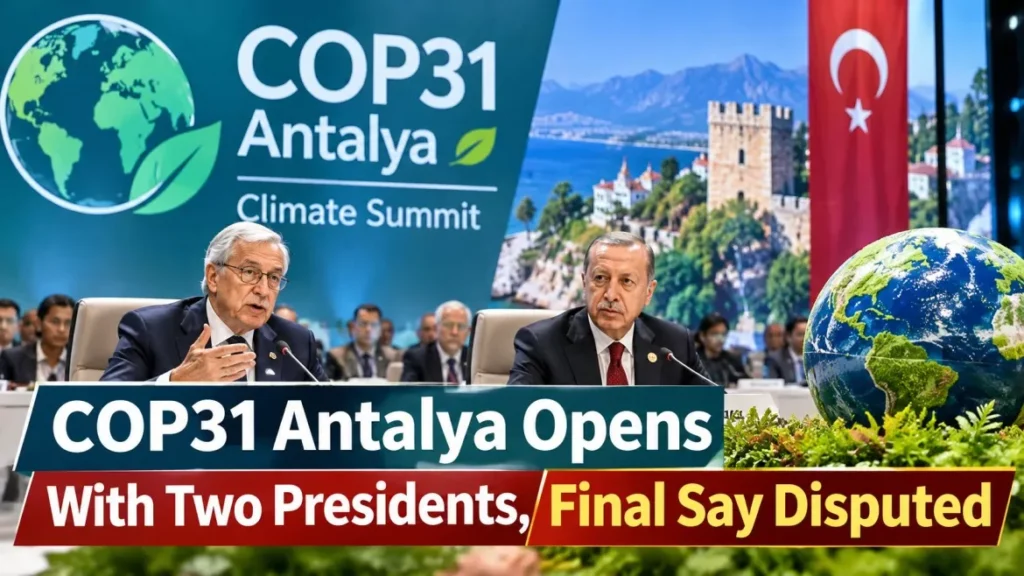

COP31 Antalya opens on Monday 9 November 2026 in southern Türkiye with two governments sharing the top job. Türkiye’s Murat Kurum is COP President, while Australia’s Chris Bowen runs the formal negotiations under what the governing document calls exclusive authority. Both sides have said publicly that they disagree over who holds the final word.
Who Holds Which Job at COP31 Antalya
COP31 is the 31st Conference of the Parties to the United Nations Framework Convention on Climate Change, the 1992 treaty under which countries negotiate collective climate action. Every COP has a single presiding country. This one has two.
As of Sunday 8 November 2026, the day before the opening plenary, the division of labour agreed between the two governments stands as follows.
| Function | Türkiye | Australia |
|---|---|---|
| Title | COP31 President (Murat Kurum, Minister of Environment, Urbanisation and Climate Change) | President of Negotiations and Vice-President of the COP (Chris Bowen, Minister for Climate Change and Energy) |
| Venue and hosting | Hosts the summit at the Antalya Expo Center and hosts the World Leaders’ Summit | No hosting role |
| Formal negotiations | Consulted by Australia | Runs the talks, prepares draft text and issues any cover decision |
| Action Agenda | Designs and runs the voluntary, non-negotiated Action Agenda and its ten themes | No formal role |
| Claimed final authority | States that the final decision rests with the COP31 Presidency | States it holds exclusive authority over the negotiations |
The conference runs from 9 to 20 November 2026, according to the United Nations’ own COP31 page. More than 190 countries are expected to take part, UN News reported on 8 November 2026. A World Leaders’ Summit is scheduled for 11 and 12 November, the third and fourth days — later in the programme than at most recent COPs, which front-loaded their leaders’ events.
Türkiye Says the Final Decision Is Its Own
The unresolved question at COP31 is not on the agenda: it is who gets to settle the agenda. Both presidencies have described their own powers in terms the other has not accepted.
Speaking in Trabzon on 10 September 2026, Kurum set out Türkiye’s reading. “Türkiye and Australia are not co-presidents,” he said, in remarks translated from Turkish and reported by Climate Home News. “Türkiye is the President of COP31 and Australia is the President of Negotiations.” He added: “We are in consultation with Australia but the final decision lies with the presidency of COP31.” Speaking in April 2026, he had already said that “at the end of the day, the decisions will be taken by the COP31 Presidency.”
The written arrangement points the other way on the negotiations themselves. A modalities document agreed at the end of COP30 in November 2025 says the Australian representative holds “exclusive authority in relation to the negotiations” for the duration of the conference, according to Climate Home News, which reported the document’s wording. The same document gives that representative the titles President of Negotiations and Vice President of the COP.
Bowen has rejected the co-presidency label while describing the working relationship as functional. At the mid-year Bonn talks in June 2026 he said Australia and Türkiye were “working together seamlessly and with one goal.” Asked who would gavel the summit to a close, he answered: “Kurum and I… Together.” He also acknowledged “nervousness” about the structure, telling reporters: “I do understand because it’s a new thing. But what we’re doing actually has a lot of benefits and potential.”
What the document does not contain is a tie-breaker. Its only mechanism, as reported by Climate Home News, is that “if there is a difference of views between Türkiye and Australia, consultations will take place” until the difference is resolved “to mutual satisfaction.” It does not say what follows if those consultations fail. Kurum has said no problems have arisen so far, telling reporters in September that “we have not experienced any problems so far, and we do not expect to encounter any in the future.”
Analysts have been more cautious. Anna Perez Catala of IDDRI, a Paris-based research institute, told Agence France-Presse that the model “has no precedent” at UN climate summits and that it “aims to showcase countries can work together even in difficult times, but could bring disagreements.” Jennifer Morgan, Germany’s former climate envoy, warned that unclear roles at past COPs have “diverted attention from the work at hand.” A French government official told the same agency there was a “clear division of roles,” but added: “we’ll see how it works in practice.”
How Two Countries Ended Up Sharing One Summit
The arrangement is the residue of a hosting contest neither side would concede. Under UN practice, the host rotates between regional groups and is chosen by consensus within the group.
Australia and Türkiye both bid for 2026. Australia had campaigned for roughly three years and planned to hold the summit in Adelaide, with a Pacific partnership at its centre. Türkiye argued it could bridge industrialised and developing countries and pointed to Antalya’s hotel capacity.
Neither withdrew during COP30 in Belém, Brazil, in November 2025. With no consensus, the conference would have defaulted to Bonn, the seat of the UN climate secretariat. After closed-door talks, the two governments settled on the split, announced in Belém on or about 19 November 2025 and set out in a modalities document dated 21 November 2025.
The deal also carried Pacific commitments: a pre-COP meeting hosted in Fiji from 5 to 8 October 2026, a leaders’ event in Tuvalu, and a pledging event for the Pacific Resilience Fund. One former Turkish climate diplomat summarised the outcome bluntly to Climate Home News: “We bear the burden, but they hold the power.”
The Agenda Fight Waiting at the Opening Plenary
Australia’s immediate task on Monday is procedural: getting the agenda adopted without a fight. Opening plenaries have consumed days at past COPs when countries contest what may be discussed.
The African Group of Negotiators, chaired by Ghana, wrote to UN climate chief Simon Stiell requesting three additional agenda items, Climate Home News reported on 28 October 2026: tripling adaptation finance, trade and climate change, and the financing arrangements of the Green Climate Fund. Nepal separately requested an item on mountains and climate change.
Europe is expected to resist the trade item. At COP30, China and several large emerging economies pushed for discussion of “unilateral trade measures,” a reference aimed largely at the European Union’s carbon border levy, which charges importers for emissions embedded in certain goods.
A common resolution is to move contested items out of the formal agenda and into consultations run by the presidency, where they are discussed without a mandated outcome. Which presidency would run such consultations at this COP is one of the practical questions the split arrangement leaves open.
Where the Adaptation Money Dispute Stands
Finance is the fault line most likely to decide whether Antalya is judged a success. The dispute is not about whether to increase adaptation funding — money for sea walls, drought-resistant crops and flood defences rather than emissions cuts — but about the baseline, the payers and the date.
- The COP30 commitment: Governments agreed in Belém to at least triple adaptation finance by 2035. Carbon Brief’s analysis of the decision notes it sets no baseline year, makes no inflation adjustment, and allows money channelled through multilateral development banks to count.
- What tripling would deliver: Roughly $85 billion to $120 billion a year, according to a United Nations assessment reported on 4 November 2026.
- What is estimated to be needed: About $305 billion a year by 2035 in today’s prices for developing countries, per the UN Environment Programme’s Adaptation Gap Report 2026.
- What was actually provided: International public adaptation finance from developed countries reached $28.2 billion to $31.7 billion in 2024.
- The wider goals: A target of $300 billion a year by 2035 was agreed at COP29 in Baku in 2024, alongside an aspiration to mobilise $1.3 trillion a year by 2035 from all sources.
- Total climate finance: Developed countries provided and mobilised a record $136.7 billion in 2024, according to figures from the Organisation for Economic Co-operation and Development.
All of these figures are in US dollars and apply globally rather than to any one country. They are flows between governments and institutions, not payments to individuals.
Antwi-Boasiako Amoah, chair of the African Group, put the central complaint plainly at a media briefing in late October 2026: “nobody is even sure of the [tripling] baseline.” At the June 2026 Bonn session, developed countries — mostly European governments — declined to write a tripling target into the decision text on the Global Goal on Adaptation, the Paris Agreement’s framework for measuring adaptation progress. Climate Home News reported on 5 November 2026 that the European Union is arriving in Antalya without new money on the table.
The Electrification Pledge Türkiye Wants Signed
Türkiye’s flagship initiative is voluntary and sits outside the negotiations. Known as “35 by 35,” it asks governments to commit to raising electricity’s share of final energy use to 35% globally by 2035.
Sources differ on the starting point, and the pledge text does not fix a baseline year. The Council on Foreign Relations and Climate Home News both put electricity’s current share at about 23% to 24% of final energy use; ABC News reported the proposal as a rise from just over 20% in 2024. Climate Action Tracker projects about 28% by 2035 under current policies, which places the target above trajectory but not dramatically so.
Campaigners have criticised the pledge for not requiring the additional electricity to be clean and for avoiding any explicit reference to moving away from fossil fuels. Kurum has argued that electrification will “automatically” reduce fossil fuel use. The launch is expected on Energy Day, 10 November 2026. Australia has signed up and European governments are considered likely to; India may decline and China’s position is undecided, Climate Home News reported.
A separate voluntary measure, the Antalya Artificial Intelligence Pledge, puts AI and data-centre electricity demand on a COP agenda for the first time in this form. “We must openly discuss AI’s growing energy consumption,” Kurum said in remarks reported by ABC News on 7 November 2026.
Who Is Attending, and Who Is Not
The United States will not send an official federal delegation, for the second year running. It formally withdrew from the Paris Agreement with effect from January 2026, and its withdrawal from the underlying UN climate convention is due to take effect in 2027.
American participation continues outside the federal government. More than 100 state and local leaders, including governors and mayors, are attending under the America Is All In, Climate Mayors and US Climate Alliance banners, ABC News reported, alongside a congressional delegation of 19 members. “America Is All In is showing up in force at COP31 to let the world know that millions of Americans are still in,” said Gina McCarthy, the coalition’s chair and a former administrator of the US Environmental Protection Agency.
The leaders’ list is thinner than at recent COPs. Brazil’s President Luiz Inácio Lula da Silva, Spain’s Prime Minister Pedro Sánchez and Greater Manchester mayor Andy Burnham are among those expected, while India and China are not sending their top leaders, according to Climate Home News’s review of the early speakers’ list.
Rights groups have criticised Türkiye’s restrictions on protest and civil society. Climate Home News reported on 5 November 2026 that government approval for a planned demonstration was still pending, and that the UN climate secretariat had warned it lacked the resources to admit new observer organisations within the year available.
Key Dates at COP31 Antalya
- Monday 9 November 2026: COP31 opens in Antalya with the opening plenary, where the agenda must be adopted.
- Tuesday 10 November 2026: Energy Day, with the expected launch of the “35 by 35” electrification pledge.
- Wednesday 11 and Thursday 12 November 2026: World Leaders’ Summit, hosted by Türkiye.
- Tuesday 17 and Wednesday 18 November 2026: The high-level ministerial segment resumes.
- Friday 20 November 2026: Scheduled close of negotiations. COPs routinely run past their scheduled end.
- Early December 2026: An extraordinary meeting of the Intergovernmental Panel on Climate Change is planned, after it failed for a sixth time to agree a timeline for its next assessment reports.
What Is Agreed, What Is Claimed and What Is Unverified
On a story with two presidencies and nearly 200 negotiating parties, it is worth separating the three.
Agreed and documented: The dates, the Antalya venue, the two officials’ titles, and the written division of roles in the modalities document. So is the direction of travel on temperature: the world is now on course to exceed 1.5°C of warming above pre-industrial levels, a conclusion set out in the UN Environment Programme’s Emissions Gap Report 2026. COP31 will also launch the second global stocktake, the Paris Agreement’s five-yearly review of collective progress.
Claimed and contested: Who has the final say. Türkiye says the COP31 Presidency decides; the modalities document gives Australia exclusive authority over the negotiations. Both positions are on the record and neither has been tested. Projections of end-of-century warming — about 2.8°C under current policies, or about 2.6°C if announced pledges are delivered in full — are modelled estimates, not measurements, and vary between modelling groups.
Not yet established: Whether the agenda will be adopted without a procedural fight, whether any adaptation finance baseline will be set, whether the just transition mechanism agreed in principle at COP30 will be made operational, and whether a cover decision will reference fossil fuels. The COP30 political package omitted the words “fossil fuels” from its official text; Brazil published a voluntary 182-page transition roadmap separately, which its own officials describe as not a negotiated document.
COP31 Antalya: Frequently Asked Questions
When and Where Is COP31 Antalya Taking Place?
COP31 runs from 9 to 20 November 2026 at the Antalya Expo Center in Antalya, Türkiye. The World Leaders’ Summit is scheduled for 11 and 12 November, and negotiations are due to close on 20 November, though COPs frequently overrun.
Who Is in Charge of COP31, Türkiye or Australia?
Both, in different respects, and the boundary is disputed. Türkiye’s Murat Kurum is COP31 President and runs the hosting and the voluntary Action Agenda; Australia’s Chris Bowen is President of Negotiations and, under the modalities document agreed in November 2025, holds exclusive authority over the formal talks. Türkiye states that the final decision rests with its presidency.
Why Are Two Countries Running COP31 Together?
Australia and Türkiye both bid to host and neither withdrew at COP30 in November 2025. Without consensus the summit would have defaulted to Bonn, so the two governments agreed to split the roles instead. No previous UN climate summit has been run this way.
Is the United States Attending COP31?
Not at federal level. The United States is sending no official delegation for the second consecutive year, having left the Paris Agreement with effect from January 2026. More than 100 US state and local officials and a 19-member congressional delegation are attending independently.
What Is the Second Global Stocktake That Starts at COP31?
It is the Paris Agreement’s formal five-yearly assessment of whether countries are collectively on track, and it begins at COP31 in November 2026. The first stocktake concluded at COP28 in 2023; the second is due to conclude in November 2028.