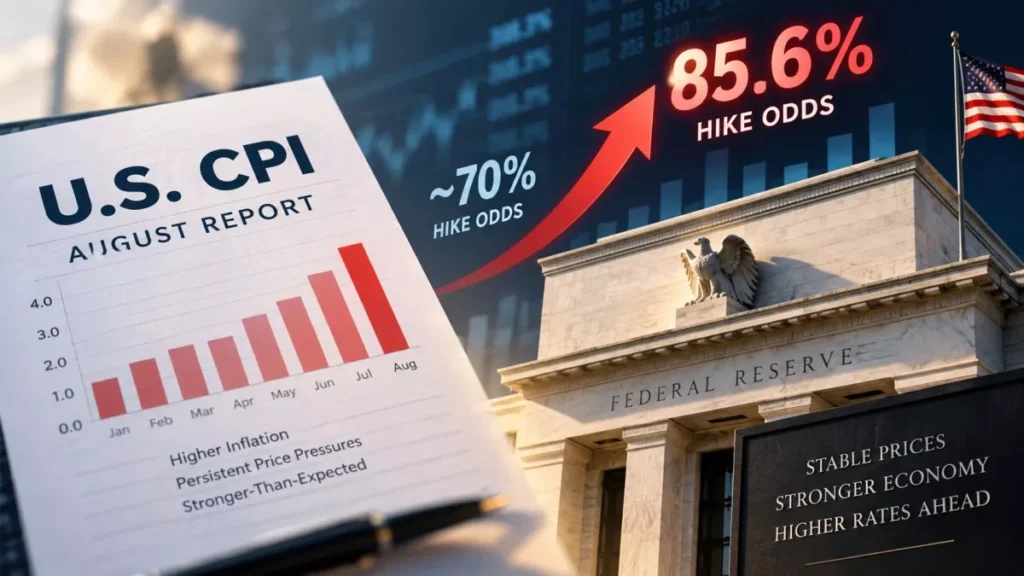

United States consumer prices rose 3.4% in the year to August 2026, the Bureau of Labor Statistics reported on 11 September. Core inflation rose 0.3% on the month, a tenth more than economists expected. Traders then put the odds of a Federal Reserve rate rise on 16 September at about 85.6%.
What the August CPI Report Showed
The August CPI report put the Consumer Price Index for All Urban Consumers up 0.4% on the month, after a 0.1% rise in July. The Bureau of Labor Statistics, the United States federal agency that compiles official price and employment data, publishes the index monthly and covers the United States only.
These are the headline readings from the release. Monthly figures are seasonally adjusted; the 12-month figures are not.
| Index | Change in August 2026 | Change over 12 months |
|---|---|---|
| All items | +0.4% | +3.4% |
| All items less food and energy (core) | +0.3% | +2.4% |
| Energy | +2.1% | +16.3% |
| Gasoline | +3.9% | +27.4% |
| Food | +0.1% | +2.7% |
| Shelter | +0.3% | +3.0% |
| Airline fares | +2.7% | +23.4% |
Inflation at 3.4% remains above the Federal Reserve’s 2% target. The core measure, at 2.4% over the year, eased from 2.5% in July, so the two gauges moved in opposite directions over the month.
Why the Headline Landed on Forecast but Core Did Not
The two numbers in the report tell different stories, which is why coverage of the same release has carried opposite headlines. The monthly core reading of 0.3% came in a tenth of a percentage point above the 0.2% economists had forecast, and that is the figure that moved markets.
Outlets differed on the headline number. Yahoo Finance reported that the 3.4% annual rate matched the estimates of economists polled by LSEG, while Morningstar and Bloomberg described the release as coming in above forecasts. Both descriptions can be read from the same data: the headline was close to consensus, the core was not.
Core inflation excludes food and energy because those two categories swing sharply from month to month. Policymakers watch it as a read on underlying price pressure. In August the distinction mattered more than usual, because energy did most of the work in the headline number.
Where the August Price Rises Came From
Energy was the single largest driver. The energy index rose 2.1% in August after falling 1.5% in July, and gasoline alone accounted for more than a third of the monthly increase in all items, according to the Bureau of Labor Statistics release.
- Gasoline: up 3.9% on the month and 27.4% over 12 months, the sharpest annual rise among the major components.
- Airline fares: up 2.7% on the month and 23.4% over the year, a category exposed to jet fuel costs.
- Shelter: up 0.3% after a 0.1% rise in July, and 3.0% over the year.
- Food: up 0.1% on the month, the smallest monthly move among the headline categories, and 2.7% over the year.
These are national index movements, not the change any individual household faces. What a given family pays depends on where it lives, what it buys and how it heats and travels, and can differ substantially from the national figure. Energy costs have also fed through to other United States price readings, including the movement in mortgage rates earlier in September.
What It Changes for the Fed Decision on 16 September
The report lands four days before the Federal Open Market Committee announces its decision. The committee meets on 15 and 16 September 2026, with the decision and a press conference by Chair Kevin Warsh on the afternoon of the 16th.
As of 11 September 2026, the federal funds rate target range stands at 3.50% to 3.75%, where it has been since December, and the CME FedWatch tool put the probability of a quarter-point increase at that meeting at about 85.6%. Fox Business cited that reading on the day of the release; Yahoo Finance reported the same measure at roughly 85% on Friday morning, up from around 70% before the data was published.
That figure is a price, not a forecast. FedWatch derives it from federal funds futures, so it reflects what traders are paying to position for an outcome at a given moment, and it moves through the day. A quarter-point increase would take the target range to 3.75% to 4.00%.
The Federal Reserve sets policy for the United States. Other central banks decide separately and on their own timetables, as the European Central Bank’s move on 10 September showed.
What Is Still Undecided
Nothing in the August CPI report commits the committee to anything. Warsh, who became Fed chair on 13 May 2026, has declined to offer the explicit guidance on future moves that his predecessors tended to give, and has said the outcome of meetings should not be settled in advance.
The committee’s own June projections showed the split. Nine of 18 officials projected the federal funds rate would end 2026 above the current range, with a median projection of 3.8%, a quarter point above where it stands. The committee left rates unchanged at its July meeting with internal dissent recorded.
What the report does not settle: whether August’s energy spike proves temporary, whether the committee treats a 2.4% core reading as progress or as a stall, and how the decision divides when it is taken on 16 September.
August CPI Report: Questions Readers Are Asking
When Was the August CPI Report Released?
The Bureau of Labor Statistics published it on 11 September 2026. It covers price changes during August 2026 in the United States.
What Is Core CPI and Why Does It Differ From the Headline?
Core CPI is the index for all items excluding food and energy, two categories whose prices swing sharply month to month. In August 2026 it rose 2.4% over the year while the headline index rose 3.4%, because energy costs sat outside the core measure.
Does the Report Mean the Federal Reserve Will Raise Rates?
No. The 85.6% figure reported on 11 September 2026 is a market-implied probability from the CME FedWatch tool, not a decision. The Federal Open Market Committee announces its decision on 16 September 2026.
Which Country Does This CPI Report Cover?
The United States only. The Consumer Price Index is compiled by a United States federal agency and measures prices paid by urban consumers there. Other countries publish their own national inflation statistics on separate schedules.