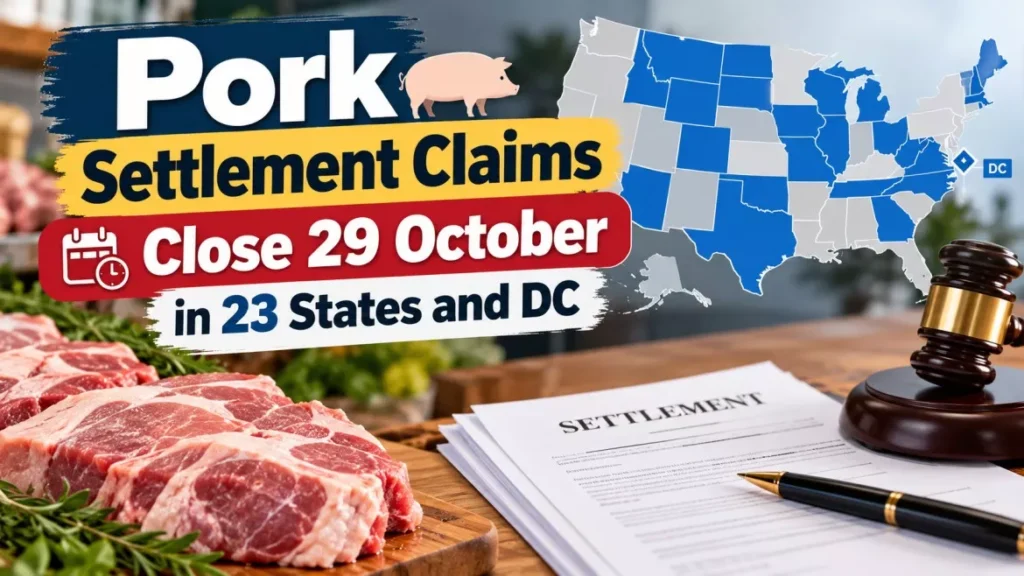

The pork settlement claim deadline is 29 October 2026, and the class covers 23 United States states plus the District of Columbia rather than 24 states. Five pork producers have agreed to pay a combined $117.065 million without admitting wrongdoing. Claims go through Epiq, the administrator the court appointed.
Who Is Covered by the Pork Settlement
Eligibility turns on three things at once: where the pork was bought, when it was bought, and what kind of pork it was. The court’s order of 31 July 2026 defines the class as people and entities who indirectly purchased raw pork bacon, or raw pork bellies, loins, shoulder, ribs or pork chops, fresh or frozen, for personal consumption.
“Indirectly purchased” means bought from a retailer such as a grocery store rather than from the producer. The purchase window runs from 28 June 2014 to 30 June 2018.
The order lists the covered jurisdictions, which it calls the Repealer Jurisdictions, as Arizona, California, the District of Columbia, Florida, Hawaii, Illinois, Iowa, Kansas, Maine, Michigan, Minnesota, Missouri, Nebraska, Nevada, New Hampshire, New Mexico, New York, North Carolina, North Dakota, Rhode Island, South Carolina, Tennessee, Utah and West Virginia. That is 24 jurisdictions in total: 23 states and Washington DC. Much of the coverage of this settlement describes it as covering “24 states”, which does not match the order.
Three of those jurisdictions have a shorter window. For class members in Kansas, Tennessee and South Carolina, the order states that the class period begins on 28 June 2015, a year later than for everyone else. Purchases made in those three states during the first year of the general class period therefore fall outside the class.
The order also excludes the defendants themselves, their officers, directors and employees, entities they control, federal, state and local government bodies, the judge and court staff on the case, jurors assigned to it, and any co-conspirator named in the action.
Which Pork Products Count, and Which Do Not
The class definition is narrower than “pork” and the exclusions are not incidental. According to the order, the covered products are raw pork bacon and six named cuts, and the definition then carves out three categories.
- Organic pork: excluded entirely, whatever the cut.
- No-antibiotics-ever pork: excluded entirely. This is pork marketed as raised without any antibiotics, often labelled NAE.
- Marinated, seasoned, flavoured or breaded products: excluded, with bacon the single exception.
Cooked or processed pork products such as ham, sausage and deli meats are not among the covered cuts. Neither exclusion appears in most summaries of the settlement, several of which describe eligibility simply as having bought raw pork or bacon in the period.
What the Five Settlements Are Worth
Six defendants settled with the consumer class, but only five of them are paying cash.
| Settling defendant | Cash settlement |
|---|---|
| Tyson Foods | $85,000,000 |
| Clemens Food Group | $13,500,000 |
| Seaboard Foods | $10,000,000 |
| Hormel Foods | $4,465,000 |
| Triumph Foods | $4,100,000 |
| Agri Stats | Conduct reforms, no cash payment |
| Total cash | $117,065,000 |
The individual amounts are reported by legal-news outlets covering the settlement agreements rather than stated in the notice order itself, and they sum exactly to the $117.065 million figure. Agri Stats, a company that collected and distributed industry data, agreed to changes in its conduct instead of a payment.
The fund is reduced before distribution. Reporting on the settlement puts the attorneys’ fee request at up to $39,021,667 plus interest, with litigation expenses of up to $5 million, and administration costs still to be set. Those figures require the court’s approval and are to be decided at the same hearing as the settlements themselves.
The underlying claim was that the processors used Agri Stats to exchange information and coordinate supply and pricing. The defendants deny it. The court’s order states explicitly that neither the order nor the settlement agreements are to be treated as an admission or as evidence of any violation, liability or wrongdoing. Nothing in this case has been proved against any defendant.
Four Deadlines That All Fall on One Day
As of 9 October 2026, claims are open and close on 29 October 2026, three weeks away. The court set that date as 90 days from its order of 31 July 2026, and the same day is the cut-off for three other steps.
- File a claim: 29 October 2026.
- Request exclusion from the class: 29 October 2026. A class member who opts out keeps the right to sue separately and receives nothing from the fund.
- Object to any of the settlements: 29 October 2026, by letter to the court and the administrator.
- File a notice to appear at the final approval hearing: 29 October 2026.
An objection letter must carry the member’s name, address and telephone number, the notice ID number where available, the reasons for objecting, the name of their lawyer if they have one, a statement naming which settlements they object to in the case, a statement of whether they or their lawyer want to speak at the hearing, and their signature. The order sets out each of those requirements.
Claims are filed through the official settlement website at OverchargedForPork.com or by post to Epiq, the administrator. Receipts are not required; the claim form asks for an estimate of qualifying purchases through a short set of questions. The claim form is signed under penalty of perjury, so the estimate given is a sworn statement.
How Payments Are Worked Out and How They Arrive
Payments are pro rata, which means the fund is divided in proportion to how much covered pork each valid claimant reports buying rather than paid as a fixed sum per person. No per-person figure can be calculated in advance, because it depends on how many valid claims arrive.
The order records that co-lead counsel will work with Epiq to establish whether a minimum payment for claimants is feasible, and that there may be more than one round of distribution. Where it is no longer economical to distribute to class members, residual money may go to a court-approved cy pres recipient, meaning a charitable or public-interest body, be escheated to a state, or be distributed as the court directs.
The payment methods approved by the court are wider than cash alone, and claimants choose among them:
- Physical cheque: posted to the claimant.
- Zelle: a United States bank-to-bank transfer service.
- Digital Mastercard: a virtual prepaid card.
- Retailer gift cards: Amazon, Starbucks, Walmart, Kroger or Safeway.
The court found those methods fair and reasonable in the same order. The gift-card option is absent from almost all of the coverage of this settlement.
What Happens After the Claim Window Closes
Filing a claim does not produce a payment this year. The settlements still need final approval, and the case is at the notice stage rather than the payment stage.
The court has granted preliminary approval to each of the six settlements, on dates running from July 2024 for Hormel through to May 2026 for Triumph and Agri Stats, and it approved the notice plan and plan of allocation on 31 July 2026. The final approval hearing, at which the court decides whether the settlements are fair, reasonable and adequate, is reported as 11 December 2026 at 11am Central Time before the judge in the case. The order itself schedules that hearing for 40 days after the exclusion deadline, or as soon afterwards as the court can hear it.
Payments follow final approval and the resolution of any appeals. Where appeals are filed, that process can add a year or more. If the court refuses final approval, the order provides that the settling defendants and the plaintiffs may rescind their agreements.
The case is In re Pork Antitrust Litigation, Civil No. 18-1776, in the United States District Court for the District of Minnesota, before Chief Judge John R. Tunheim. Earlier settlements in the same litigation with JBS and Smithfield were separate, and their consumer claims period closed in April 2026, so a claim filed there does not carry over.
Readers following other consumer claim windows may want our reports on the Flo settlement deadline and the Paramount and Warner Bros settlement.
Frequently Asked Questions
What Is the Pork Settlement Claim Deadline?
29 October 2026. That is also the last day to exclude yourself from the class, to object to any of the settlements, or to file notice of an intention to speak at the final approval hearing.
Which States Are in the Pork Settlement?
Twenty-three states plus the District of Columbia: Arizona, California, Florida, Hawaii, Illinois, Iowa, Kansas, Maine, Michigan, Minnesota, Missouri, Nebraska, Nevada, New Hampshire, New Mexico, New York, North Carolina, North Dakota, Rhode Island, South Carolina, Tennessee, Utah and West Virginia, with Washington DC. In Kansas, Tennessee and South Carolina the class period starts on 28 June 2015 instead of 2014.
Does Organic Pork Count?
No. The court’s class definition excludes pork marketed as organic and pork marketed as no-antibiotics-ever, and excludes marinated, seasoned, flavoured or breaded products other than bacon.
How Much Will Each Claimant Receive?
No amount is fixed. The fund of $117,065,000 is divided pro rata according to how much covered pork each valid claimant reports buying, after fees, expenses and administration costs approved by the court, so the figure depends on the number of valid claims.
Are Receipts Needed to File?
No. The claim form asks for an estimate of qualifying purchases rather than documentary proof, and is submitted under penalty of perjury.
When Will Payments Be Made?
No payment date has been set. Payments follow the final approval hearing, reported for 11 December 2026, and the resolution of any appeals, which can take a year or more.