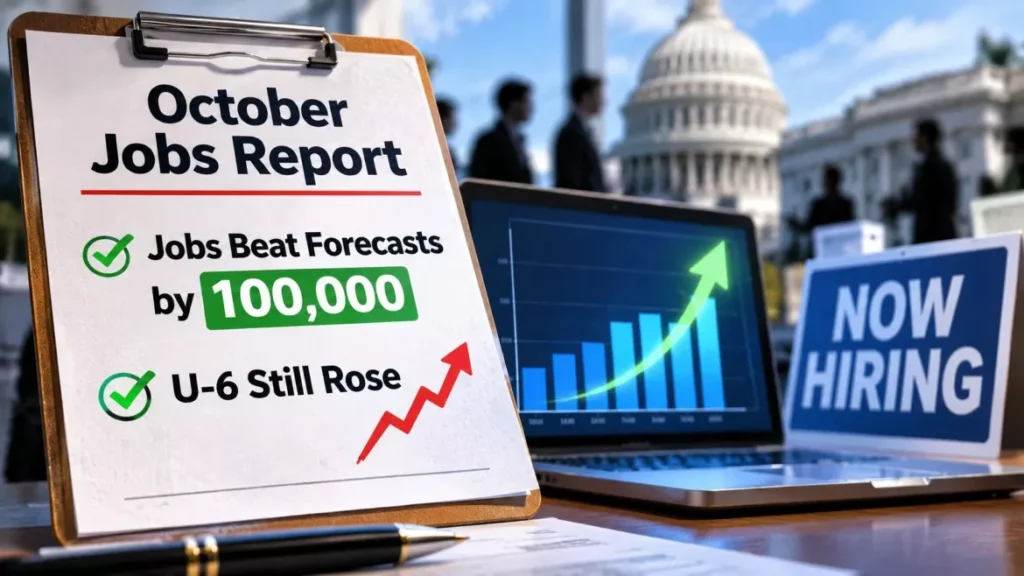

The October jobs report showed the United States added 165,000 jobs, about 100,000 more than economists had forecast. The Bureau of Labor Statistics published the figures on 6 November 2026, and the unemployment rate came in at 4.1%. Traders then raised the odds of a Federal Reserve interest rate rise on 9 December.
What the October Jobs Report Showed
Hiring was far stronger than Wall Street expected. Economists polled by LSEG had forecast roughly 65,000 new jobs, and payrolls instead rose by 165,000 — more than three times the average monthly gain of 48,000 over the previous twelve months.
The gains were broad rather than concentrated in one corner of the economy. Private employers added 159,000 jobs and governments added 6,000, with federal payrolls down 1,000, state governments up 8,000 and local governments down 1,000.
| Measure | October 2026 | Forecast or prior |
|---|---|---|
| Nonfarm payrolls | +165,000 | +65,000 forecast (LSEG poll) |
| Unemployment rate | 4.1% | 4.2% expected to hold |
| Average hourly earnings, month | +0.4%, to $38.00 | +0.3% forecast |
| Average hourly earnings, year | +3.1% | +2.4% forecast |
| Labour force participation | 61.9% | Little changed |
| Employment-population ratio | 59.3% | Little changed |
Four sectors drove most of the increase, according to the Bureau of Labor Statistics release:
- Professional and business services: up 70,000, led by scientific and technical services and by administrative and support work.
- Health care: up 42,000, concentrated in hospitals, home health care and outpatient centres.
- Transportation and warehousing: up 25,000, mostly couriers and messengers.
- Manufacturing: up 19,000, against a forecast of about 5,000.
Two earlier months were also revised upward. August was raised by 53,000 to 186,000 jobs, and September by 31,000 to 60,000 — together 84,000 more jobs than previously reported. Revisions of that direction and size matter because they change the trend the Federal Reserve is reading, not just a single month.
Where the Same Report Looked Weaker
The headline figures were strong, but several measures inside the same release moved the other way. This is the part most coverage of the report left out.
The broadest measure of underemployment rose. U-6 — which counts the unemployed plus people only marginally attached to the labour force plus those working part time because they cannot find full-time work — reached 7.9% in October, up from 7.6% in September. That is a rise of 0.3 percentage points in a single month.
The detail behind it is specific. The number of people working part time for economic reasons climbed by 339,000 to 4.8 million. Long-term unemployment also stayed high, with 2.0 million people out of work for 27 weeks or more, making up 27.6% of all unemployed people.
Pay is a third soft spot. Average hourly earnings rose 3.1% over the year to October, which is below the 3.7% annual rate of consumer price inflation recorded for September 2026 and published on 14 October. On that comparison, average pay was not keeping pace with headline prices. Core inflation, which strips out food and energy, ran at 2.6% over the same period.
These are averages across the whole country, and no individual worker or household experiences the average. A national pay figure says nothing about any particular job, industry or region.
Why the Next Move Points Up, Not Down
The Federal Reserve, the central bank of the United States, is in an unusual position for this stage of an economic cycle: the live question is whether to raise rates, not cut them. Inflation has run above its 2% target for more than five years.
The sequence explains why. On 16 September 2026 the Fed raised its benchmark by a quarter point to a target range of 3.75% to 4%, its first increase since 2023. At the following meeting on 28 October it held that range, but the Federal Open Market Committee statement said inflation “remains elevated” and the vote was 10 to 2.
Both dissenters wanted to go further. Governor Lisa D. Cook and Cleveland Fed President Beth M. Hammack each “preferred to raise the target range for the federal funds rate by 1/4 percentage point at this meeting”, according to the statement. Fortune reported that this was the first time since 1992 that a Fed governor and a regional Fed president dissented together, and that it was Cook’s first dissent since joining the board in 2022.
A strong jobs report removes one argument against moving. If the labour market were deteriorating, a central bank worried about inflation would still have reason to wait. October’s payroll figure weakened that reason.
What Happens at the 9 December Meeting
The Federal Open Market Committee next meets on 8 and 9 December 2026, with the rate decision announced on 9 December. A quarter-point increase would lift the target range from 3.75%-4% to 4%-4.25%.
As of 6 November 2026, market pricing favoured that increase but did not treat it as settled. The readings moved through the day and come from different instruments, so they do not match exactly:
- CME FedWatch, 6 November: a 76.8% probability of a quarter-point rise in December, up from 66.9% a week earlier, as reported by Fox Business.
- Market pricing cited by Reuters, 6 November: about 78% at mid-morning, after peaking near 85% shortly after the data landed and sitting near 67% on 5 November.
- Bank forecasts: Goldman Sachs expects hikes to resume in December, while MUFG has put the chance at 55%, below market pricing.
These are probabilities derived from traded contracts, not forecasts from the Fed, and they change daily. Chair Kevin Warsh has given no explicit guidance on December and has said he does not favour forward guidance outside a crisis.
One scheduled release falls before the decision. The October Consumer Price Index is due on 10 November 2026, and a second inflation reading will reach the committee before it votes.
What a Quarter-Point Move Would Touch
A change in the federal funds rate does not reach every borrowing or saving cost in the same way, or at the same speed. The mechanism is worth separating from the headline.
Variable-rate borrowing tends to move first, because most credit card rates in the United States are tied to the prime rate, which tracks the Fed’s benchmark closely. Fixed-rate debt already taken out does not change. Mortgage rates are not set by the Fed at all: they follow longer-term bond yields and lenders’ own pricing, which is why they sometimes move in the opposite direction to a Fed decision.
On the saving side, higher benchmark rates can raise returns on high-yield savings accounts and certificates of deposit, but a Fed increase does not oblige any individual bank to raise what it pays, and traditional savings accounts have historically been slow to follow.
Terms vary by lender, by product and by individual circumstances, and the figures above describe the United States only. Other central banks set their own rates on their own timetables; the European Central Bank, for instance, moved its deposit rate to 2.50% in September 2026.
What Is Still Unknown
Several things are genuinely unresolved rather than merely unreported.
- The decision itself: the committee has not voted, and no outcome is confirmed until 9 December.
- The dissenters’ reasoning: neither Cook nor Hammack had published a written explanation of their October votes.
- The inflation path: Fed staff do not expect inflation to return to 2% until 2029, and October’s CPI reading is not yet published.
- Year-on-year comparisons: no seasonally adjusted U-6 figure exists for October 2025, because that data was not collected during the federal government shutdown, so the usual twelve-month comparison cannot be made.
Frequently Asked Questions
How Many Jobs Did the October Jobs Report Show?
The United States added 165,000 nonfarm jobs in October 2026, according to the Bureau of Labor Statistics release of 6 November 2026. Economists polled by LSEG had forecast about 65,000.
Did the Unemployment Rate Go Up or Down?
The unemployment rate was 4.1% in October 2026, which the Bureau of Labor Statistics described as little changed. Economists had expected it to hold at 4.2%. About 7.1 million people were unemployed.
When Is the Next Federal Reserve Rate Decision?
The Federal Open Market Committee meets on 8 and 9 December 2026 and announces its decision on 9 December. The target range for the federal funds rate currently stands at 3.75% to 4%.
Why Would the Fed Raise Rates Rather Than Cut Them?
Inflation in the United States has run above the Fed’s 2% target for more than five years, and consumer prices rose 3.7% in the year to September 2026. The committee’s 28 October 2026 statement said inflation “remains elevated”, and two members voted to raise rates at that meeting.
What Is U-6 and Why Did It Rise?
U-6 is the broadest official measure of labour underutilisation in the United States, counting the unemployed, people marginally attached to the labour force and those working part time because they cannot find full-time work. It rose to 7.9% in October 2026 from 7.6% in September, with part-time work for economic reasons up 339,000 to 4.8 million.