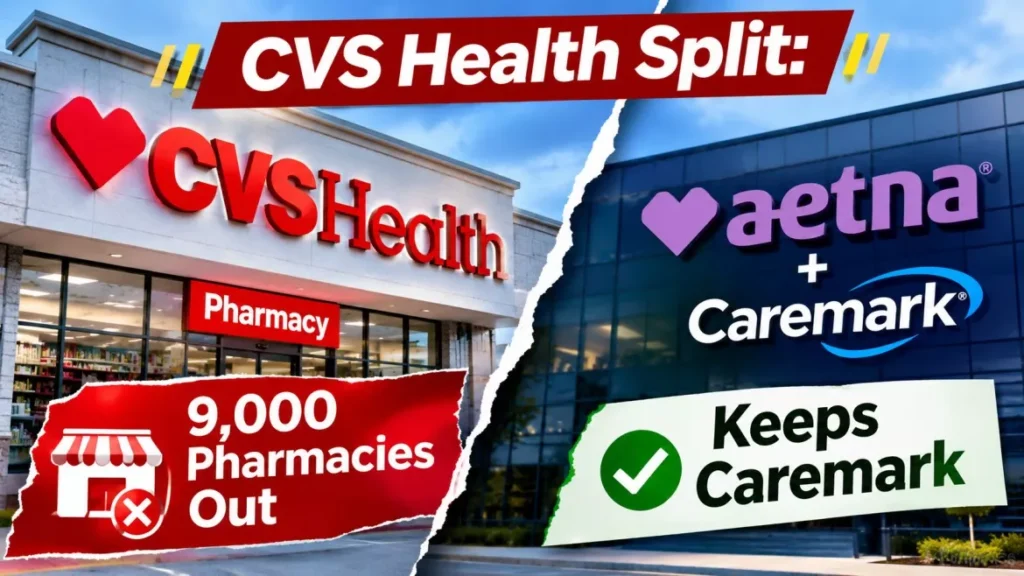

CVS Health will break into two publicly traded companies, separating its roughly 9,000 United States pharmacies from its Aetna insurance and Caremark drug-benefits businesses. The CVS Health split was announced on 4 November 2026 and is expected to complete in the first half of 2028. Aetna and Caremark stay together.
What CVS Health Announced on 4 November
CVS Health, the largest pharmacy and health-benefits company in the United States, said it intends to break itself into two independent, publicly traded businesses. Shareholders would end up owning stock in both.
In a Form 8-K filed with the Securities and Exchange Commission on 4 November 2026, the company described a transaction “intended to be tax-free to the Company and its shareholders for U.S. federal income tax purposes.” A tax-free separation means shareholders are not taxed on the new shares they receive at the time of the split.
One company keeps the insurance and drug-benefits side of the business. The other takes the drugstores. The announcement landed alongside third-quarter results and a raised full-year forecast, and CVS shares still fell about 12% in midday trading that day, according to CNN and CNBC.
Which Businesses Go to Each Company
The division is along a single line: anything that pays for or manages care stays in one company, and anything that dispenses or delivers it in a store moves to the other. The one exception is mail-order pharmacy, which follows the retail business.
| Business | Which company it goes to |
|---|---|
| Aetna health insurance | Healthcare solutions company |
| CVS Caremark (pharmacy benefit manager) | Healthcare solutions company |
| CVS Specialty | Healthcare solutions company |
| Oak Street Health (primary care clinics) | Healthcare solutions company |
| Signify Health (in-home health visits) | Healthcare solutions company |
| About 9,000 retail pharmacies | CVS Pharmacy |
| Mail-order pharmacy | CVS Pharmacy |
| MinuteClinic, including virtual care | CVS Pharmacy |
| Health100 technology services | CVS Pharmacy |
A pharmacy benefit manager, or PBM, is the middleman a health plan hires to decide which drugs it covers, what it pays pharmacies for them, and which pharmacies a patient may use. Caremark is the largest in the United States, and CVS Health says it handles drug benefits for approximately 87 million plan members.
The retail company will be called CVS Pharmacy. The other one has no permanent name yet: CVS Health says it “will be referred to as CVS Health” for the time being. The company describes the retail side as holding more than 1,000 walk-in and primary care medical clinics and employing nearly 30,000 pharmacists.
What Changes for Pharmacy Customers and Aetna Members
Nothing changes now. CVS Health states in its announcement that “Customers, patients and clients will continue to receive their medicine, care, benefits and services, uninterrupted,” and says it will keep operating and competing as it does today until the separation is complete.
Because Aetna and Caremark land in the same company, the arrangement most people encounter does not come apart. An employer that buys Aetna medical cover with Caremark drug cover attached still deals with one company, and a prescription steered to a CVS store is still covered under the same terms it is covered under today.
No store closures were announced as part of the plan. That is confirmed by CNN, NBC News and The American Journal of Managed Care, all of which reported that the company named none.
Two cautions belong here. First, the company’s statement is a stated expectation about a transaction that has not happened, not a guarantee about how two separated companies will deal with each other afterwards. Second, plan terms are set by individual plan documents, not by corporate structure, and they vary by employer, by state and by plan year. The authoritative source for any particular plan is that plan’s own member materials and the notices Aetna or Caremark send to the people enrolled in it.
As of 5 November 2026, the separation is an announced intention rather than a completed transaction. CVS Health says it still requires final approval from its board of directors, an effective Form 10 registration statement filed with the SEC, and customary confirmation of the separation’s tax-free treatment. A Form 10 is the registration document a company being spun off files before its shares can trade on their own.
The Third-Quarter Results That Came With It
CVS Health published third-quarter results the same morning. Total revenues were $108.4 billion for the three months to 30 September 2026, up 5.4% from $102.9 billion a year earlier. Adjusted earnings were $2.09 a share, against $1.60 in the same quarter of 2025.
On a reported basis the swing is larger: diluted earnings of $1.68 a share, compared with a loss of $3.13 a year earlier, when the company wrote off $5.7 billion of goodwill in its Health Care Delivery unit. Goodwill is the premium a buyer pays above the value of an acquired business’s assets, and writing it off is an accounting charge rather than a cash cost.
The company raised its full-year 2026 guidance on the same day:
- Adjusted earnings per share: at least $8.20, up from a range of $7.90 to $8.10.
- Reported diluted earnings per share: at least $6.98, up from a range of $6.84 to $7.04.
- Cash flow from operations: at least $15.5 billion, up from at least $11.5 billion.
- Total revenues: at least $420.0 billion.
Segment figures show why the insurance side is the stronger half. Health Care Benefits, which contains Aetna, lifted adjusted operating income to $912 million from $314 million, and its medical benefit ratio improved to 91.3% from 92.8%. That ratio is the share of premium income paid out in medical claims, so a lower number means more premium left over. Health Services, which contains Caremark, earned $2,106 million on revenue of $53,964 million. Pharmacy and Consumer Wellness, the drugstores, earned $1,635 million on revenue of $35,498 million, with revenue down 2.0%.
One number cuts against the insurance story. Aetna’s medical membership was 26.1 million at 30 September 2026, down from 26.7 million a year earlier, so the margin improvement came with fewer members rather than more. The 37 million figure CVS Health cites for people served by its insurance products counts a wider set of products than medical cover alone. Rival UnitedHealth also reported falling membership alongside a third-quarter beat in October.
Why CVS Is Unwinding the 2018 Aetna Deal
The split reverses the strategy CVS bought into eight years ago. CVS completed its acquisition of Aetna on 28 November 2018; its 2018 annual report puts the total consideration transferred at $69.77 billion, and the figure reaches roughly $78 billion once Aetna’s assumed debt is counted. The Department of Justice cleared the deal only on condition that Aetna sell its standalone Medicare Part D prescription drug plans.
The argument then was that owning the insurer, the PBM and the drugstores together would let CVS manage a patient’s care end to end. The argument now is that the three businesses are worth more apart. Chief executive David Joyner, who took the job in October 2024, said the company is splitting “out of strength,” and that the benefits of integration would be “preserved in commercial agreements between the two organizations,” adding: “we don’t need the integration of an operating structure.”
Pressure from state legislatures runs underneath it. Arkansas passed Act 624 in 2025, which would have barred pharmacy benefit managers from owning or operating retail pharmacies in the state from 1 January 2026. CVS Caremark and Express Scripts sued in federal court in Little Rock, and on 28 July 2025 US District Judge Brian Miller granted a preliminary injunction. The law has not taken effect and the case has not been decided. CVS argued it would otherwise have had to close 23 Arkansas locations.
Michael Cherny of Leerink Partners said the separation may be aimed “to avoid what has been relentless state legislative scrutiny,” and pointed to a “never-ending litany of state lawsuits.” Julie Utterback of Morningstar said “improving financial results probably helped with the timing of the move.”
What Is Still Undecided
More is unsettled than settled. The announcement names two chief executives and almost nothing else.
- The healthcare company’s name: it carries the CVS Health name on an interim basis only.
- Most of the leadership and both boards: David Joyner becomes chairman and chief executive of the healthcare solutions company and Prem Shah, currently group president, becomes chief executive of CVS Pharmacy; further appointments and board members are to be announced later.
- The commercial agreements: the contracts meant to replace common ownership have no published terms. Joyner told Managed Healthcare Executive that the work would take 15 to 18 months and described Health100 as the “connective tissue” between the two.
- Whether it happens at all: board approval, the Form 10 and the tax confirmation are all outstanding.
- The store estate: no closures were announced, though Fox Business reports CVS has closed roughly 10% of its locations over the past five years.
How Analysts and Pharmacy Groups Responded
The sharpest analyst question is about Aetna’s Medicare Advantage star ratings. Ben Hendrix of RBC Capital Markets asked how the split would affect them, because retail pharmacists help keep Aetna members engaged and the ratings determine bonus payments to the insurer. Star ratings are the quality scores the Centers for Medicare and Medicaid Services, the United States agency that runs Medicare, assigns to each plan; higher scores earn extra federal money. Readus247 covered the same mechanism in the 2027 Medicare Advantage plan changes.
Brian Tanquilut of Jefferies noted the insurance and PBM businesses are growing faster than retail pharmacy, and that “back then, the idea of retail standing alone was unthinkable.” Cherny said the retail business has been gaining share with gross margins stabilising, but questioned whether contracts between two separate companies can hold the same advantages as common ownership.
Independent pharmacy groups were sceptical that the structure changes behaviour. B. Douglas Hoey of the National Community Pharmacists Association called it “potentially encouraging news” but said that because the same shareholders will own both companies, the incentives for “suppressing competition, patient steering and formulary manipulation” may remain. A formulary is the list of drugs a plan agrees to cover. Hoey added: “They should behave like a regular pharmacy, but we’ll see how that goes.”
Joseph M. Shields of Transparency Rising said the split shows vertical integration is “not working.” Anthony J. Loiacono of Judi Health argued that keeping CVS Specialty with Caremark and Aetna means the healthcare company still profits from drug spending, which he called a conflict of interest. The split does not separate the PBM from the insurer, which is the pairing most state bills have targeted. For the drugstore company, the comparison that hangs over it is Rite Aid, which closed its last stores in 2025.
Frequently Asked Questions
When Will the CVS Health Split Happen?
CVS Health expects to complete the separation in the first half of 2028. It announced the plan on 4 November 2026, so roughly 18 months separate the announcement from the earliest expected completion.
Does the CVS Health Split Change My Aetna Plan or My Prescriptions?
Not at present. CVS Health says customers, patients and clients will keep receiving their medicine, care, benefits and services without interruption, and the company continues to operate as one business until the separation completes. Plan terms are set by each plan’s own documents, which vary by employer, state and plan year.
Which Company Will Caremark Belong To?
Caremark stays with Aetna in the healthcare solutions company, alongside CVS Specialty, Oak Street Health and Signify Health. The split does not separate the pharmacy benefit manager from the insurer.
Will CVS Pharmacies Close Because of the Split?
CVS Health announced no store closures as part of the plan. Analysts have raised the possibility that a standalone retail company would review weaker locations more closely, but the company has not said it will close any.
Is the CVS Health Split Certain to Go Ahead?
No. The company describes it as an intention subject to conditions that include final approval by its board of directors, an effective Form 10 registration statement filed with the SEC, and confirmation of the separation’s tax-free treatment. None of those had been completed as of 5 November 2026.