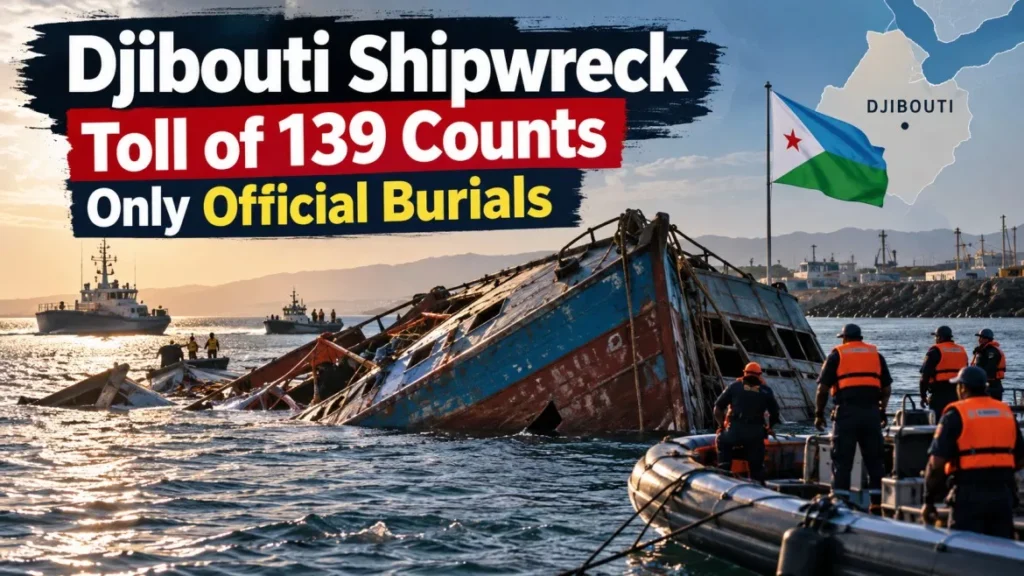

The Djibouti shipwreck death toll of 139 counts only bodies buried by Djibouti’s authorities, the head of the UN migration agency’s mission in the country has said. A boat carrying 305 people capsized on the night of 8 to 9 October 2026 off Obock, bound for Yemen. At least 84 remain missing.
The Crossing and the Capsizing
Migrants boarded the boat on the evening of Thursday 8 October 2026 at a point on Djibouti’s Red Sea coast, intending to cross the Bab el-Mandeb Strait to Yemen. The International Organization for Migration, the United Nations agency responsible for migration, says the vessel went down near Guehere, north of the port town of Obock, during the night of 8 to 9 October.
It sank close to shore, soon after departure. Alexandre Coissac, IOM’s Chief of Mission in Djibouti, told the Associated Press the boat went down “mainly because it was overcrowded”. Coissac said local authorities were “overwhelmed with all the bodies that kept coming at once towards the shore”.
IOM first reported 109 dead and more than 116 missing in a statement issued from Geneva and Obock on 11 October 2026. Later the same day it raised the toll to 139 after 30 more bodies were recovered, and put the number missing at 84.
The Numbers as IOM Reports Them
All figures below are IOM’s, as published on 11 October 2026. The agency describes the dead as “at least” 139 and has said the toll could rise.
| Figure | Count | Source and date |
|---|---|---|
| People on board | 305 | IOM, 11 October 2026 |
| Confirmed dead | At least 139 | IOM, 11 October 2026 (revised up from 109 the same day) |
| Missing | At least 84 | IOM, 11 October 2026 |
| Survivors | More than 80, all Ethiopian nationals | IOM, 11 October 2026 |
| Survivors receiving IOM assistance at Obock | 64 | IOM, 11 October 2026 |
| Children among the first 109 recovered | 15 (9 girls, 6 boys) | IOM, 11 October 2026 |
In the first 109 bodies recovered, IOM recorded 52 men, 42 women and 15 children. It has not published a demographic breakdown of the further 30 recovered later. As of 13 October 2026, the 11 October statement remains the most recent IOM figure set on this shipwreck.
Why 139 Is a Floor, Not a Total
The three published numbers appear to account for everyone on board: 139 dead, 84 missing and more than 80 survivors sum to roughly 305. The arithmetic is misleading, because the categories overlap.
Coissac told the Associated Press that the official count of 139 includes only those bodies buried by Djibouti’s authorities. Other bodies were buried by the migrants themselves, and those are not added to the official figure until the authorities can verify them. People already buried in that way are therefore still being carried in the “missing” column.
Coissac described those burials in stark terms. “What is terrible is that they were buried with no names, in a common grave, like in a war situation,” he said. He added that the dead in the common grave had no names recorded, and that “they all have a mother, a father, and we may never learn what happened”.
Two consequences follow for anyone reading the figures. The dead are undercounted rather than overcounted, and the division between “dead” and “missing” reflects a verification process on the ground, not a settled finding about who survived.
Who Was on Board
Every one of the more than 80 survivors is an Ethiopian national, according to IOM. The agency has not published the nationalities of the dead or the missing, and no official list of names has been released.
IOM says it is assisting 64 survivors at its Migrant Response Centre in Obock with healthcare, psychosocial support, protection, temporary shelter, food and help re-establishing contact with family. Survivors were treated after swallowing seawater. Coissac said they were in shock and difficult to interview; some learned that relatives had died, while others were given phones to tell families at home that they had lived.
The Eastern Route, and Why Crossings Continue
The Eastern Route runs from the Horn of Africa across the Gulf of Aden and the Bab el-Mandeb Strait to the Arabian Peninsula, used mainly by Ethiopian migrants heading for work in Gulf states. IOM says tens of thousands of people transit Djibouti on it each year.
- Deaths in 2025: More than 900 migrants died or went missing on the route, according to IOM’s Missing Migrants Project, while the number of people making the journey rose 18%.
- March 2026: A shipwreck off Djibouti left nine people dead and 45 missing, IOM reported at the time.
- Arrivals since 10 September 2026: IOM’s Displacement Tracking Matrix recorded more than 20,000 incoming movements into Djibouti from Ethiopia.
- Movement the other way: More than 3,700 refugees arrived in Djibouti from Yemen over roughly the same period, and 539 Ethiopian migrants returned from Yemen.
- Stranded in Djibouti: More than 3,000 migrants were observed stranded along routes inside Djibouti between 20 and 30 September 2026, often without access to basic services.
The route now carries traffic in both directions. Fighting in Yemen between the internationally recognised government, which is backed by Saudi Arabia, and the Houthi movement has escalated, and the Associated Press reports that at least 2,000 Yemenis have received assistance in Djibouti in recent weeks. The same conflict has reached further north: a missile strike on Riyadh’s King Khalid International Airport halted flights earlier this month. Migrants are still crossing towards Yemen despite it, a pattern IOM had already flagged in its warning about displacement from Yemen and an underfunded aid response.
Amy Pope, IOM’s Director General, linked the deaths to the absence of alternatives. “No one gets into a boat like that unless they believe there is no other safe way,” she said, adding that “safe and legal pathways save lives” and that “we cannot keep treating these deaths as normal”.
What Is Happening Now
Djiboutian authorities are continuing search and recovery operations for the people still unaccounted for, and are providing medical care and arranging burials. IOM has appealed for more donor support for search and rescue and for life-saving assistance, and for expanded safe migration pathways.
Jose Barahona, the UN Resident Coordinator in Djibouti, said he was “deeply saddened” by the loss of at least 139 lives and added: “We express our solidarity and welcome the ongoing search and rescue efforts.”
No cause has been formally determined by any investigating authority. Overcrowding is Coissac’s assessment, given to the Associated Press; no inquiry findings, charges or arrests connected to the voyage had been announced as of 13 October 2026.
Frequently Asked Questions
How Many People Died in the Djibouti Shipwreck?
IOM reported at least 139 dead on 11 October 2026, revised up from 109 earlier the same day. The agency has said the figure could rise, and it counts only bodies buried by Djibouti’s authorities.
Why Might the Real Death Toll Be Higher?
Alexandre Coissac, IOM’s Chief of Mission in Djibouti, told the Associated Press that some bodies were buried by the migrants themselves and are not added to the official count until authorities verify them. Those people remain listed as missing.
Where and When Did the Boat Sink?
Near Guehere, north of Obock in Djibouti, during the night of 8 to 9 October 2026. The boat had left the evening of 8 October for Yemen and sank close to shore shortly after departure.
Who Were the Survivors?
More than 80 people survived, all Ethiopian nationals according to IOM. The agency is assisting 64 of them at its Migrant Response Centre in Obock. The nationalities of the dead and missing have not been published.
What Is the Eastern Route?
It is the migration corridor from the Horn of Africa across the Bab el-Mandeb Strait to the Arabian Peninsula, used mainly by Ethiopians seeking work in Gulf countries. IOM’s Missing Migrants Project recorded more than 900 deaths and disappearances on it in 2025.