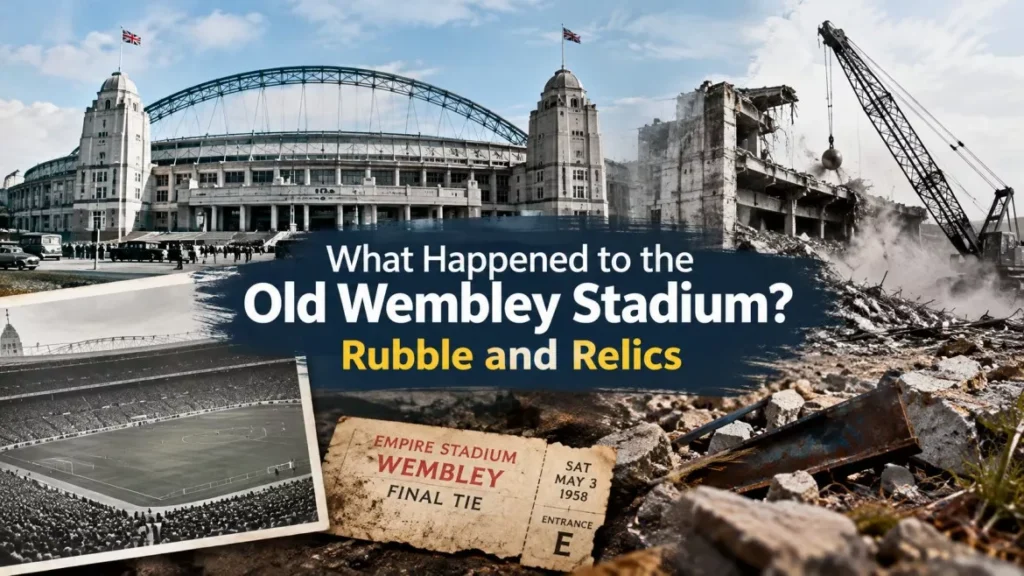

The old Wembley Stadium was demolished between December 2002 and 2003, and most of it never left the site. Contractors crushed the rubble on the spot and laid it as pile mats beneath the new stadium’s foundations. Surplus spoil from the wider works went to four man-made hills in west London.
When Did the Old Wembley Stadium Close?
The stadium staged its last event on 7 October 2000, when England lost 1-0 to Germany in a World Cup qualifier.
Dietmar Hamann scored the only goal from a free kick in the 14th minute, the final goal in the ground’s history, in front of 76,377 spectators. Kevin Keegan resigned as England manager immediately afterwards, before he had left the building. The last club fixture had been that year’s Charity Shield, which Chelsea won 2-0 against Manchester United.
It had opened as the Empire Stadium on 28 April 1923, in time for that year’s FA Cup final, which Bolton Wanderers won 2-0 against West Ham United. Sir John William Simpson and Maxwell Ayrton designed it, with Sir Owen Williams as engineer. Its original standing capacity of 125,000 had fallen to 82,000 seats by the time it closed.
What Happened to the Twin Towers?
The Twin Towers were pulled down in February 2003, despite holding Grade II listed status since 1976.
Sir Robert McAlpine’s firm had built them in 1922 and 1923, and they stood about 126 feet, or 38 metres, high. Preliminary work began in December 2002 with the removal of the concrete crowns from the flagpoles. A Liebherr 974 crawler excavator, nicknamed Goliath, brought down the rest.
Their survival had looked likely for years. English Heritage expected them to be preserved, and Brent Council said it would not approve a new stadium without them, granting planning permission on the understanding that they would be kept. The final designs dropped them anyway, and English Heritage withdrew its objections.
Moving them was examined and rejected. A proposal in early 2000 to relocate the towers to Widnes as part of a national rugby league museum came to nothing, and engineers judged relocation impractical because the ferro-concrete would crumble if disturbed.
Where Did the Rubble Actually Go?
Most of it stayed on the Wembley site and was built into the stadium that replaced it.
Demolition contractor McGee, which was on site from 2002 until 2004, reprocessed the rubble where possible and laid it as pile mats. Those mats later formed part of the foundations of the new Wembley. The stadium demolition itself took roughly six months.
That detail is routinely left out of the popular version of the story, which has the old ground carted wholesale across London to become a park. The park is real, but it was fed by surplus spoil from the wider Wembley works and from several other London projects, not by the stadium alone.
What Is Northala Fields?
Northala Fields is a public park in Northolt, in the London Borough of Ealing, built from construction spoil and opened to the public in 2008.
Four conical earth mounds run along its edge beside the A40 Western Avenue, screening the park from the road. The tallest carries a spiral path to a viewpoint. Artist Peter Fink and architect Igor Marko, partners in FoRM Associates, designed it for Ealing council after winning a competition, and the scheme was completed in 2007.
The funding model is the unusual part. Roughly 1.5 million cubic metres of clean construction spoil was deposited on the site under controlled conditions, and the fees charged for accepting it generated about 6 million pounds of income. That paid for a park costing around 5.5 million pounds at no cost to ratepayers, and the same spoil became the mounds. The material came from a pool of London projects including the old Wembley works, Heathrow Terminal 5 and White City.
The park took three honours in 2009: it won the Landscape Institute award for best design over five hectares, won an HW Landscape Amenity award for community involvement, and was a finalist for a World Architecture Award.
What Survived of the Old Stadium?
Four things outlasted the demolition in identifiable form.
- The top of one tower: Installed as a memorial on the St Raphael’s Estate in Brent, though published accounts place the surviving piece at three different Brent locations.
- The flagpoles: Taken to the Fawley Hill estate of the late Sir William McAlpine, whose family firm had built the towers.
- About 40,000 red plastic seats: Dismantled by hand and sent to a hazardous waste facility, because the pigment in the plastic was deemed contaminated.
- Watkin’s Tower foundations: Uncovered during the demolition work, the buried remains of an abandoned Victorian tower intended to outdo the Eiffel Tower.
The replacement stadium opened in 2007 with a capacity of 90,000 and an arch in place of the towers. Published accounts put its final cost close to 800 million pounds.
Where It All Stands in October 2026
As of 12 October 2026, both halves of the answer are still in place and open to the public.
Northala Fields remains an Ealing council park, and its mounds are the largest surviving physical trace of the demolition anywhere off the Wembley site. The new stadium continues to operate on the footprint of the old one, with the reprocessed rubble underneath it.
No further relic of the Twin Towers has been publicly recovered or relocated since the demolition was completed in 2003. The one point still genuinely unsettled is where the preserved tower section now sits: accounts published since name the St Raphael’s Estate, Brent River Park and Brent Civic Centre, and no authoritative record resolves it.
Frequently Asked Questions
When Was the Old Wembley Stadium Demolished?
Demolition began in December 2002 and finished in 2003. The Twin Towers came down in February 2003.
Why Were the Twin Towers Not Saved?
They were Grade II listed and planning permission had been granted on the understanding they would be retained, but the final stadium designs excluded them and English Heritage withdrew its objections. Engineers also judged relocation impractical.
Which Park Was Built From Wembley Rubble?
Northala Fields in Northolt, west London. Its four mounds were raised from construction spoil that included material from the old Wembley works, alongside spoil from Heathrow Terminal 5 and White City.
What Was the Last Match at the Old Wembley Stadium?
England against Germany on 7 October 2000, a 1-0 defeat decided by a Dietmar Hamann free kick. A crowd of 76,377 attended.
Is Any of the Old Wembley Stadium Still Standing?
No part of the structure stands. Its crushed rubble lies within the foundations of the current stadium, and the top of one tower, the flagpoles and the mounds at Northala Fields survive away from it.