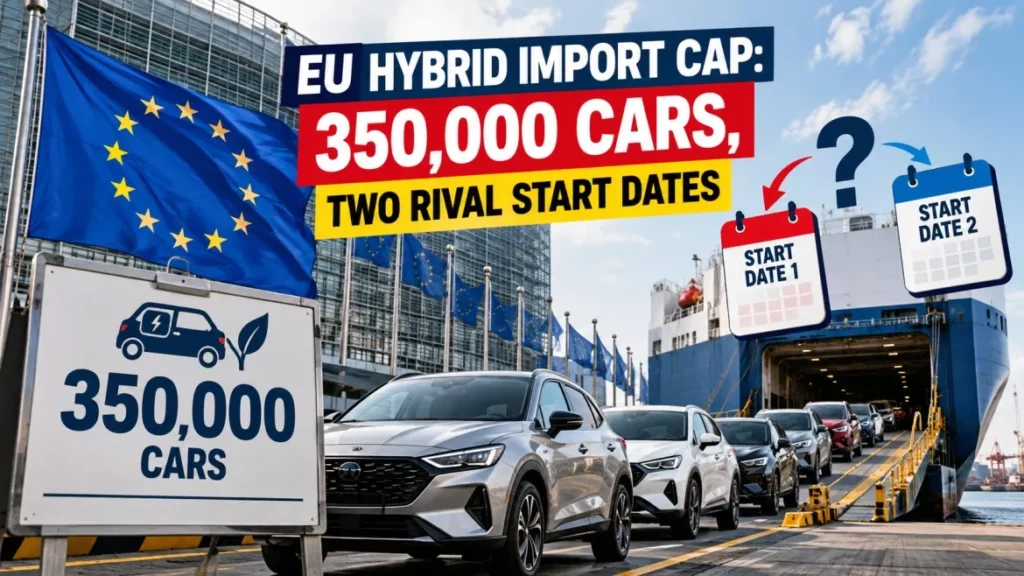

The EU hybrid import cap on China-made cars is 350,000 vehicles a year, plug-in hybrids included, two senior EU officials said on 12 October 2026. Cars Chinese companies build in Europe are excluded. Neither Brussels nor Beijing has published the agreement, and officials have named two different start dates.
What the EU Hybrid Import Cap Covers
The EU hybrid import cap applies to hybrid and plug-in hybrid passenger cars manufactured in China, whatever badge they carry. A plug-in hybrid, or PHEV, is a car with both a petrol engine and a battery that can be charged from the mains and driven for a limited distance on electricity alone.
Two senior EU officials told the Associated Press on Monday 12 October that customs authorities across the 27 member states would coordinate monitoring and stop shipments once the annual quota was filled. The limit does not apply to cars built in Europe by Chinese manufacturers, which is the route several Chinese brands have been taking as tariffs have risen.
The quota sits on top of duties the EU already charges. Since 2024 the bloc has applied anti-subsidy duties of 7.8% to 35.3% on China-built battery electric cars, on top of the standard 10% car tariff, for a maximum of 45.3%. Those duties cover fully electric cars, not hybrids, which is why hybrids became the faster-growing import.
Where the 350,000 Number Came From
The figure has not been published by either government. It reached the public through two wire services on 12 October, each citing EU officials who were not named.
The negotiation itself was announced three days earlier. Maroš Šefčovič, the European Commissioner for Trade and Economic Security, held two days of talks in Beijing with Chinese Commerce Minister Wang Wentao on 8 and 9 October, and said afterwards that the two sides had reached a “shared understanding” that could more than halve Chinese hybrid and plug-in hybrid exports to the bloc. He called it “a first step” and did not give a volume, a timetable or a mechanism.
China’s Ministry of Commerce issued its own account the same week and also named no quota.
December 2026 or 2027? The Two Accounts Compared
The two wire reports agree on the number and disagree on when it starts and how long it lasts. Both were published on 12 October 2026.
| Detail | Associated Press account | Agence France-Presse account |
|---|---|---|
| Annual quota | 350,000 China-made hybrids | 350,000 China-made hybrids |
| Start | As early as December, per one official | From 2027 |
| Duration | Not stated | Four years |
| Annual growth | Not stated | Rises 6% a year from the second year |
| Scope | Hybrids and plug-in hybrids; excludes Chinese-brand cars built in Europe | Hybrids and plug-in hybrids |
| Enforcement | Member-state customs coordinate and halt shipments at the quota | The EU’s safeguard measure |
| Sourcing | Two senior EU officials, anonymous under Commission policy | Unnamed EU officials |
As of 13 October 2026, neither the European Commission nor China’s Ministry of Commerce has published a legal text, an implementing regulation or a start date for the arrangement, so the gap between the two accounts has not been resolved by either side.
Beijing Calls It an Upward Arrangement, Not a Cap
China’s Ministry of Commerce describes the same deal as a licence to export more, not less. A ministry spokesperson set out three principles on 12 October, in a question-and-answer statement carried by the state news agency Xinhua.
- Respect for facts: Citing Eurostat, the EU’s statistics agency, the spokesperson said the bloc imported 107,000 Chinese hybrids in 2024 and 302,000 in 2025, and said the two sides had agreed an “upward arrangement” building on the 2025 level.
- Non-discrimination: No measure will single out Chinese products or treat Chinese firms unfairly, and China’s quota “will not be lower than any other EU import source”.
- Compliance: The arrangement should follow World Trade Organization rules, and China retains every right, including taking a dispute to the WTO and seeking trade compensation.
The two descriptions are not easily reconciled. Brussels presents a ceiling that cuts shipments; Beijing presents a floor that grows from 302,000. A quota of 350,000 a year would be higher than the 2025 import total and lower than the up to 800,000 units one EU official estimated for 2026. Which framing is accurate depends on the baseline chosen, and no published text sets one.
In September 2025 the ministry had taken a harder line, saying that voluntary export restraints of this kind would seriously violate WTO rules.
Why Chinese Carmakers Lean So Heavily on Exports
The quota lands on an industry that is now selling abroad because it cannot sell at home. The China Association of Automobile Manufacturers, the country’s main industry body, released September figures on 12 October.
| Measure | September 2026 | Change on a year earlier |
|---|---|---|
| Passenger car exports | About 919,000 units | Up 64% |
| Domestic passenger car sales | More than 1.6 million units | Down 27% |
| Exports, January to September | More than 7.1 million units | Up more than 70% |
Other outlets published slightly different September figures, drawn from the separate monthly series of the China Passenger Car Association; the numbers above are the manufacturers’ association’s, as reported by the Associated Press on 12 October 2026.
Europe is a small slice of that export volume but a fast-growing one. Eurostat recorded 50,408 plug-in hybrids imported from China in July 2026, up 163.2% on July 2025, according to the figure Beijing’s commerce ministry cited.
Analysts quoted by the Associated Press expect the response to be local assembly rather than fewer cars. Ming Lee, head of Greater China automotive and industrial research at BofA Global Research, said of Chinese manufacturers that “more and more volume will be made locally”. Because the quota excludes cars built in Europe, a factory inside the bloc is a way around it.
What Is Still Undecided
The arrangement is not yet policy, and several pieces of it are missing.
- Political sign-off: Šefčovič said the package would be put to EU leaders for assessment. The European Council meets in Brussels on 15 and 16 October 2026.
- The legal instrument: AFP’s sources point to the EU’s safeguard mechanism, a trade tool that limits imports of a product; the Commission has not confirmed which instrument it will use.
- The start date and the term: December 2026 and 2027 have both been reported, and only one account mentions a four-year term with 6% annual growth.
- What counts toward the quota: No published rule says how shipments already at sea, or cars assembled partly in China, would be treated.
- Beijing’s recourse: China has reserved the right to bring a WTO dispute and seek compensation, which it would not need to do if it regarded the measure as settled and compliant.
The two sides have scheduled a ministerial video conference for January 2027 and a third in-person consultation for March 2027, which means the terms can still move.
Frequently Asked Questions
How Many Chinese Hybrids Can the EU Import Under the Cap?
Two senior EU officials put the figure at 350,000 China-made hybrid cars a year, including plug-in hybrids. Neither the European Commission nor China’s Ministry of Commerce has published that number.
When Does the EU Hybrid Import Cap Start?
There is no confirmed start date. One EU official told the Associated Press it could begin as early as December 2026, while Agence France-Presse reported that it applies from 2027 for four years.
Does the Cap Include Plug-In Hybrids?
Yes. Both wire accounts of the arrangement say plug-in hybrids are counted alongside conventional hybrids.
Are Chinese Cars Built in Europe Covered?
No. The limit applies to cars manufactured in China, and cars that Chinese companies build inside Europe fall outside it, according to the EU officials who described the quota.
How Does This Relate to the EU Tariffs on Chinese Electric Cars?
It is separate. The 2024 anti-subsidy duties of 7.8% to 35.3%, plus the standard 10% tariff, apply to China-built battery electric cars. Hybrids were not covered by those duties, and the new arrangement addresses them by volume rather than by price.