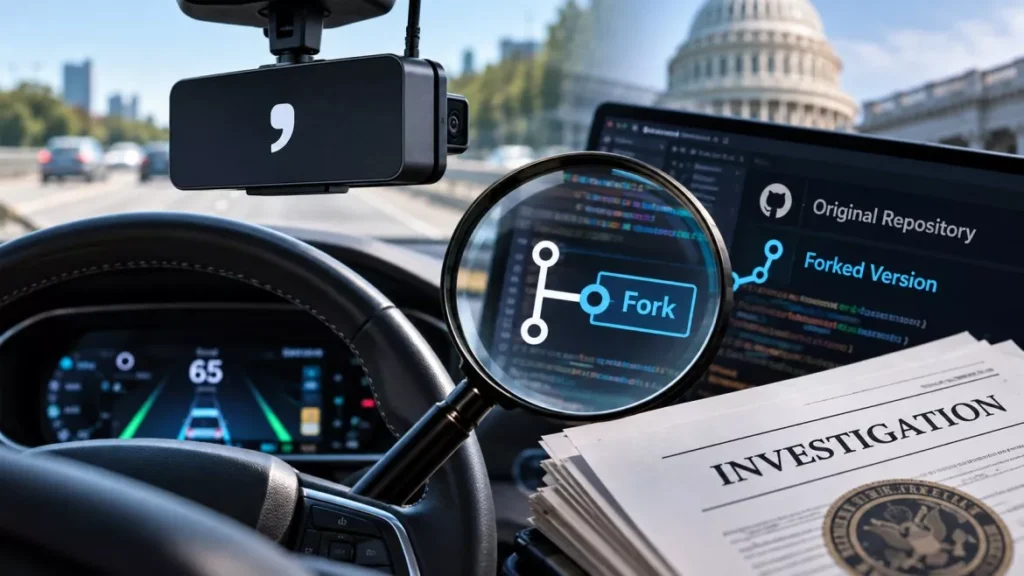

A federal Comma AI investigation is now open, targeting the aftermarket driver-assistance devices built by George Hotz’s company. NHTSA’s Office of Defects Investigation opened Preliminary Evaluation PE26007 on 21 September 2026, covering five crashes, three deaths and as many as 11 injuries. At least one crash ran third-party software.
What NHTSA Is Investigating
The investigation is a Preliminary Evaluation, the first formal tier of a federal defect inquiry. Its stated concern is narrow and specific: vehicles running Comma AI devices striking stopped or slowly moving vehicles in the same travel lane.
| Item | Detail |
|---|---|
| Case number | PE26007, Preliminary Evaluation |
| Opened | 21 September 2026 |
| Subject | Comma AI devices running openpilot |
| Crashes | 5 |
| Deaths | 3, across 2 crashes |
| Injuries | Up to 11 across 4 crashes, some serious |
| Regulator’s focus | Failure to detect slow or stopped in-lane vehicles |
The Office of Defects Investigation has said it will examine three things: how the system performed, what safeguards exist to keep drivers engaged, and whether modified versions of the software were running in any of the crashes. That third item is what separates this case from every other driver-assistance probe the agency has opened.
The Crash That Put a Software Fork in the File
The clearest of the two fatal crashes happened on Interstate 10 in Ascension Parish, Louisiana. According to the Louisiana State Police, just before 8.30pm on 1 February 2026 a 2022 Toyota RAV4 struck a 2023 Chevrolet Tahoe near milepost 179 — a fully marked Gonzales Police Department unit that was “unoccupied and positioned in the left lane with emergency lights activated while officers investigated a separate crash”. Two rear-seat passengers died. The driver and front-seat passenger were hospitalised with moderate injuries.
The state police account makes no mention of driver-assistance software. The software link comes from the federal file: TechCrunch, reporting on the ODI documents, says the RAV4 was running FrogPilot — not openpilot itself, but a third-party fork of it.
A fork, in software terms, is a copy of an open-source project that someone outside the original team has modified and released under its own name. Comma AI publishes openpilot’s source code openly, which is central to its appeal and means anyone can alter how the system behaves, including how cautious it is. FrogPilot is one such community build. Comma did not write it and does not ship it.
That creates a question the agency has flagged but not answered: if the code driving the car was modified by a third party, whose defect is it? Federal law makes equipment manufacturers responsible for recalling defective equipment they sold. It is less settled how that applies when the hardware is the company’s and the software running on it is not.
How Openpilot Works, and What Comma Tells Drivers
Comma AI, founded in 2015 by George Hotz, sells a dashboard-mounted device that plugs into a car’s existing wiring, typically in about 15 minutes, and takes over two functions: adaptive cruise control, which manages speed, and automated lane centring, which manages steering. It works across hundreds of mainstream car models and is not sold or endorsed by any carmaker.
This is a driver-assistance system, not a self-driving one. The driver remains legally and practically responsible for the vehicle. Comma’s own materials say users must remain “alert, pay attention, and be ready to take over at all times”.
The company has also acknowledged the specific weakness now under investigation. TechCrunch reports that Comma’s website states openpilot’s performance “can be affected by vehicles in the same lane that are not moving”. Stationary objects are a long-standing difficulty for radar and camera systems of this class across the industry, because a system tuned to brake for everything that is not moving would brake constantly for signs, bridges and parked cars.
Comma AI has not commented publicly on the investigation. TechCrunch said the company could not be reached and that Hotz did not respond to requests for comment.
What Happens Next, and How Long It Takes
A Preliminary Evaluation is an information-gathering stage, not a finding of fault, and it does not stop anyone selling or using anything. NHTSA aims to close this tier within about eight months, which points to roughly mid-2027 for a decision on whether to go further.
- Preliminary Evaluation: The current stage. The agency requests records from the company, interviews complainants and decides whether the evidence supports a defect theory. Target: about eight months.
- Engineering Analysis: The escalation, if warranted. It adds testing, comparison against rival systems and deeper technical work. Target: about 18 months.
- Recall or closure: The agency can seek a voluntary recall, order one, or close the case without action.
As of 24 September 2026, NHTSA has not requested a recall, has not ordered Comma AI to stop selling its devices, and has set no deadline for findings. Comma AI has issued no statement. The two fatal crashes remain under investigation, and the agency has not published which software build was running in the four non-fatal cases. Owners of the devices are not being asked to do anything; the practical advice is unchanged from what the company already says, which is to watch the road and be ready to brake. Readers following the wider picture may recall the separate NHTSA investigation into Tesla’s Cybercab opened earlier this month.
Frequently Asked Questions
What Triggered the Comma AI Investigation?
NHTSA’s Office of Defects Investigation recorded five crashes in which vehicles fitted with Comma AI devices appear to have failed to detect or respond to stopped or slow-moving vehicles in the same lane. Three people died and as many as 11 were injured.
Is Openpilot Being Recalled or Banned?
No. A Preliminary Evaluation gathers evidence and carries no restriction. NHTSA has not requested a recall, ordered one, or halted sales, and it has given no date for a decision.
What Is FrogPilot and Why Does It Matter Here?
FrogPilot is a third-party modified version of openpilot, built by people outside Comma AI. Federal documents reported by TechCrunch place it in one of the fatal crashes, which raises the unresolved question of who is accountable for a defect in software the device maker did not write.
Does Openpilot Drive the Car by Itself?
No. It provides adaptive cruise control and automated lane centring. The driver stays responsible for the vehicle, and Comma tells users to stay alert and be ready to take over at all times.
How Long Will the Investigation Take?
NHTSA targets about eight months to complete a Preliminary Evaluation, which would place a decision around mid-2027. If it escalates to an Engineering Analysis, the agency’s target for that stage is about 18 months.