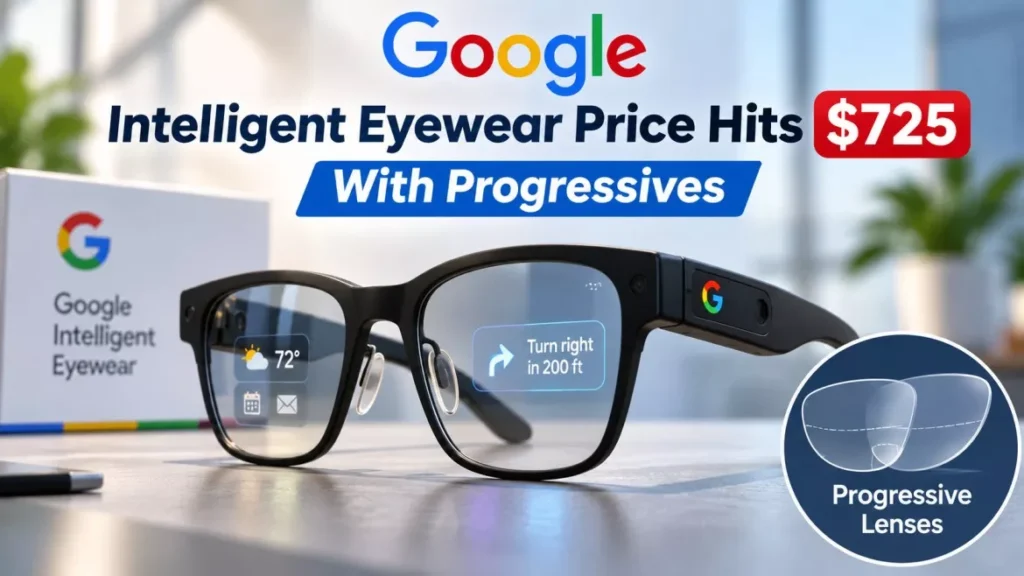

The Google Intelligent Eyewear price starts at $395 for Warby Parker frames and $449 for Gentle Monster, with preorders open since 12 November 2026. The glasses ship on 10 December in the United States and South Korea only. Progressive prescription lenses add $330 a pair.
What the $395 Price Actually Buys
That $395 covers a frame and a non-prescription lens, either clear or tinted. It does not include a prescription, and it is the lowest price in a 30-model lineup rather than a single ticket price.
Samsung Electronics engineered the glasses. Warby Parker, the New York eyewear retailer, and Gentle Monster, the South Korean eyewear brand, designed the frames. Google supplies Gemini, its AI assistant, and the Android XR software underneath.
| Collection | Designs | Starting price | Top price |
|---|---|---|---|
| Warby Parker | Three: Alden, Reid, Wren | $395 | Not published |
| Gentle Monster | Six | $449 | $489 |
Warby Parker offers each style as optical or sun, in Pine, Saddle and Jet Black. Gentle Monster’s six designs come in colours including dark red, pink, grey and yellow, with tinted, clear, blue or brown lenses. The Korea Times reported the full American lineup as 30 models, made up of 14 Warby Parker variants and 16 from Gentle Monster.
What Prescription Lenses Add to the Price
A buyer who needs a prescription pays between $100 and $330 more, which is the part of this launch that the $395 figure hides. Most people shopping for glasses need one.
The technology site 9to5Google itemised Warby Parker’s configurator for the Reid frame on 12 November. These are the add-on prices it recorded, and Warby Parker has not published a separate price list for the collection:
| Lens option (Warby Parker Reid) | Added cost | Running total from $395 |
|---|---|---|
| Single-vision prescription | $100 | $495 |
| Readers (magnification) | $100 | $495 |
| Anti-fatigue | $100 | $495 |
| Progressives (varifocals) | $330 | $725 |
| Light responsive (transitions) | $125 | $520 |
| Thinner lenses | $60 | $455 |
| Blue light filtering | $50 | $445 |
| Polarised | $50 | $445 |
| Anti-reflective coating | $35 | $430 |
Options stack, so a progressive lens with thinner glass and an anti-reflective coating passes $800. Gentle Monster’s upgrades are cheaper and fewer: 9to5Google listed a light-adaptive lens at $50, a clear or blue-filter lens with prescription at $100, and a light-adaptive prescription lens at $140, measured on the GGS001 01 style.
Google’s own announcement says prescriptions are available for most Gentle Monster frames and across a wider range at Warby Parker. Neither company has published what a prescription costs in a sun lens.
Where You Can Buy Them, and Which Brand
Only two countries get the glasses on 10 December, and they do not get the same product. The United States receives both collections; South Korea receives Gentle Monster alone.
- United States: All 30 models, through Warby Parker’s website and more than 360 of its stores, and through Gentle Monster’s own channels.
- South Korea: The 16 Gentle Monster variants only. The Korea Times reported Korean pricing starting at 650,000 won, about $445.
- Everywhere else: No release date. Google has not said whether Europe, the United Kingdom, India or Canada will get the glasses.
The restriction is enforced in software, not just in shipping. Google says the eyewear works only with a Google Account registered in the United States or South Korea, and the account holder must be 18 or older. Importing a pair does not get round that. Google has set regional limits on Gemini hardware and software before, including the Gemini CarPlay app whose daily brief stayed US-only.
As of 14 November 2026, preorders are open in those two countries, no pair has shipped, and Google has named no date for any other market.
Which Phones Work With Intelligent Eyewear
The glasses need a paired phone for most functions, and the supported list is narrow. Google’s preorder page sets these requirements:
- Google Pixel: Pixel 7 series and later, running the September 2026 Android 17 update or later.
- Samsung Galaxy: Galaxy S, S FE, Z Fold, Z Flip and Fold Ultra series, running One UI 9.0 or higher.
- iPhone: iPhone 13 Pro and later. Google’s product page lists iPhone 13 and later with at least 6GB of RAM, running iOS 26.6 or later, which amounts to the same set of handsets.
Three features do not reach iPhone at launch. Guided Vision, which gives conversational audio descriptions for people who are blind or have low vision, works only with compatible Android phones and may require a subscription; Google states it is not a medical device or a mobility aid. Aira Explorer, which streams the camera feed to a human interpreter, is also Android-only for now, as is Audible. Google has not said when or whether those three reach iOS.
What Gemini Does on the Glasses
There is no screen in the lens, so every answer arrives as audio. Gemini wakes on “Hey Gemini” or a tap on the frame.
- Visual questions: Asking about something in view, such as the story behind a street mural.
- Calendar and lists: Adding an event from a poster, adding items to a grocery list, and getting a reminder before the next meeting.
- Navigation: Google Maps turn-by-turn directions read aloud.
- Translation: Google Translate speech translation with automatic language detection across more than 70 languages.
- Audio: YouTube Music, Spotify and Apple Music, plus hands-free calls and messages.
Google says a version with a display in the lens will follow, and has given no date or price for it.
How the Hardware Compares With Ray-Ban Meta Gen 3
On paper the two products are close, and Google’s cheapest frame undercuts Meta’s by $54. Meta’s Ray-Ban Gen 3 went on sale on 23 September 2026 at $449 in the United States, €449 in the euro area and £409 in the United Kingdom.
| Specification | Google Intelligent Eyewear | Ray-Ban Meta Gen 3 |
|---|---|---|
| Starting US price | $395 (Warby Parker) | $449 |
| On sale | 10 December 2026 | 23 September 2026 |
| Camera | 12MP ultra-wide | 12MP |
| Video | Up to 3K, stabilised | Up to 3K at 30fps |
| Battery | Up to 9 hours | Up to 9 hours |
| Charging case | Up to 7 recharges | About 50 extra hours |
| Fast charge | 60% in about 30 minutes | 50% in 20 minutes |
| Display | None | None |
| Assistant | Gemini | Meta AI |
Google’s frames weigh around 41 grams and carry IPX4 water resistance, which covers splashes rather than immersion. Google’s announcement post lists the 12-megapixel ultra-wide camera, the nine-hour battery figure and the 41-gram weight, and notes that battery life varies with use and settings. Reviewers of Meta’s comparable glasses have reported four to five hours under heavy video and assistant use, so the nine-hour rating on either product should be read as a mixed-use estimate.
Both sit well below the display-equipped tier. Meta’s Ray-Ban Display costs $799 with its Neural Band wristband, and Snap’s Specs are priced at $2,195. The audio-only segment is filling up fast: Alibaba put the Qwen Glasses N1 on sale in China at about $450 in October.
What Google Says About the Camera and Privacy
Google is leading with privacy claims, which is a direct response to the main objection to camera glasses. Four of them are specific enough to check once the glasses ship.
- Face blurring: The glasses are designed to blur bystanders’ faces before Gemini processes what the camera sees.
- Data use: Camera visuals sent to Gemini are not saved in Gemini History, not used to train AI models, and not used to target ads.
- Recording indicator: An outward-facing light shows when photos or video are being captured, and the glasses are designed to stop recording if that light is covered or switched off.
- Hardware off switch: Every pair has a physical switch, and users control which apps reach the camera and microphone.
Google also says data is encrypted on the glasses and in transit, and that Gemini chats can be reviewed or deleted. None of this has been tested independently yet, because no reviewer has a shipping unit.
What Is Still Unconfirmed
Four things matter to buyers and are not settled. Google has published no release date, price or specification for the display model; no date or country list beyond the United States and South Korea; no prescription pricing for sun lenses; and no answer on whether Guided Vision, Aira Explorer and Audible will come to iPhone.
The lens add-on prices above come from one outlet’s reading of Warby Parker’s configurator rather than a published price list, so they may change before 10 December. The 650,000 won Korean starting price was reported by the Korea Times and has not appeared in Google’s own materials in dollars.
Frequently Asked Questions
How Much Does Google Intelligent Eyewear Cost?
Warby Parker frames start at $395 and Gentle Monster frames run from $449 to $489, both with non-prescription lenses. A single-vision prescription adds about $100 and progressives about $330, so a varifocal pair reaches roughly $725.
When Does Google Intelligent Eyewear Ship?
Sales begin on 10 December 2026 in stores and online. Preorders opened on 12 November 2026.
Can I Buy Google Intelligent Eyewear in the UK or India?
No. The launch covers the United States and South Korea only, and the glasses require a Google Account registered in one of those two countries. Google has announced no date for any other market.
Does Google Intelligent Eyewear Work With iPhone?
Yes, on iPhone 13 Pro and later running iOS 26.6 or later. Guided Vision, Aira Explorer and Audible are limited to compatible Android phones at launch.
Do the Glasses Have a Display in the Lens?
No. This generation is audio-only, with a 12-megapixel camera but no screen. Google says a display version will follow but has not given a date.