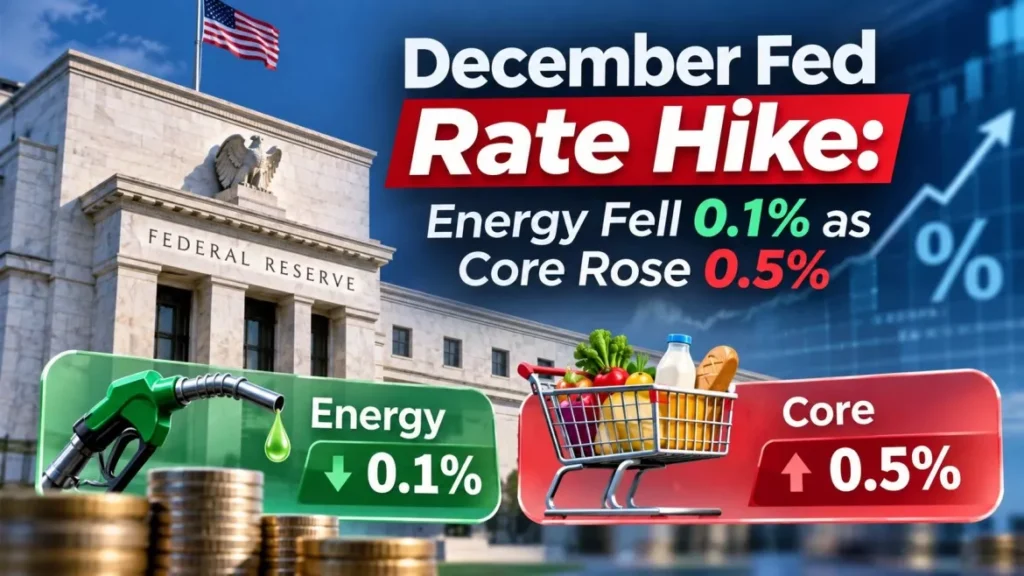

United States producer prices rose 0.3% in October, the last such reading before the Federal Reserve decides on a December Fed rate hike. Energy prices fell 0.1% on the month while the measure excluding food, energy and trade services rose 0.5%. The Bureau of Labor Statistics published the figures on 13 November 2026.
Treasury Secretary Scott Bessent and Chicago Federal Reserve President Austan Goolsbee disagreed publicly the same morning over what the numbers mean. The Federal Reserve, the United States central bank, meets on 8 and 9 December 2026, and financial markets have moved close to fully pricing a December Fed rate hike. The argument between the two men is about a single question: whether the inflation now showing up in American price data is a temporary energy shock that will fade on its own, or something broader that interest rates have to address.
What the October PPI Report Showed
The Producer Price Index measures what American producers receive for their output, before goods and services reach consumers. The October reading was mixed rather than uniformly hot or cool.
| Measure | October 2026, monthly | 12 months to October 2026 |
|---|---|---|
| Final demand (headline) | +0.3% | +6.5% |
| Less foods and energy | +0.3% | +5.0% |
| Less foods, energy and trade services | +0.5% | +4.9% |
| Final demand goods | +0.5% | +10.2% |
| Final demand services | +0.2% | — |
| Final demand energy | −0.1% | +37.0% |
| Final demand foods | +1.3% | +1.7% |
All figures are seasonally adjusted for the monthly changes and unadjusted for the 12-month changes, and all are drawn from the Bureau of Labor Statistics release published on 13 November 2026. The annual rate of 6.5% is, in the agency’s own wording, “the largest 12-month rise since moving up 7.4 percent in November 2022”. September’s monthly gain was revised to 1.4%.
The headline 0.3% came in under the 0.4% that economists had expected, and the annual 6.5% under a 6.6% forecast. On those two numbers alone, the report looked softer than feared. That is where most coverage stopped.
Why the Energy Argument Is Being Tested
The October internals cut against the idea that energy is doing the work. Prices for final demand energy edged down 0.1% on the month, not up.
Within that, the declines were large. Diesel fuel fell 7.9% and crude petroleum fell 10.3% over the month. Energy remains far more expensive than a year ago — up 37.0% over the 12 months to October — but in the month under discussion it subtracted from producer inflation rather than adding to it.
Meanwhile the narrower core measure accelerated. Prices excluding foods, energy and trade services rose 0.5% for the second consecutive month, against a median forecast of 0.3%. The broader core measure excluding only foods and energy rose 0.3%, in line with forecasts and down from 0.8% in September.
The two core measures differ because of trade services, which capture the margins wholesalers and retailers earn rather than the prices of goods themselves. Those margins are volatile, and they fell 0.2% in October. Stripping them out is what lifts the figure to 0.5%.
The clearest single driver of October’s services increase was not energy at all. Final demand transportation and warehousing services rose 2.0%, with truck transportation of freight up 3.9% — the largest single contributor to the services rise. Services overall rose for a fifth straight month. The same pattern appeared in September’s producer price data, when wholesale inflation ran well ahead of consumer inflation.
What Bessent Said and What Goolsbee Said
Both men spoke to CNBC on Friday 13 November 2026, and they reached opposite conclusions from the same data.
| Scott Bessent, US Treasury Secretary | Austan Goolsbee, Chicago Fed President | |
|---|---|---|
| Core claim | The inflation is an energy supply shock tied to the conflict with Iran, and it is already easing | Price pressure has spread well beyond energy into categories oil does not drive |
| On the data | Recent readings are “very noisy numbers”; the Fed should look forward, not at backward-looking figures | Tariff and oil shocks should have faded by now; services inflation is among the most troubling parts of recent reports |
| On demand | The underlying US economy is strong | Points to “old-fashioned demand overheating coming from the AI data center buildout” |
| On the December vote | Says he is not telling the Fed what to do: “But I’m not on the Fed” | Did not commit to a position; he is not an FOMC voter in 2026 |
Bessent’s position, as he put it, is that “the Fed should understand that this is an energy supply shock”. He said he would not reverse course dramatically over such a shock if he were setting policy, while stressing that he is not. He also said the Fed should keep an open mind, noting that it had cut rates last year.
Goolsbee told CNBC’s “Squawk Box” that inflation had “proved far more persistent than we predicted” and that demand was spreading “out of its lane”. He said price pressures had reached services and medical care, categories that do not usually track oil, and that the central bank “has definitely got work to do to continue to reestablish its credibility”. He said he doubts inflation is on a path back to the Fed’s 2% target.
One point is worth separating from the dispute. Because the United States is a net energy exporter, higher global oil prices can lift American corporate profits and wages as well as costs, which can generate inflation beyond the direct supply effect. That mechanism is a matter of economic research rather than a claim either official made.
Where the December Fed Rate Hike Decision Stands
As of 13 November 2026, the federal funds target range in the United States is 3.75% to 4.00%, and the Federal Reserve has issued no guidance on what it will do in December.
The range was set on 17 September 2026, when the Fed raised rates by a quarter point — its first increase since 2023. At the following meeting on 28 October 2026 the Federal Open Market Committee held the range unchanged on a 10–2 vote. Governor Lisa Cook and Cleveland Fed President Beth Hammack dissented, both preferring a quarter-point rise. Chair Kevin Warsh described the hold as an observational pause after September’s increase, said financial conditions were “tighter, but not tight”, and declined to give forward guidance for December.
Market pricing has since hardened. CME Group’s FedWatch tool put the probability of a rise to 4.00%–4.25% at the December meeting at 89.4%, as reported by Al Jazeera on 13 November 2026. CNBC reported the same day that markets were fully pricing a quarter-point increase, with a better-than-10% probability attached to a half-point move. These are market-implied probabilities, not Fed signals, and they have moved quickly: the same measure stood near 72% a week earlier.
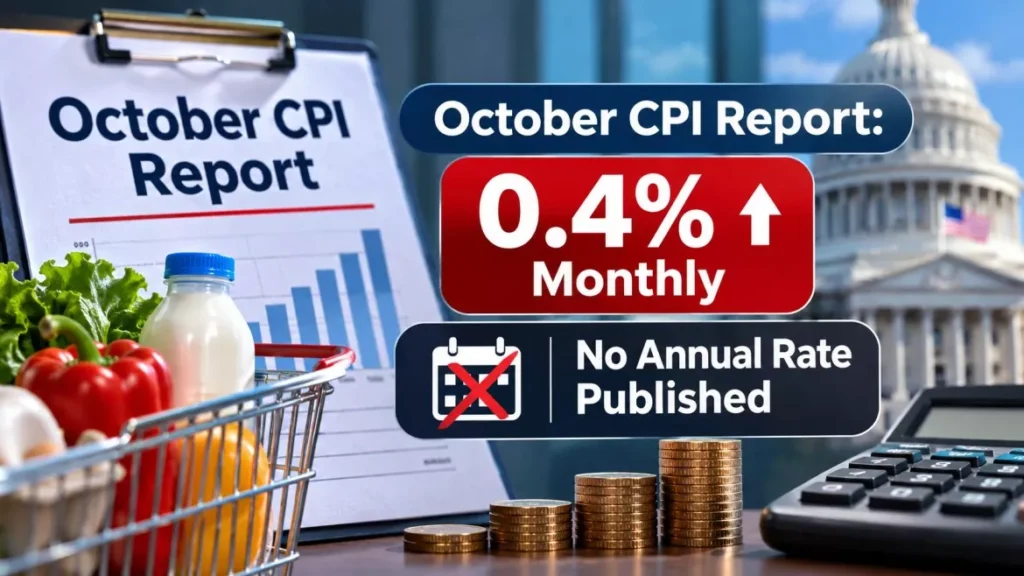
Governor Christopher Waller said earlier in the week that he would support a quarter-point increase in December unless core consumer price inflation came in at 0.3% or more, and that he would consider a half point depending on the data. The October consumer price index, published on 11 November 2026, showed a 0.4% monthly rise.
The next producer price release covers November and is published after the December meeting, so the figures reported on 13 November are the last producer-price reading the committee will have in hand.
What a Quarter-Point Rise Would Change
A change in the federal funds target range applies to the United States only, and it does not reach all borrowing costs equally.
- Variable-rate credit: The federal funds rate feeds the US prime rate, which most American credit cards and home equity lines of credit are priced against. A quarter-point rise in the target range usually moves prime by the same amount.
- Savings: Deposit and certificate rates offered by US banks tend to follow the policy rate, but banks set them individually and pass changes through at different speeds and to different degrees.
- Mortgages: The Fed does not set mortgage rates. Fixed US mortgage rates track long-term Treasury yields and can move in the opposite direction to the policy rate if markets expect inflation to be contained.
- Outside the United States: The decision does not change rates in other countries. Its effects abroad run indirectly, through the dollar, bond yields and the decisions of other central banks.
Terms vary by lender, product and individual circumstances, and the averages published for any of these products are not what a particular borrower or saver is offered.
What Is Still Undecided
Several things that will shape the 9 December decision are not yet known.
- The size of any move: Markets price a quarter point as the base case, but a half point retains measurable probability, and Waller has said he would consider one.
- Who will dissent: The October meeting produced two dissents in favour of a hike. The Fed has not indicated how the committee is now divided.
- Goolsbee’s vote: He is not a voting member of the Federal Open Market Committee in 2026. He rotates into a voting seat in 2027.
- The November jobs report: It is due in early December and is the last major labour-market reading before the meeting.
- Whether the Fed accepts either framing: Neither Bessent nor Goolsbee speaks for the committee, and Warsh has given no indication of which reading of the data he favours.
Frequently Asked Questions
Will the Fed Raise Rates in December 2026?
The Federal Reserve has not said. Its decision is due on 9 December 2026, and CME FedWatch put the probability of a quarter-point rise at 89.4% on 13 November 2026. That is a market estimate, not an announcement.
Why Are There Two Different Core PPI Figures?
One excludes foods and energy and rose 0.3% in October 2026. A narrower one also excludes trade services — the margins wholesalers and retailers earn — and rose 0.5%. Trade margins are volatile, which is why the two measures diverge.
Did Energy Prices Rise in the October PPI Report?
No. Final demand energy prices fell 0.1% over the month, with diesel down 7.9% and crude petroleum down 10.3%. Energy was still 37.0% higher than in October 2025.
Does Austan Goolsbee Vote on the December Fed Rate Hike?
No. The Chicago Fed president is not a voting member of the Federal Open Market Committee in 2026, though he takes part in its discussions. He rotates into a voting seat in 2027.
Does a US Rate Decision Change Borrowing Costs in Other Countries?
Not directly. The federal funds target range applies to the United States. Effects elsewhere are indirect, transmitted through exchange rates, global bond yields and the separate decisions of other central banks.