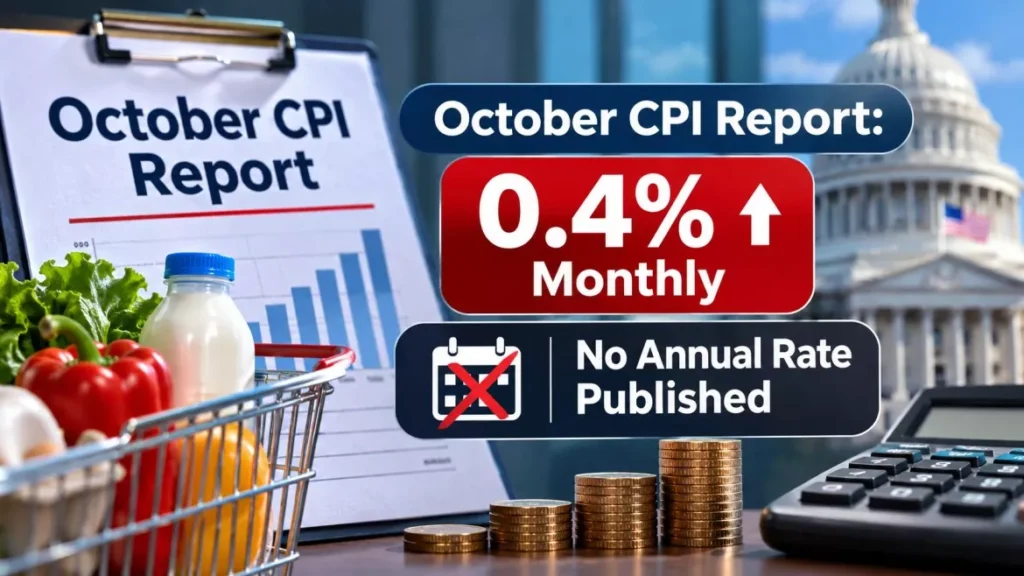

The October CPI report put United States consumer prices up 0.4% for the month and published no annual inflation rate. The Bureau of Labor Statistics never collected October 2025 prices during that year’s funding lapse, leaving no base month to measure against. The gap applies to the headline index and to core inflation alike.
What the October CPI Report Published
The release carries a full set of monthly figures and no yearly ones. The Consumer Price Index for All Urban Consumers, the measure covering more than 90% of the US population, rose 0.4% in October on a seasonally adjusted basis, after rising 0.6% in September. Core inflation, which strips out food and energy to show the underlying trend, rose 0.3% for the third month in a row.
Housing costs did most of the work. The Bureau of Labor Statistics said the shelter index rose 0.3% and accounted for “over thirty percent of the monthly all items increase”. Before seasonal adjustment, the index reached a level of 337.511 on its 1982-84=100 base, a rise of 0.2% over the month.
These are the main component moves for October 2026, seasonally adjusted, as published by the Bureau of Labor Statistics on 10 November 2026.
| Category | October 2026 | September 2026 |
|---|---|---|
| All items | +0.4% | +0.6% |
| All items less food and energy (core) | +0.3% | +0.3% |
| Food | +0.5% | Unchanged |
| Energy | +0.7% | +5.2% |
| Gasoline | +1.0% | +9.1% |
| Electricity | +0.9% | — |
| Natural gas | -0.8% | — |
| Shelter | +0.3% | +0.4% |
| Rent | +0.2% | — |
| Owners’ equivalent rent | +0.3% | — |
| Medical care | +0.3% | +0.1% |
| Motor vehicle insurance | +0.7% | — |
| Recreation | +0.8% | +0.5% |
| Used cars and trucks | -1.2% | +0.7% |
| Communication | -0.1% | — |
Within groceries, the beef index rose 0.9% over the month, and the indexes for fruits and vegetables and for dairy products each rose 0.6%. Nonalcoholic beverages fell 0.3% and cereals and bakery products were unchanged. Gasoline is the one figure that reads two ways: it rose 1.0% after seasonal adjustment, but the release notes that “before seasonal adjustment, gasoline prices decreased 0.7 percent in October”.
Why There Is No Annual Inflation Rate for October
There is no annual rate because the month it would be measured against was never priced. A 12-month percent change needs an index for the same month a year earlier, and for most CPI series October 2025 does not have one.
The reason is the 2025 lapse in appropriations, the funding gap that shut parts of the federal government. Price collection stopped from 1 October 2025 through 12 November 2025. In the October CPI news release, the agency puts it plainly: “BLS did not collect survey data for October 2025 because of a lapse in appropriations. For most CPI series, BLS could not publish October 2025 indexes. As a result, BLS cannot publish 12-month percent changes for October 2026 for indexes where October 2025 data are unavailable.”
The effect is visible throughout the document. Table 7, the release’s 12-month analysis table, runs from “All items” down to individual grocery lines such as frankfurters and white bread, and the annual change column is a dash on every row. A note repeated under the tables reads: “The Oct 2026 12-month percent change values are not available due to the 2025 lapse in appropriations.”
Two things are worth separating here:
- Monthly figures: Published as normal, because September 2026 and October 2026 indexes both exist.
- Annual figures: Withheld for October 2026, because the October 2025 base is missing.
- Item-level annual figures: Also withheld, not just the headline and core numbers.
The Last Official Annual Rate Is Still September’s 3.7%
As of 10 November 2026, the most recent official 12-month inflation rate for the United States is 3.7%, for September 2026, and October’s is blank. That September figure, published by the Bureau of Labor Statistics on 14 October 2026, is what the September CPI report recorded. The chained index, an alternative measure that allows for shoppers switching between categories, put the same month at 3.6%.
The October release does still contain older annual readings. Its chained-index table shows November 2025 at 2.7% and December 2025 at 2.7%, rising through 4.2% in May 2026 before easing to 3.7% in September. October 2026 is the only row in that run with nothing in the annual column.
Three Substitute Estimates, and What Each Assumes
Several outside estimates now stand in for the missing figure, and they do not agree. None of them is an official statistic.
| Source | Headline | Core | Method | As of |
|---|---|---|---|---|
| Cleveland Fed inflation nowcast | 3.81% | 3.21% | Model using a small number of data series | 10 November 2026 |
| Axios calculation | About 4% | 2.8% | Assumes the missing October 2025 readings sat halfway between September and November 2025 | 10 November 2026 |
| Bureau of Labor Statistics | Not published | Not published | Publishes a method, not a number | 10 November 2026 |
The Cleveland Fed, one of the twelve regional Federal Reserve banks, describes its nowcasts as model estimates rather than official statistics, and the numbers change as new data arrive. The Axios estimate was reported by that outlet alone and rests on an assumption about a month nobody measured.
The Bureau of Labor Statistics itself does not fill the hole, but it does publish a method. Its fact sheet on approximating missing data sets out a geometric mean: take the index values for the months immediately before and immediately after the missing month, multiply them, and take the square root. For October 2025 that means combining the September and November 2025 readings, which is close to the reasoning behind the Axios figure.
When the Annual Rate Returns
The next CPI release can carry an annual rate again, because its base month was published. The November 2026 report is scheduled for Thursday 10 December 2026 at 8:30 a.m. Eastern Time, and the October release’s own tables show a 12-month change of 2.7% for November 2025, which a published November 2025 index is required to produce.
One caveat belongs with that. The Bureau of Labor Statistics has not issued a statement saying the 12-month series resumes in full in December; the release addresses only October 2026. Collection restarted on 13 November 2025, so November 2025 was priced for part of the month, and the agency has not said whether every individual series will carry an annual change.
There is a timing consequence worth noting. The Federal Open Market Committee, the Federal Reserve panel that sets US interest rates, meets on 8 and 9 December 2026 — the day before that CPI release. On present schedules, it will decide without any published annual inflation reading more recent than September’s 3.7%.
Who Is Left Without a Number
The missing figure matters most to contracts that are written around it. The release notes that unadjusted CPI data “are also used extensively for escalation purposes”, and that many collective bargaining agreements and pension plans tie compensation changes to the index.
Agreements keyed to the 12-month change for October have no published figure to read this year. The Bureau of Labor Statistics method above is offered for use “if all parties agree”, which leaves the decision with the parties to each contract rather than with the agency. Terms vary by contract, plan and jurisdiction, and the agency’s fact sheet on approximating missing data is the official reference point.
Not every CPI-linked payment is affected. The 2027 Social Security cost-of-living adjustment of 3.6% was calculated from third-quarter figures and announced on 14 October 2026, before this gap applied.
What the Fed Does Next
The October reading met a threshold a Federal Reserve governor had set hours earlier. Christopher Waller spoke in London on 10 November 2026, at the Bank of England Watchers Conference, before the figures were released that morning. He said that if core CPI inflation came in “around 0.3 percent or even higher”, then “a 50 basis point hike in the policy rate should be considered at the December meeting”. Core came in at 0.3%.
Waller’s base case was smaller. “I would still support a 25 basis point increase in the FOMC’s policy rate at our December meeting,” he said, adding in his prepared remarks that “hiking only 25 basis points would put our credibility at risk, a risk I am not eager to take.” He described inflation as “well above 2 percent and the focus of my attention”.
Market pricing moved the same way. CBS News, citing CME Group’s FedWatch tool, reported an 85% chance of a quarter-point increase and a 15% chance of a half-point move after the data; other outlets cited 89% and 11% the same day, and these readings change through each trading session. Treasury yields rose, with CNBC reporting the 10-year yield moving back toward 5%.
What has not happened is a decision. Waller is one voice on a committee of several, the Federal Reserve held rates steady in October with two members dissenting in favour of an increase, and no vote has been taken. The October jobs report published on 6 November is the other recent input the committee has in front of it.
Economists quoted by CBS News read the report as firming up a move. James McCann of Edward Jones said the data “most likely seals the deal on a rate hike to close the year”, and Andrew Davis of Bryn Mawr Trust said it “suggests underlying inflation remains more persistent than the Fed would like”. Vanguard raised its year-end 2026 core inflation forecast to 3.2%.
Frequently Asked Questions
What Was the October 2026 CPI Inflation Rate?
US consumer prices rose 0.4% in October 2026 on a seasonally adjusted monthly basis, and core prices rose 0.3%. There is no official annual rate for the month.
Why Is There No Annual Inflation Rate for October 2026?
The Bureau of Labor Statistics did not collect prices for October 2025 during that year’s lapse in appropriations, so there is no base month for a 12-month comparison. The gap covers the headline index, core inflation and individual item indexes.
What Is the Latest Official US Annual Inflation Rate?
As of 10 November 2026, it is 3.7%, for the 12 months to September 2026, published on 14 October 2026.
When Will the Annual Inflation Rate Be Published Again?
The November 2026 CPI report is scheduled for 10 December 2026, and a November 2025 base index exists for that comparison. The Bureau of Labor Statistics has not confirmed that every series will carry an annual change.
Will the Federal Reserve Raise US Interest Rates in December 2026?
The Federal Open Market Committee meets on 8 and 9 December 2026 and has not decided. Governor Christopher Waller said on 10 November that he would support a quarter-point increase and that a half-point move should be considered.