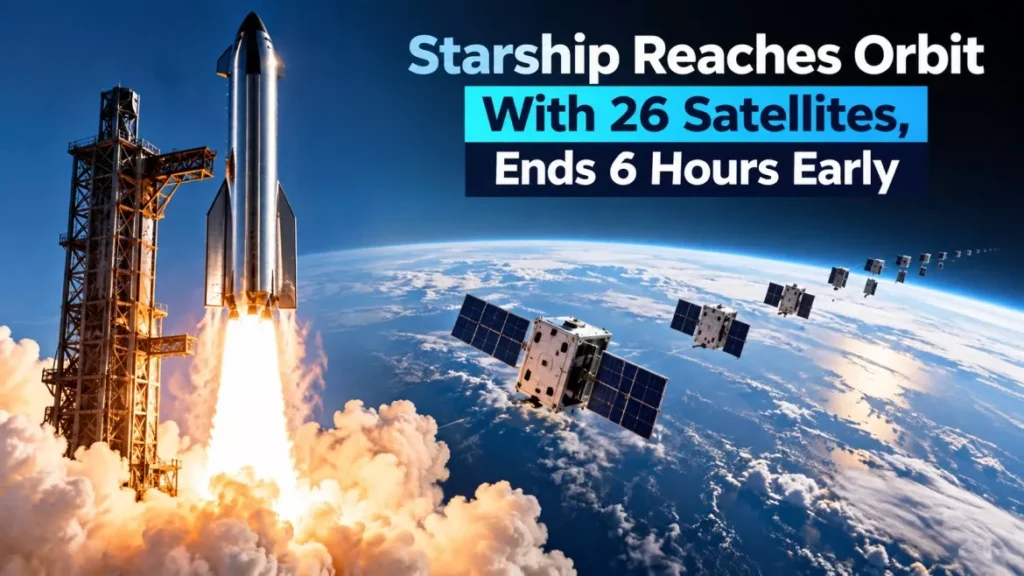

Starship reaches orbit for the first time, on its fourteenth test flight. SpaceX launched Flight 14 from Starbase, Texas, at 12:48:59 UTC on 28 September 2026 and deployed 26 Starlink V3 satellites from a 275-kilometre orbit. The flight ended after 3 hours and 8 minutes, about six hours early.
Starship Orbit Timeline: What Happened and When
Flight 14 was the fourteenth full-scale test of the vehicle and the first to carry a paying payload. The sequence below is drawn from the mission timeline published by Spaceflight Now before launch and the flight record compiled afterwards.
- 12:48:59 UTC: Liftoff from Starbase orbital launch pad B in Cameron County, Texas, using Super Heavy booster 21 and Ship 41, both Block 3 vehicles.
- About two and a half minutes in: Stage separation. One of the booster’s 33 Raptor engines had already shut down during the climb without affecting the ascent.
- About 25 minutes in: Ship 41 relit a sea-level Raptor to raise and round out its path, the burn that put Starship into orbit at roughly 28,000 km/h (17,500 mph).
- About 34 minutes in: Satellite deployment began, releasing the 26 Starlink V3 spacecraft at roughly one-minute intervals over about half an hour.
- About 90 minutes in: SpaceX decided to bring the ship home at its first checkpoint rather than complete six orbits.
- 3 hours 8 minutes in: Splashdown in the Pacific Ocean. The ship settled upright, tipped over and was destroyed by residual propellant.
The Super Heavy booster made a powered splashdown in the Gulf of Mexico. SpaceX had said before the flight that it would not attempt to catch either stage on this mission, to keep the objectives simple. Elon Musk, SpaceX’s chief executive, explained the caution by saying the company’s “popularity would diminish very rapidly” if debris fell on populated areas, in remarks reported by Al Jazeera.
Planned Mission Against What Actually Flew
Flight 14 met both of its headline goals and none of its endurance goals. The table sets the pre-flight plan against the outcome.
| Element | Planned | Actual |
|---|---|---|
| Orbital insertion | Circular orbit after a relight at about 25 minutes | Achieved, about 275 km (170 miles) |
| Payload | 26 Starlink V3 satellites, Starlink Group 31-1 | All 26 deployed |
| Orbits completed | About six | Cut short at the first checkpoint |
| Mission duration | Close to 10 hours | 3 hours 8 minutes |
| Ship splashdown | Pacific Ocean off the coast of Chile | Pacific Ocean, on an early return |
| Booster recovery | Powered splashdown in the Gulf, no tower catch | Powered splashdown in the Gulf |
| Stages recovered | None | None |
Why the Flight Ended Six Hours Early
Two engine problems and one failed on-orbit check turned a ten-hour flight plan into a three-hour one. None of them stopped Starship reaching orbit.
The first came on the way up. One of the booster’s 33 Raptor engines shut down shortly after liftoff, which the vehicle absorbed. The second was more consequential: one of the ship’s six Raptor engines — one of the three vacuum-optimised units used in space — quit early during the ascent burn. Flight controllers briefly called off the orbital insertion before reversing the decision minutes later, having judged that the remaining engines were enough.
The deciding factor came once Starship was in orbit. An early on-orbit contingency check did not pass, and SpaceX used the first scheduled opportunity to deorbit rather than press on through six revolutions. The deorbit burn ran about six and a half hours ahead of the published plan. SpaceX has not published a technical explanation of which check failed.
The booster’s own relights were partial. It lit 26 of 28 planned engines for the boostback burn and 11 of 13 for the landing burn, stepping down to five and then three engines as it neared the water.
What 26 Starlink V3 Satellites Add to the Network
These were the first Starlink V3 satellites placed in orbit for real service rather than testing. V3 is the generation Starship was built to carry: at a reported mass of up to roughly 2,000 kg each, they are too heavy for Falcon 9 to launch in useful numbers.
On capacity, SpaceX has said a V3 satellite carries about ten times the downlink and 22 times the uplink of a V2. Trade reporting puts each V3 at roughly one terabit per second of downlink. A full Starship load — up to about 60 satellites, which this flight did not carry — has been described by SpaceX as adding around 60 terabits per second in one launch.
What none of that settles is when Starlink subscribers notice. Gigabit service depends on ground terminals that can use the extra capacity, and SpaceX has not published a date for when V3 capacity reaches particular countries or plans. Twenty-six satellites is a first tranche joining a constellation that Al Jazeera puts at more than 11,000 spacecraft. Three of the 26 carry extra cameras to photograph the ship’s heat shield.
Starship Reaches Orbit: What Changes Now
As of 29 September 2026, Starship has flown to orbit once, delivered one commercial payload and recovered neither stage. SpaceX has not published a date for Flight 15.
Reporting by NASASpaceflight puts the next attempt no earlier than 19 October 2026 with booster 22 and Ship 42, and says SpaceX may try to catch the upper stage at the tower for the first time depending on how Flight 14 is assessed. A further flight, numbered 16, is sketched for no earlier than 30 October from Launch Complex 39A in Florida. None of those dates is confirmed by SpaceX, and Starship dates have slipped repeatedly: Flight 14 itself moved from 18 September to 22 September to 28 September. The Federal Aviation Administration issued the launch and reentry licence for this flight on 26 September, two days before it flew.
The bigger stake is NASA’s. Starship is the lander NASA has contracted for the Artemis Moon missions. NASA’s own Artemis page describes a “[d]emonstration mission in low Earth orbit, planned for 2027, to evaluate one or both commercial human landing systems developed by SpaceX and Blue Origin”, and says it is working with SpaceX on Starship HLS for Artemis III and Artemis IV. Artemis II flew crew around the Moon in April 2026. Jared Isaacman, the NASA administrator, called Flight 14 a “[g]orgeous launch, getting Ship to orbit and managing every step in a safe, responsible, and especially inspirational way”.
Readers following the run-up can compare this outcome with our earlier reports on the Starship Flight 14 launch date and licence and on the original flight plan with no tower catch. For constellation context, see our explainer on how many Starlink satellites are in orbit.
What Is Still Unconfirmed
- The failed on-orbit check: SpaceX has not said what the contingency check was or why it did not pass.
- The engine failures: No cause has been published for either the booster engine shutdown or the vacuum Raptor that quit during ascent.
- Flight 15: The 19 October target, the vehicle assignments and a possible tower catch come from NASASpaceflight’s manifest reporting, not from SpaceX.
- Starlink V3 service dates: No country, plan or speed-tier timetable has been announced for the capacity these 26 satellites add.
- Artemis III: NASA lists the crewed landing after a 2027 in-orbit demonstration; it has not tied a landing date to Flight 14’s result.
Frequently Asked Questions
Did Starship Reach Orbit on Flight 14?
Yes. Flight 14 on 28 September 2026 was the first time Starship reached orbit, about 275 kilometres up, after 13 earlier suborbital test flights.
How Long Did the Flight Last?
Three hours and eight minutes, against a plan of close to ten hours and six orbits. SpaceX deorbited at the first scheduled checkpoint after an on-orbit check failed.
Did the Rocket Explode?
The upper stage splashed down in the Pacific, settled upright, tipped over and was destroyed by leftover propellant. That was after the mission was complete, and SpaceX had not planned to recover it.
What Did Starship Carry?
Twenty-six Starlink V3 satellites, designated Starlink Group 31-1, the first V3 units sent up for operational service. Three carry cameras to image the ship’s heat shield.
When Is the Next Starship Launch?
SpaceX has not announced a date. NASASpaceflight reports Flight 15 no earlier than 19 October 2026, possibly with the first attempt to catch the upper stage at the tower.
Does This Affect NASA’s Moon Landing?
Starship is NASA’s contracted Artemis lander, so orbital flight is a prerequisite. NASA still lists a low Earth orbit demonstration of the landers in 2027 and has not moved its Artemis dates because of Flight 14.