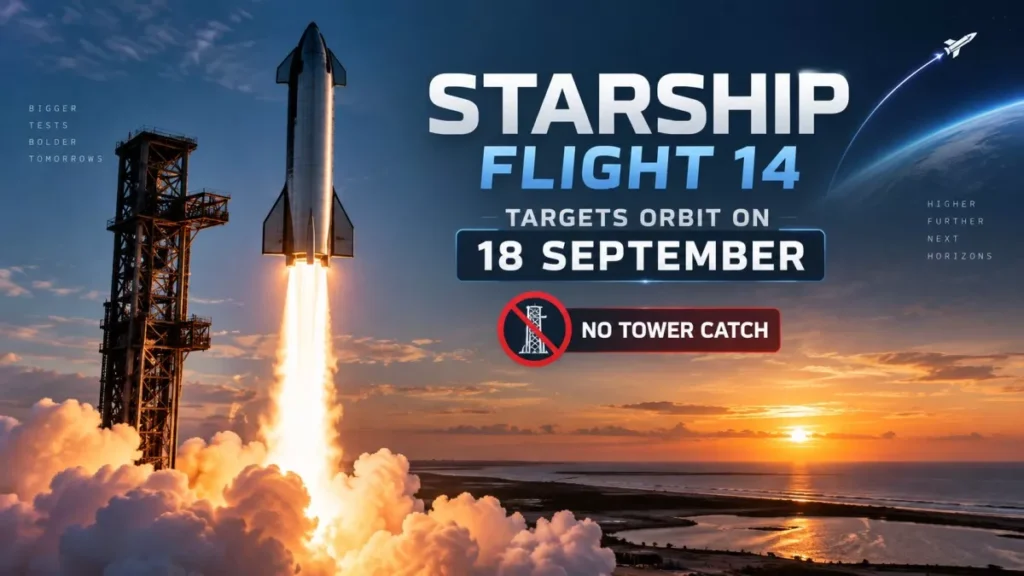

Starship Flight 14 is scheduled to lift off from Starbase, Texas, no earlier than 18 September 2026, in a two-hour window opening at 12:15 UTC. It is the first Starship flight aiming for orbit rather than a suborbital arc, carrying about 20 Starlink V3 satellites. Neither stage will be caught.
When Starship Flight 14 Launches
The current target is Friday 18 September 2026, from Pad B at Starbase in south Texas. The window runs from 12:15 UTC to 14:14 UTC, with a backup window at the same times on 19 September.
That date has already moved once. An FCC filing reported in early September pointed to 15 September, and the schedule has since settled on the 18th. As of 13 September 2026, no FAA launch licence for the flight has been reported as issued; the most recent public status, on 11 September, was that the licence remained pending.
Why This Flight Is Not Like the First Thirteen
Flights 1 through 13 flew suborbital trajectories, coming down without ever completing a circuit of the Earth. Flight 14 is the first designed to circularise into low Earth orbit.
It is also the first to carry a live commercial payload rather than mass simulators. The roughly 20 Starlink V3 satellites aboard are meant for operational service, not for a demonstration. These are the large, flat spacecraft with laser inter-satellite links and oversized solar arrays that SpaceX intends to replace its current constellation with, and TechTimes reports each is rated at about one terabit per second of downlink capacity. No other rocket now flying can lift them in these numbers, which is why the constellation upgrade has waited on Starship. Our explainer on how many Starlink satellites are in orbit covers the fleet this generation is intended to succeed.
What Comes Back, and What Does Not
Both stages end this flight in the water. The tower catch that SpaceX has made the visual signature of the programme is not on the plan.
| Element | Flight 14 plan |
|---|---|
| Booster 21 (Super Heavy Block 3) | Controlled splashdown in the Gulf of Mexico, no tower catch |
| Ship 41 (Starship Block 3) | Splashdown in the Indian Ocean, tower catch deferred to a later flight |
| Payload | About 20 Starlink V3 satellites deployed to operational orbit |
| Trajectory | Orbital insertion, a first for the programme |
SpaceNews reported in August that a catch of the upper stage was unlikely on this flight. Deferring both recoveries keeps the risk on the part of the mission that has never been attempted, which is reaching and leaving a stable orbit with satellites aboard.
The Approval SpaceX Still Needs
The environmental side of the paperwork is finished. The FAA issued a Finding of No Significant Impact and a Record of Decision covering Flight 14, which cleared the largest administrative obstacle.
A launch licence is a separate decision, and it has not been reported as granted. According to TechTimes, the review is harder this time because the regulator has to model what happens if Ship 41’s deorbit burn fires at the wrong moment or fails altogether, and the vehicle’s path then crosses populated ground. That question does not arise on a suborbital profile, which is why Flight 14’s licence is not a formality.
What Has Already Been Tested
Both stages completed their ground campaigns in August.
- 19 August 2026: Ship 41 fired a single engine in a test simulating the deorbit burn.
- 21 August 2026: Ship 41 completed a full-duration, six-engine static fire lasting about 60 seconds.
- 28 August 2026: Booster 21 completed a full 33-engine static fire.
What Could Still Move the Date
Three things can push Flight 14 to the right, and only one of them is in SpaceX’s hands.
- The launch licence: without it the vehicle cannot fly, and no issuance had been reported as of 13 September 2026.
- Weather and sea state: both stages need acceptable conditions at widely separated splashdown zones, in the Gulf of Mexico and the Indian Ocean.
- Ground systems: SpaceX has scrubbed Starship attempts over pad and ground-equipment problems before, sometimes inside the final hour.
The 19 September backup window exists for exactly this reason. Neither date is a commitment.
Starship Flight 14: Common Questions
When Is Starship Flight 14 Launching?
No earlier than 18 September 2026, in a window from 12:15 UTC to 14:14 UTC, launching from Pad B at Starbase, Texas. A backup window is held for 19 September.
Will SpaceX Catch the Booster or the Ship?
No. Booster 21 is set for a controlled splashdown in the Gulf of Mexico and Ship 41 for a splashdown in the Indian Ocean. The tower catch is deferred to a later flight.
What Is Starship Flight 14 Carrying?
About 20 Starlink V3 satellites destined for operational service. It is the first Starship flight with a live commercial payload rather than test mass.
Is This Starship’s First Orbital Flight?
Yes. The previous thirteen integrated flights all followed suborbital trajectories. Flight 14 is the first intended to circularise into low Earth orbit.
Could the Launch Date Slip Again?
It can. An earlier FCC filing pointed to 15 September before the target moved to the 18th, and the FAA launch licence had not been reported as issued as of 13 September 2026.