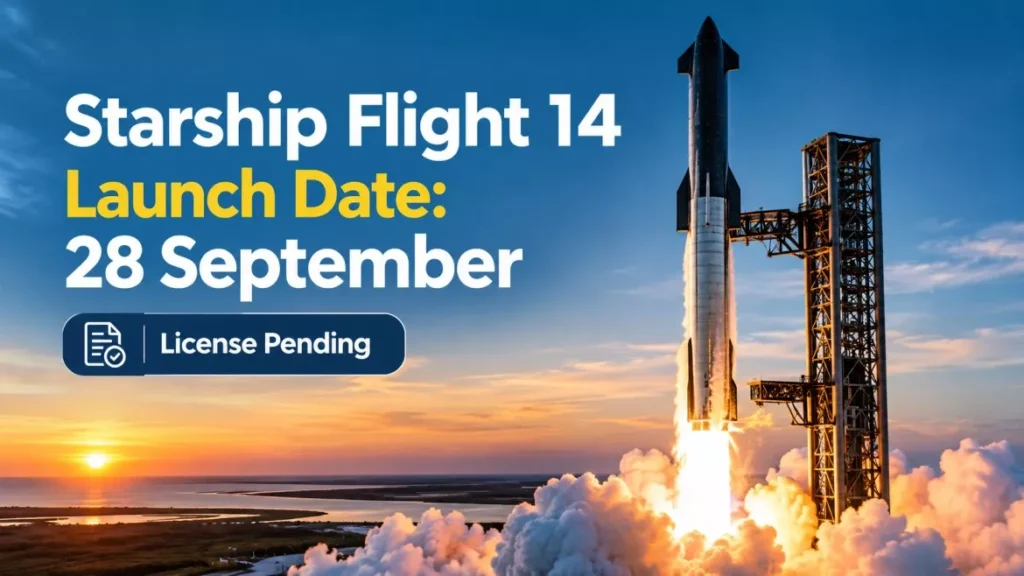

The Starship Flight 14 launch date has moved to Monday 28 September 2026, a six-day slip from 22 September. SpaceX announced the change on 17 September and said the flight is targeted pending regulatory approval. The window opens at 12:15 GMT and runs for 75 minutes.
Why the Date Moved
SpaceX gave no reason for the six-day slip, and that absence is the most reported fact about it. The company’s announcement on 17 September was a single line: it is now targeting Monday 28 September, as early as that date, pending regulatory approval.
This is the second slip for the flight. SpaceX had earlier been working toward 18 September, as the previous target date for Flight 14 showed, then moved to 22 September before settling on 28 September. No technical fault has been announced for either change, and no vehicle anomaly has been reported.
The conditional phrase matters more than the date. Reporting through early September, including TechTimes on 2 September, noted that the Federal Communications Commission had cleared the frequency and deployment plan for the satellites on board, but that the Federal Aviation Administration launch licence remained outstanding. Advanced Television reported on 18 September that the FAA has issued a notice to airmen covering the flight.
When the Window Opens Where You Are
The 75-minute window opens at 12:15 GMT and closes at 13:30 GMT on Monday 28 September 2026.
| Location | Window opens |
|---|---|
| Starbase, Texas (CDT) | 7:15 a.m. |
| New York (EDT) | 8:15 a.m. |
| London (BST) | 1:15 p.m. |
| Berlin and Paris (CEST) | 2:15 p.m. |
| India (IST) | 5:45 p.m. |
| Tokyo (JST) | 9:15 p.m. |
| Sydney (AEST) | 10:15 p.m. |
Advanced Television described a longer window of two hours and 24 minutes opening at 07:23 Texas time. TechCrunch, Starlust and the launch database Next Spaceflight all give the 75-minute window opening at 7:15 a.m. local time, and that is the figure used above.
What Flight 14 Has to Achieve
Flight 14 is the first Starship mission designed to reach orbit rather than fly a suborbital arc, so success is a sequence rather than a single moment. Every previous Starship test has deliberately stopped short of orbital velocity.
- Liftoff: The vehicle leaves Pad 2 at Starbase, Texas.
- Stage separation and booster return: The Super Heavy booster performs a boostback and landing burn to a controlled water splashdown. There is no tower catch attempt on this flight.
- Orbital insertion: The upper stage reaches roughly 275 kilometres, about 170 miles, and enters orbit for the first time in the programme.
- Payload deployment: Twenty-six Starlink V3 satellites are released.
- Deorbit burn: The ship relights to bring itself down, the step that turns an orbit into a controlled return.
- Re-entry and splashdown: The ship comes down in the Pacific Ocean after roughly six orbits and close to ten hours of flight.
SpaceX has said it applied heat-shield changes drawn from analysis of Flight 13 hardware recovered from the sea, and Starlust reports that two recovered tiles from that flight are flying again on this one.
Why the 26 Satellites Are the Point
The payload is the reason this flight is being treated as a turning point rather than another test. Starlink V3 satellites are too large for the Falcon 9 rocket that has carried the constellation until now, so Starship is the only vehicle in SpaceX’s fleet that can loft them.
Each V3 satellite is rated at about one terabit per second of capacity, putting the full stack at roughly 26 terabits per second, which Next Spaceflight describes as around ten times the capacity of the V2 generation. TechCrunch reported that SpaceX describes Flight 14 as the first Starship launch to generate revenue for its launch division, although that revenue is internal, earned by delivering SpaceX’s own satellites. Next Spaceflight also lists three of the 26 satellites as carrying cameras intended to image the ship’s heat shield; that detail appears in the launch database and has not been separately confirmed by SpaceX.
For context on the size of the network these satellites join, our earlier explainer on how many Starlink satellites are in orbit sets out how the constellation has grown.
The Hardware Flying This Time
Both major pieces of this vehicle are new. Next Spaceflight lists Booster 21 and Ship 41, each making its first flight, in the Starship and Super Heavy version 3 configuration: 124.4 metres tall, nine metres in diameter, and about 80,800 kilonewtons of thrust at liftoff.
What Could Still Change Before Monday
As of 19 September 2026, SpaceX’s own wording attaches a condition to the date: the flight is targeted for 28 September pending regulatory approval, and the company has not announced that the FAA launch licence has been granted. A date that carries that phrase can move again without any hardware problem occurring.
Three things remain unknown. SpaceX has not said what caused either of the two delays. It has not published a confirmed licence status. And it has not committed to a backup date if 28 September is missed, which on past Starship flights has typically meant a slip of days rather than weeks.
Frequently Asked Questions
When Is the Starship Flight 14 Launch Date?
Monday 28 September 2026, with a 75-minute window opening at 12:15 GMT, which is 7:15 a.m. local time at Starbase, Texas. SpaceX has described the date as the earliest possible and conditional on regulatory approval.
Why Was Starship Flight 14 Delayed?
SpaceX has not said. The company announced the move from 22 September to 28 September on 17 September without giving a cause, and no vehicle problem has been reported.
Will SpaceX Catch the Booster on Flight 14?
No. The Super Heavy booster is set for a controlled splashdown in water rather than a return to the launch tower, and the upper stage is also not being caught on this flight.
What Is Starship Carrying?
Twenty-six Starlink V3 satellites, the first production batch of that generation to be deployed by Starship. Each is rated at roughly one terabit per second of capacity.
Has Starship Reached Orbit Before?
No. Earlier Starship test flights stopped short of orbital velocity by design. Flight 14 is the first attempt at orbital insertion, followed by a deorbit burn and a Pacific splashdown after about ten hours.