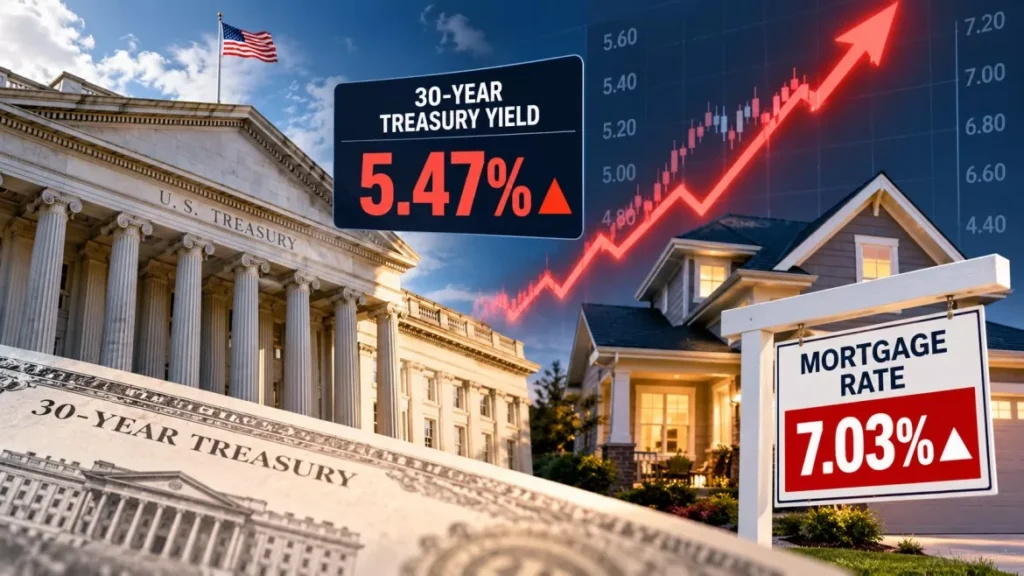

The 30-year Treasury yield reached 5.47% on 24 September 2026, the highest reading in the United States Treasury’s daily par yield series since 2004. The 10-year stood at 5.10% and the 20-year at 5.53% the same day. Hours earlier, Freddie Mac’s weekly survey put the average 30-year fixed mortgage at 7.03%.
What the Official Readings Show
The figures below are the United States Treasury’s own Daily Treasury Par Yield Curve Rates, the end-of-day benchmark the department publishes for each business day. They are quoted in per cent a year.
| Date (2026) | 2 Year | 10 Year | 20 Year | 30 Year |
|---|---|---|---|---|
| 16 September | 4.45% | 4.94% | 5.39% | 5.35% |
| 23 September | 4.85% | 5.05% | 5.45% | 5.40% |
| 24 September | 4.87% | 5.10% | 5.53% | 5.47% |
As of 25 September 2026, the 24 September close was the most recent published reading; the figure for 25 September had not yet been posted to the Treasury’s daily yield curve table. Intraday quotes ran higher than the official close: Reuters reported the 30-year at 5.444% during Thursday’s session and Bloomberg put it as high as 5.48%. Yields move continuously, so any single number is a snapshot with a timestamp attached.
Basis points are the unit used for these moves: one basis point is one hundredth of a percentage point. The 30-year rose 7 basis points between 23 and 24 September and 12 basis points from the day of the Federal Reserve’s September decision.
Why the 30-Year Treasury Yield Is Rising
The immediate trigger was data, not policy. On 23 September 2026 S&P Global’s flash United States composite output index came in at 58.4, up from 56.0 in August and the strongest reading since July 2021, with input costs rising at their fastest pace since October 2022.
A bond’s yield rises when its price falls, and prices fall when investors demand more compensation for holding fixed payments over a long period. Strong growth alongside rising costs points to inflation staying above target, which reduces what those fixed payments will be worth.
Three other pressures are running at the same time. Energy costs have stayed high through the conflict involving Iran, with Brent crude trading around $105 a barrel on 25 September 2026. Government borrowing is heavy on both sides of the Atlantic. And the Federal Reserve raised its target range to 3.75%–4% on 16 September 2026, its first increase since 2023, which lifted the short end of the curve as well.
What Has Already Changed for Borrowers
Long Treasury yields are the reference point for fixed-rate mortgages in the United States, and the pass-through has already happened.
- 30-year fixed average: 7.03% in the week to 24 September 2026, up from 6.95% the week before and 6.30% a year earlier.
- 15-year fixed average: 6.42%, up from 6.26% the previous week and 5.49% a year earlier.
- Run of increases: the fifth consecutive weekly rise, and the first survey reading at or above 7% since the week of 16 January 2025.
These are national averages published in Freddie Mac’s weekly survey and apply to the United States only. They are not what any individual borrower is quoted, which depends on credit profile, deposit size, loan type, lender and location. “The housing market remains supported by a solid labor market and an economy that is growing at a healthy rate,” Freddie Mac chief economist Sam Khater said in the release.
What the Same Move Means on the Savings Side
The mirror image of a higher borrowing cost is a higher return on lending to the government. On 24 September 2026 a two-year Treasury note yielded 4.87% and a 30-year bond 5.47%, both before tax and both fixed for the life of the security.
Bank deposit rates follow the short end rather than the long end, and they follow it with a lag and at each bank’s discretion. Terms, minimum balances, early-withdrawal penalties and tax treatment differ by institution and by country, and a headline rate advertised by one bank is not a market-wide figure.
This Is Not Only a United States Story
The same repricing is running through other government bond markets, which is why the move matters to readers outside America.
- Japan: the 10-year government bond yield reached its highest level since 1996 on 24 September 2026, days after the Bank of Japan raised rates.
- Germany: the 10-year Bund yield rose briefly above 3.6% during September 2026, a level last seen 17 years ago.
- German borrowing: the country’s finance agency said on 24 September 2026 that federal borrowing is expected to reach a record €525.5 billion, about $598 billion, in 2026.
Higher government yields raise the cost of state borrowing, and that tends to feed through to mortgage and business lending rates in the same currency.
What the Treasury Has Already Done
The United States Treasury moved before this week’s readings. In a press release dated 19 August 2026 it raised the maximum size of its liquidity support buyback operations in the longer-dated nominal sectors from $2 billion per operation to at least $4 billion, covering the 10-to-20-year and 20-to-30-year maturity buckets.
The change took effect on 9 September 2026 and runs to 4 November 2026. Treasury said the increase “reflects Treasury’s desire to provide greater liquidity support in longer-dated nominal sectors where there is consistent strong sponsorship from market participants”. A buyback is the department purchasing its own outstanding bonds in the secondary market, which supports trading conditions; it is not a commitment to hold yields at any level.
What Is Scheduled and What Is Unknown
The Federal Open Market Committee’s projections published on 16 September 2026 showed most officials expecting at least one further increase this year, with year-end rate projections clustered above 4%. Projections are not decisions, and the committee has not committed to a further move.
What is not known: whether the September activity and cost readings hold in the final data, where energy prices settle, and whether long yields respond to the buyback programme after it ends on 4 November 2026. This article reports the published figures and their dates; it does not forecast where they go next.
30-Year Treasury Yield: Frequently Asked Questions
What Is the 30-Year Treasury Yield Today?
The most recent official reading available on 25 September 2026 was 5.47%, for 24 September 2026, in the United States Treasury’s Daily Treasury Par Yield Curve Rates. The series is updated each business day after the close.
Why Do Bond Yields Rise When Prices Fall?
A bond pays fixed amounts on fixed dates. If its market price falls, those unchanged payments represent a larger return relative to what a buyer now pays, so the yield rises. The two always move in opposite directions.
Does a Higher 30-Year Treasury Yield Mean Higher Mortgage Rates?
In the United States, long-dated Treasury yields are the main reference for fixed-rate mortgage pricing, and the two have moved together through September 2026. Freddie Mac’s 30-year average reached 7.03% in the week to 24 September 2026. The relationship is not fixed, and lender margins vary.
Is the Bond Selloff Only Happening in America?
No. Japan’s 10-year yield hit its highest level since 1996 on 24 September 2026 and Germany’s 10-year Bund traded above 3.6% during the month, its highest in 17 years.
What Is a Treasury Buyback?
It is the United States Treasury buying back its own previously issued bonds in the secondary market to support liquidity. From 9 September to 4 November 2026 the maximum size of each longer-dated operation is at least $4 billion, up from $2 billion.