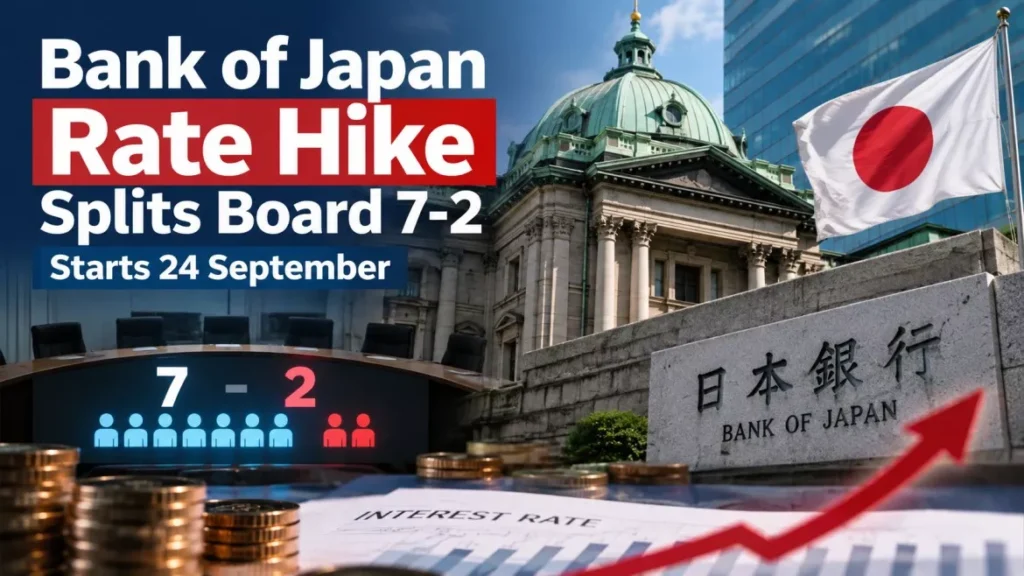

The Bank of Japan rate hike confirmed on Friday 18 September 2026 lifts the policy interest rate to around 1.25 per cent, the highest level in Japan since April 1995. The board voted 7-2, and the new rate applies from 24 September. Two members opposed the increase, and the yen weakened rather than strengthened.
What the Bank of Japan Changed
The decision raises the rate Japanese banks charge each other for overnight loans, which is the anchor for almost every other interest rate in the country. Three separate rates moved.
| Rate | Previous | New | Applies From |
|---|---|---|---|
| Uncollateralised overnight call rate (the policy rate) | Around 1.00% | Around 1.25% | 24 September 2026 |
| Complementary deposit facility rate | 1.00% | 1.25% | 24 September 2026 |
| Basic loan rate | 1.25% | 1.50% | 24 September 2026 |
The increase was a quarter of a percentage point, published by the Bank of Japan as a change in the guideline for money market operations on 18 September 2026. It came roughly three months after the previous rise, to around 1.00 per cent in June 2026 — the shortest gap between Japanese rate increases since 1990.
This applies to Japan only. It sets the cost of borrowing in yen, and it does not change interest rates in any other country.
Why the Yen Fell on a Rate Rise
A central bank raising rates would normally lift its currency, because higher rates make holding that currency more rewarding. On 18 September the opposite happened: the yen weakened against the US dollar after the decision and Governor Kazuo Ueda’s news conference.
The reason was not the rate itself but what the day signalled about the next one. Two things disappointed traders who had positioned for a firmly hawkish message.
- The split vote: a 7-2 board suggested less momentum behind further increases than a unanimous decision would have.
- Ueda’s tone: he declined to promise a particular pace, saying only that the Bank was “in a phase where we need to look at various data carefully” and that big or consecutive increases would depend on inflation risks becoming much larger.
Analysts quoted by Reuters on 18 September made the same reading. Naka Matsuzawa of Nomura Securities called the fall “a knee-jerk reaction to the two dissent votes”. Ray Attrill of National Australia Bank said markets were disappointed that the Bank “couldn’t even get the unanimous vote”. Yugo Tsuboi of Daiwa Securities said the outcome was “likely to be seen as dovish”. Bart Wakabayashi of State Street pointed to the gap that still exists between Japanese rates and those elsewhere.
Currency levels move continuously, and the direction described here is the intraday move on 18 September 2026 as reported that day. Early coverage of the decision and coverage published after Ueda’s news conference did not agree on the direction, which is itself a sign of how sharply sentiment turned during the day.
David Chao of Invesco framed the wider point: “The BOJ has finally shed its long-term status as a monetary policy outlier and is joining the ranks of the other major central banks.” Japan spent decades with rates at or below zero while the US Federal Reserve and the European Central Bank moved through far larger cycles.
Why Two Board Members Voted Against
Toichiro Asada and Ayano Sato voted against the increase, favouring a more cautious approach to raising borrowing costs.
Both are regarded as reflationists — economists who argue that Japan’s long fight against deflation means policy should stay loose until higher inflation is clearly entrenched. Both were appointed to the board earlier in 2026 under Prime Minister Sanae Takaichi, who has been associated with support for easier monetary policy.
Their dissent matters beyond the arithmetic of one vote. It tells markets that the case for the next increase is contested inside the Bank, which is precisely what traders took from the day.
What It Does to Japanese Mortgages and Deposits
A policy rate is not what a household pays or earns. It reaches people through the rates commercial banks set afterwards, and that takes months.
Most outstanding Japanese home loans carry variable rates, which is why a change at the Bank of Japan reaches borrowers at all. Banks reset those benchmarks on their own schedules, and repayments typically change one or two scheduled review periods later, so a rise decided in September does not appear in a monthly payment in September.
Mizuho Research and Technologies published estimates of the effect on 18 September 2026, reported by Nippon.com. They are national averages and projections, not what any individual household will pay or receive.
| Group | Estimated Annual Effect |
|---|---|
| Borrowers in their twenties or younger | About ¥22,000 more in interest (roughly $140) |
| Borrowers in their thirties | About ¥23,000 more in interest (roughly $147) |
| Households in their sixties | Net gain of about ¥20,000 (roughly $127) |
| Households aged 70 and over | Net gain of about ¥21,000 (roughly $134) |
| Japan as a whole | Net positive of about ¥400 billion (roughly $2.5 billion) |
Dollar equivalents are converted at mid-September 2026 exchange rates and will change as the yen moves. Mizuho also projected average 10-year time deposit rates rising by 0.15 percentage points to 2.13 per cent.
The pattern is the point: the same decision moves money towards older households, who hold most of Japan’s savings, and away from younger ones, who hold most of its mortgage debt. Terms vary by bank, by contract and by when a loan was taken out.
Where Japanese Inflation Actually Stands
The Bank raised rates while its main inflation gauge was still below target, which is unusual enough to explain.
As of the August 2026 data published on 17 September 2026, Japan’s core consumer price index — which excludes fresh food but includes fuel — rose 1.7 per cent from a year earlier, down from 1.8 per cent in July, Reuters reported. That keeps core inflation below the Bank’s 2 per cent target for the eighth consecutive month, partly because government subsidies have held down utility bills. Headline inflation was 1.9 per cent, and the measure that strips out both fresh food and fuel, which the Bank watches as a gauge of demand-driven pressure, was also 1.9 per cent.
Ueda’s explanation was that the Bank is acting before the target is breached rather than after. “Underlying inflation is now quite close to 2%, and our goal has become to have this stabilise,” he said, adding that “recent wage data have also been quite strong, suggesting that wage pressures are broadening”.
What Happens Next
The Bank has not committed to a timetable for any further increase. Ueda said explicitly that the pace depends on the data, and that the Bank does not set policy to steer the currency: “We don’t guide policy to control currency moves or stabilise currency rates at a certain range.”
Economists polled by Reuters before the decision expected the policy rate to reach 1.5 per cent by the end of March 2027 and 1.75 per cent in the second quarter of 2027. Those are forecasts, not decisions, and the two dissenting votes show the board itself is not settled. The Bank’s next scheduled policy meeting decision, and the September inflation reading due in October, are the next fixed points.
Frequently Asked Questions
What Is the Bank of Japan Policy Rate Now?
Around 1.25 per cent, raised from around 1.00 per cent on 18 September 2026 and applying from 24 September 2026. It is the highest Japanese policy rate since April 1995.
When Does the Bank of Japan Rate Hike Take Effect?
The new guideline applies from 24 September 2026. Commercial banks in Japan then adjust their own deposit and loan rates on their own schedules, so the effect on a household’s mortgage payment or savings interest arrives later.
Why Did the Yen Fall After the Rate Hike?
Traders read the 7-2 split vote and Governor Ueda’s news conference as signalling no commitment to rapid further increases. Analysts quoted by Reuters on 18 September 2026 attributed the move to the dissenting votes rather than to the rate decision itself.
Who Voted Against the Bank of Japan Rate Hike?
Board members Toichiro Asada and Ayano Sato, both appointed in 2026, voted against the increase and favoured a more cautious approach.
Does the Bank of Japan Rate Hike Affect Other Countries?
Not directly. It sets the cost of borrowing in yen only. Because yen borrowing has long been used to fund investments elsewhere, changes in Japanese rates are watched internationally, but no other country’s rates change as a result.