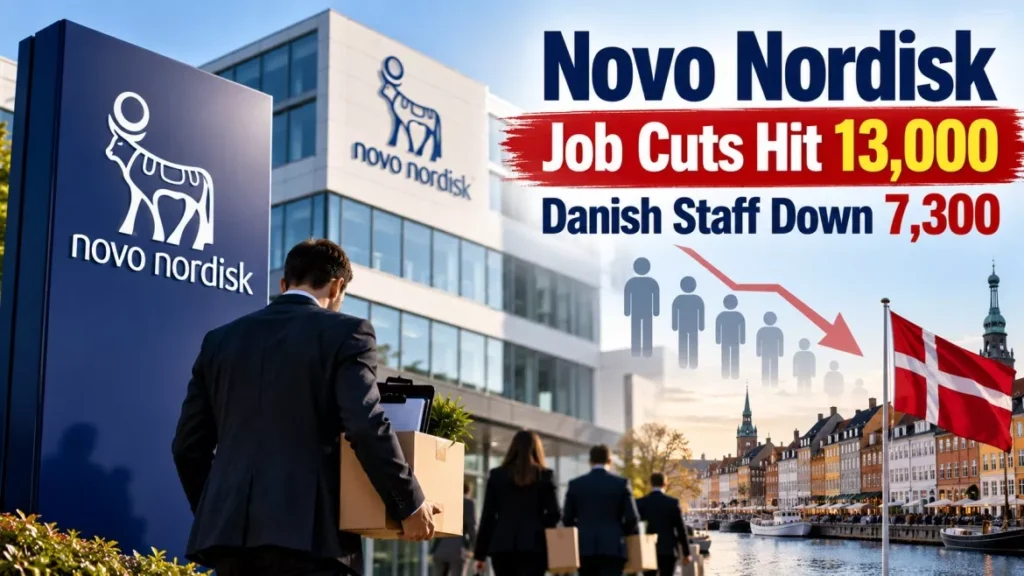

Novo Nordisk job cuts have reached 13,000, 4,000 more than the 9,000 the company announced a year ago. Chief executive Mike Doustdar disclosed the total at the Danish drugmaker’s Capital Markets Day in London on 21 September 2026, leaving about 66,000 staff worldwide. Its shares fell about 8% the same day.
A Capital Markets Day is a scheduled briefing at which a listed company sets out its strategy and financial ambitions for investors and analysts. Novo used this one to close the books on the restructuring it began in September 2025 and to put numbers on what comes next.
Where the 13,000 Job Cuts Came From
The 13,000 figure is the fall in Novo’s global headcount over roughly a year, not a single redundancy round. It combines the 9,000 roles the company said in September 2025 it intended to remove with about 4,000 further departures on top of that plan.
That distinction matters. A change in headcount also captures people who resigned and were not replaced, vacancies left unfilled, and contracts that simply ended. Novo has not published a split between compulsory redundancies and other exits, so the 13,000 should be read as the size of the shrinkage, not as a count of dismissal letters.
| Point in time | Global headcount |
|---|---|
| September 2025, when the restructuring was announced | About 78,400 |
| 21 September 2026, Capital Markets Day | About 66,000 |
As of 23 September 2026, that is where the programme stands: Novo employs approximately 66,000 people globally, the figure carried in its own Capital Markets Day announcement, and the company has not announced a further reduction target.
The original plan was costed rather than open-ended. Novo said in September 2025 it was aiming for annualised savings of DKK 8 billion, worth roughly $1.26 billion at the time, by the end of 2026, with around 5,000 of the 9,000 roles expected to go in Denmark.
Denmark Absorbed More Than Half the Decline
Novo’s Danish workforce fell by 7,309 people between September 2025 and the end of July 2026, well beyond the roughly 5,000 the company signalled at the start. Danish headcount dropped from 33,820 to 26,511 over that period, a decline of about 22%.
| Denmark headcount | Employees |
|---|---|
| September 2025 | 33,820 |
| End of July 2026 | 26,511 |
| Change | Down 7,309, or about 22% |
The same caveat applies to the Danish numbers as to the global ones: the gap between the two readings includes voluntary departures and roles left vacant, and is not a tally of people made redundant. Novo has not broken out its headcount change for any other country.
The concentration is not surprising in itself. Novo is Denmark’s largest company by market value and its production, research and head-office functions are heavily clustered around Bagsværd and Kalundborg. What is new is the scale: Denmark accounted for more than half of a worldwide decline that the company originally framed as a global exercise.
What Novo Is Doing With the DKK 10 Billion
Novo told investors the restructuring has generated more than DKK 10 billion in savings, about $1.5 billion, and that the money is being redirected rather than returned to shareholders. The company said the savings are going into research and development, into commercial support for growth brands, and into resizing manufacturing.
Doustdar framed the cuts as a trade. “These were not easy decisions for us to make, but they were necessary,” he said at the London briefing, linking them to reinvestment in the pipeline.
The pressure behind that trade is commercial. Novo’s obesity and diabetes franchise, built on the GLP-1 medicines Ozempic and Wegovy, has been losing share to Eli Lilly, and payers have been tightening what they will cover. Massachusetts insurers withdrew GLP-1 coverage for weight loss this year, one example of the reimbursement squeeze the class now faces.
Why the Shares Fell on the Day
Investors marked Novo down because the targets it attached to the savings were modest. The stock closed at DKK 260.00 on Nasdaq Copenhagen on 21 September 2026, down about 8% from DKK 281.55, and its New York-listed American Depositary Receipts, the US-traded certificates that stand in for Copenhagen shares, fell by a similar margin to about $39.81.
The 2030 and 2035 ambitions Novo published set out scale rather than speed:
- More than five multi-blockbusters by 2030: products the company expects to become major sellers in their own right.
- At least five Phase 3 programmes in obesity and diabetes, and at least five in other therapy areas: Phase 3 is the final large-scale human trial stage before a regulator is asked to approve a medicine.
- More than 60 million patients served globally by 2030: a reach target rather than a revenue one.
- More than DKK 150 billion in risk-adjusted pipeline sales by 2035: about $23 billion, with each candidate’s forecast sales discounted by its probability of success, according to Novo’s Capital Markets Day announcement.
- Revenue growth in line with peers from 2026 to 2030: compound annual growth broadly matching other large pharmaceutical companies, with a broadly stable operating margin and an attractive dividend per share.
That last line was the problem for the market. “Investors are selling the shares because they are not seeing concrete news that could drive the stock higher,” Per Hansen, investment economist at the Danish broker Nordnet, said on the day. Markus Manns, a portfolio manager at Union Investment, said the company “did not say much in terms of how to tackle the semaglutide patent expiration in 2032” — the year Novo’s US protection on the active ingredient in Ozempic and Wegovy is due to lapse.
Doustdar’s answer was that the company intends to be larger and broader by then. “We plan to come on the other side of the LOE as a bigger company than we are today and a much more diversified version of it,” he said, using the industry shorthand for loss of exclusivity. He also signalled appetite for deals: “Where you see a gap you should probably expect us to be more active in looking at business development acquisitions.”
What Novo Has Not Said
Several things were left open at the briefing. The company did not publish a country-by-country breakdown of the headcount decline outside Denmark, nor a split between redundancies and voluntary exits anywhere.
It did not rule out further reductions, and it did not set a new headcount floor. It gave no detailed plan for replacing semaglutide revenue after 2032 beyond the pipeline targets above. And while it confirmed the DKK 10 billion of realised savings, it did not restate whether the original DKK 8 billion annualised target for the end of 2026 has been met on the company’s own accounting basis.
Novo also changed its corporate name to simply “Novo” on 14 September 2026, a week before the briefing. The legal entity listed in Copenhagen and New York is unchanged.
Frequently Asked Questions
How Many Jobs Has Novo Nordisk Cut?
Novo Nordisk’s global headcount has fallen by about 13,000 over roughly a year, from about 78,400 in September 2025 to about 66,000 as of its Capital Markets Day on 21 September 2026. That is 4,000 more than the 9,000 roles the company originally said it would remove.
Were All 13,000 People Made Redundant?
No. The 13,000 is the change in total headcount, which also reflects voluntary departures and vacancies left unfilled. Novo has not published a split between compulsory redundancies and other exits.
How Many of the Novo Nordisk Job Cuts Were in Denmark?
Novo’s Danish headcount fell from 33,820 in September 2025 to 26,511 at the end of July 2026, a decline of 7,309, or about 22%. The company had originally signalled around 5,000 Danish reductions.
How Much Money Have the Cuts Saved?
Novo told investors on 21 September 2026 that the restructuring has generated more than DKK 10 billion, about $1.5 billion, which it is putting into research and development, commercial support for growth brands and manufacturing resizing. The original September 2025 target was DKK 8 billion of annualised savings by the end of 2026.
Why Did Novo Nordisk Shares Fall After the Announcement?
The shares closed down about 8% at DKK 260.00 in Copenhagen on 21 September 2026 because the growth targets disappointed investors, who had hoped for above-peer revenue growth. Analysts also noted the company gave little detail on how it will handle the 2032 expiry of its US semaglutide patent.