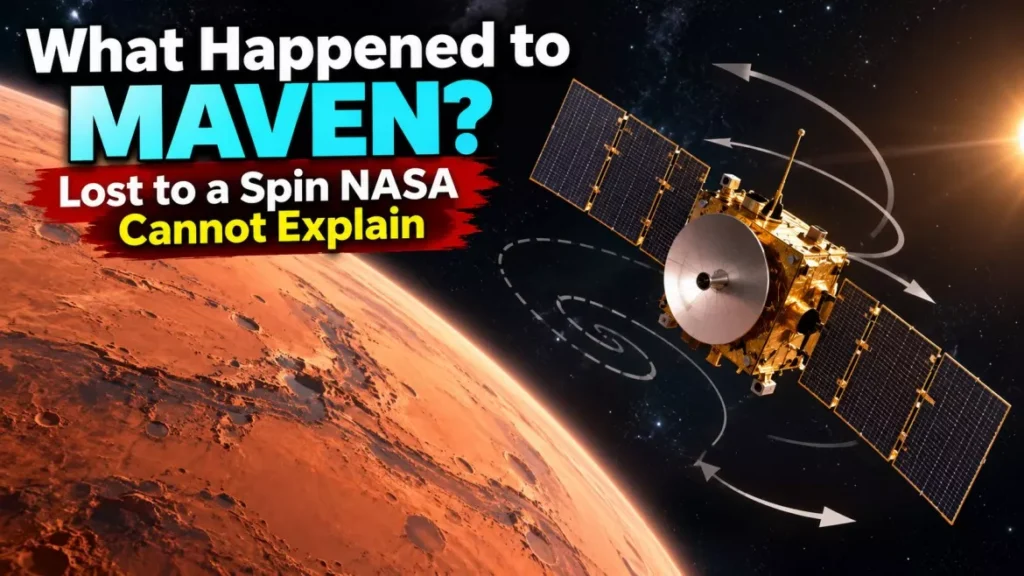

MAVEN is dead. NASA’s Mars atmosphere orbiter lost contact on 6 December 2025 after emerging from behind the planet spinning at about 2.7 revolutions per minute, which drained its batteries. NASA declared the mission over on 3 June 2026, after six months of silence.
What Went Wrong on 6 December 2025?
MAVEN went into a routine pass behind Mars with every system reporting normally and came out the other side rotating far faster than its design allowed. Ground stations listened for the scheduled signal and heard nothing.
The evidence came from a recording rather than a live link. Engineers went back through Deep Space Network data captured for an ongoing radio science experiment and pulled out fragments from the moment the orbiter reappeared, which showed it turning at roughly 2.7 revolutions per minute.
Mike Moreau, MAVEN project manager at NASA’s Goddard Space Flight Center, said that rate was faster than the spacecraft was expected to rotate and pointed to a problem it probably could not recover from. A spacecraft tumbling at that speed cannot hold its solar arrays on the Sun, and MAVEN’s batteries ran flat over the following hours.
Why Could NASA Not Recover It?
Once the batteries were empty the radio had no power, so there was no receiver left to send a command to. Recovery attempts ran for weeks without a single response.
NASA opened a formal anomaly review in late January 2026 and convened a review board in February to judge whether anything could be salvaged. The board concluded the orbiter was unrecoverable, and NASA ended the mission on 3 June 2026.
By then the spacecraft had been silent for just under six months. Nothing has been heard from it since 6 December 2025.
Does NASA Know What Caused the Spin?
No. The mechanism of the failure is established, but the thing that started it has not been publicly identified, and that remained true as of 1 October 2026.
The review board traced the chain backwards with confidence: the spin prevented charging, the batteries drained, the radio died. What tipped a healthy spacecraft into that spin in the first place is the open question. NASA said the root cause investigation was continuing when it announced the end of the mission.
A final report from the board was expected later in 2026. No such report had been published at the time of writing, so anyone claiming a definite cause for MAVEN’s failure is ahead of the evidence.
Is MAVEN Still in Orbit Around Mars?
Yes. The spacecraft is still circling Mars, inert and silent, and it has not crashed.
Estimates put its remaining orbital life at 50 to 100 years. The planet’s thin upper atmosphere will keep dragging at it until the orbit decays and the hardware burns up, which is the ordinary fate of dead Mars orbiters rather than anything specific to this failure.
There is a certain symmetry to it. MAVEN was built to measure the Martian upper atmosphere, and that same atmosphere will eventually bring it down.
What the Loss Means for Curiosity and Perseverance
The rovers still get their data back to Earth, but through four relay orbiters instead of five. MAVEN had been one of the busiest links in that chain.
| Orbiter | Operator | Status |
|---|---|---|
| Mars Odyssey | NASA | Operational |
| Mars Reconnaissance Orbiter | NASA | Operational |
| Mars Express | European Space Agency | Operational |
| Trace Gas Orbiter | European Space Agency | Operational |
| MAVEN | NASA | Lost, mission ended June 2026 |
MAVEN’s relay record was unusually strong for a spacecraft whose main job was science. NASA says it holds the solar system record for the most data relayed from another planet in a single day.
Mission managers reported that the remaining four orbiters absorbed the gap without major disruption, though with occasional delays in getting rover data down. The practical effect on Curiosity and Perseverance has been slower scheduling rather than lost science.
What MAVEN Found Before It Went Silent
MAVEN’s purpose was to work out how Mars lost its atmosphere, and it answered that question. NASA credits the mission with more than 800 scientific publications over its lifetime.
It made the first measurements of atmospheric sputtering at any planet, identified several distinct types of Martian aurora, and was the first to observe how solar storms speed up the erosion of the atmosphere into space. Its findings on where the air went sit alongside other work on where the planet’s water may still be hiding underground.
In the weeks before the anomaly it also observed the interstellar comet 3I/ATLAS from Mars orbit. Louise Prockter, director of NASA’s Planetary Science Division, said the mission’s science is key to deciding what radiation protection will be needed before sending humans to Mars.
The data has outlived the hardware. In May 2026, five months after MAVEN fell silent and a month before the mission was formally closed, a study in Nature Communications used its measurements to report the Zwan-Wolf effect in a planetary atmosphere for the first time, a squeezing of charged particles along magnetic structures previously known only in magnetospheres. The work was led by Christopher Fowler of West Virginia University, with MAVEN principal investigator Shannon Curry of the Laboratory for Atmospheric and Space Physics at the University of Colorado Boulder among the contributors. Fowler said no one expected the effect could occur in an atmosphere at all.
Frequently Asked Questions
Is MAVEN Still Working?
No. It has been unresponsive since 6 December 2025 and NASA formally ended the mission on 3 June 2026.
Did MAVEN Crash Into Mars?
Not yet. It is still in orbit and is expected to stay there for another 50 to 100 years before the atmosphere pulls it down.
How Long Did MAVEN Operate?
It launched in November 2013, reached Mars orbit in September 2014 and worked for more than 11 years, against a primary mission NASA had planned for about one year.
Can the Mars Rovers Still Send Data Without MAVEN?
Yes. Four orbiters remain in the Mars Relay Network, two from NASA and two from the European Space Agency.
What Does MAVEN Stand For?
Mars Atmosphere and Volatile Evolution, a mission built to measure the upper atmosphere and how much of it escapes to space.