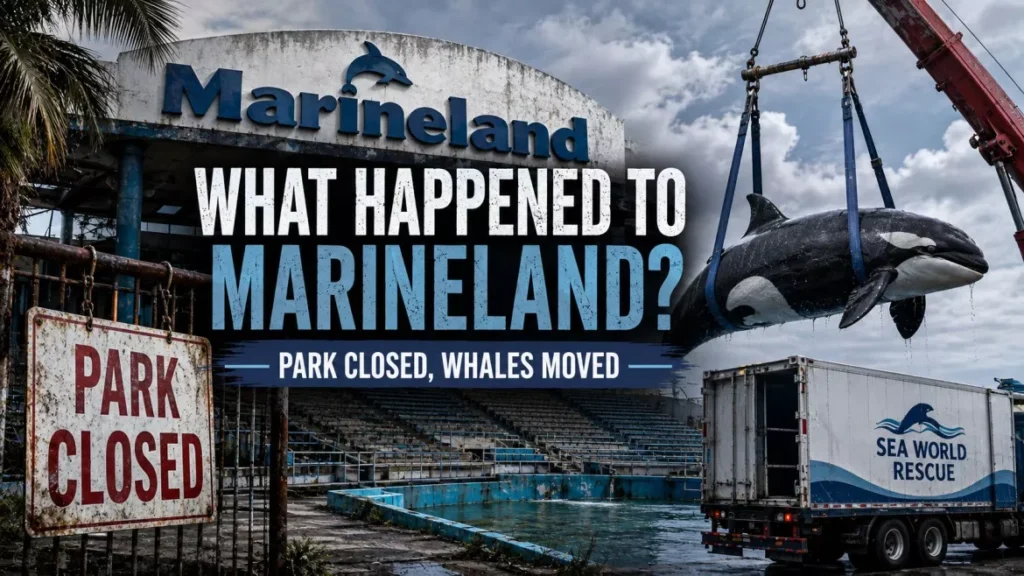

Marineland of Canada closed to the public in September 2024 and never reopened. The Niagara Falls park spent 2026 relocating 30 beluga whales and four dolphins to aquariums in the United States and Spain, working to a self-imposed deadline of 31 August. The land it sits on is for sale.
Why Did Marineland Close?
Marineland closed because it ran out of money, ran out of owners and ran out of political room to keep whales in Canada. The three problems arrived within a few years of each other, and none of them had a solution the park could afford.
The park opened in 1961 as Marine Wonderland and Animal Farm, built by John Holer, a Slovenian immigrant who had worked with circuses in Europe. He started with three sea lions in a pair of welded steel tanks and charged a quarter for admission. Over six decades it grew into a Niagara Falls institution, advertised by a television jingle that a generation of Canadians can still sing.
Holer died in June 2018. His widow, Marie Holer, took over, put the park up for sale in early 2024, and died that September, days after Marineland closed to visitors for the last time. The estate went into a trust, and the trust never opened the gates again.
The 2024 season was already a shadow of the park’s peak. It ran only from late June to 1 September, with the rides shut and admission cut. There was no 2025 season and no 2026 season.
What Happened to Marineland’s 30 Beluga Whales?
All 30 belugas and four dolphins were flown to accredited aquariums in the United States and Spain during July and August 2026, in what handlers described as the largest collective relocation of captive whales ever attempted. The moves ran in batches of two to seven animals, grouped so that whales with existing social bonds travelled together.
The first four belugas, named Acadia, Osiris, Sierra and Lillooet, landed at Chicago’s Shedd Aquarium at the end of July 2026. Further groups followed through August to SeaWorld parks in San Antonio and San Diego, the Georgia Aquarium in Atlanta, and L’Oceanogràfic in Valencia. Mystic Aquarium in Connecticut contributed veterinary and logistical expertise without housing any of the animals.
Karisa Tang, the Shedd Aquarium’s lead veterinarian and vice president of animal health, said after that first transport that it had gone as well as it possibly could have and that every human and animal involved was safe. Each flight required tailored slings, water-cooled transport containers and veterinary staff travelling alongside the whales.
Animal advocates had pushed for a different destination entirely. Their preferred outcome was a seaside sanctuary rather than another set of commercial marine parks, and a proposal for one in Nova Scotia was discussed publicly. No sanctuary capable of receiving 30 belugas was operational when the deadline arrived, so the aquarium route was the only one available.
| Destination | Location | Role in the move |
|---|---|---|
| Shedd Aquarium | Chicago, United States | Received the first belugas in July 2026 and further groups in August |
| SeaWorld San Antonio | Texas, United States | Received a group of seven belugas in early August 2026 |
| SeaWorld San Diego | California, United States | Received belugas during the August 2026 transfers |
| Georgia Aquarium | Atlanta, United States | Received belugas in the mid-August 2026 transfers |
| L’Oceanogràfic | Valencia, Spain | Received the four dolphins and two belugas in late August 2026 |
| Mystic Aquarium | Connecticut, United States | Provided expertise to the operation; housed no Marineland animals |
Final per-facility tallies were still being confirmed as the last flights went out, so the totals above are described by role rather than by exact head count.
Not every animal survived the process. A 23-year-old female beluga named Peekachu died at the Shedd Aquarium on 25 August 2026, twelve days after her transfer, as staff were treating her for dehydration. She was the only transfer death reported during the operation as of late August 2026.
Smaller residents moved separately. Two sea lions went to Vancouver in February 2026, according to reporting by the environmental news outlet Mongabay, and the park’s seals and land animals were handled outside the cetacean permits.
Did Marineland Threaten to Euthanize Its Whales?
Yes. Marineland twice told the Canadian government that its whales would be killed if it did not get either an export permit or emergency public funding.
The first standoff came in autumn 2025. Marineland had asked Ottawa for permission to send all 30 belugas to Chimelong Ocean Kingdom, a marine park in China, arguing it was the only facility large enough to take the whole pod and rich enough to move quickly. On 1 October 2025, Fisheries Minister Joanne Thompson refused the permit, saying she could not in good conscience approve a transfer that would mean, in her words, a continued life in captivity and a return to public entertainment.
Marineland’s response was blunt: without the permits, bankruptcy was inevitable and the whales would either fall into government custody or be euthanized. The park then asked the federal government for emergency money to keep feeding and treating the animals.
The second deadline came that winter. Marineland warned the animals would be euthanized if export permits were not authorised by the end of January 2026. On 26 January 2026, Thompson granted conditional approval for exports to United States facilities, stating that she had provided conditional approval and would issue the final permits once the remaining required information arrived from Marineland.
What Happened to Kiska, Canada’s Last Captive Orca?
Kiska died at Marineland in March 2023, the last killer whale held in captivity in Canada. She had lived at the park since 1979 and had been without another orca for company since 2011, which earned her the widely used nickname “the world’s loneliest whale”.
Her death closed a chapter that Canadian law had already written the ending for. Ontario banned the acquisition and breeding of orcas in 2015, allowing the one animal already at Marineland to remain. When Kiska died, there was no legal route to replace her.
Kiska was one of 20 whales to die at Marineland from 2019 onward. The other 19 were belugas. Ontario’s Animal Welfare Services opened an investigation into the park in 2020, and freedom-of-information requests by Canadian journalists kept the death toll in public view for years.
How Did a Park With 30 Whales Run Out of Money?
Marineland’s costs stayed roughly constant while its only source of revenue disappeared. A closed park still has to feed, heat, filter and medicate 34 cetaceans, and after September 2024 there were no ticket sales at all.
Reputation drove the decline that preceded it. A 2012 investigation by the Toronto Star, built on accounts from former employees, described poor water quality and unexplained animal deaths, and the coverage marked the point at which public opinion turned. Attendance and sponsorship pressure followed.
Regulation closed the other exit. Canada’s Bill S-203, the Ending the Captivity of Whales and Dolphins Act, passed the House of Commons in June 2019 and banned the capture, breeding and acquisition of cetaceans. Animals already held were grandfathered in, which meant Marineland could keep its belugas but could never breed or buy more. The park was left running a business model with a fixed, ageing and unreplaceable inventory.
Its animal welfare record also cost it in court. Anti-cruelty charges proceeded against Marineland twice: once in 2021 over water quality for its cetaceans, and once over its care of black bears, a case that concluded in 2024 and found the animals had been kept in cramped conditions with poor access to water.
By the end, the arithmetic was simple and unforgiving. Andrew Burns, the lawyer who worked on the relocation, framed the urgency in personal terms, saying he was not going to his grave with another dead whale on his conscience.
Is This the Same Marineland That Closed in France?
No. Three separate marine parks use the Marineland name, and two of them made closure news within roughly a year of each other, which is why search results for the name are so tangled.
- Marineland of Canada, Niagara Falls, Ontario. Opened 1961, closed to the public September 2024, animals relocated in 2026. This is the park most current news refers to.
- Marineland of Antibes, on the French Riviera. Closed on 5 January 2025 after more than 50 years, following a 2021 French law banning live dolphin and whale shows. Annual attendance had fallen from about 1.2 million to roughly 425,000 over the previous decade. Its two orcas, Wikie and her son Keijo, and a group of dolphins remained at the shuttered site well into 2025 while their destinations were disputed.
- Marineland of Florida, south of St. Augustine. Opened on 23 June 1938 as Marine Studios and billed as the world’s first oceanarium. It was acquired by the Georgia Aquarium in 2011 and operates today as Marineland Dolphin Adventure. It has not closed.
The Georgia Aquarium connection is a genuine one rather than a coincidence of naming: the same organisation that owns the Florida site took in belugas from the Canadian park in August 2026.
What Happens to the Marineland Property Now?
The site is for sale, and emptying it of animals was the precondition for anything else happening to it. The grounds sit a few kilometres from Horseshoe Falls, on some of the most commercially valuable tourist land in Ontario.
The City of Niagara Falls granted approval to subdivide the property, a procedural step that makes a staged sale or redevelopment possible. Estimates of the site’s size vary between published sources, so no single acreage figure can be stated with confidence.
No buyer had been publicly named as of late August 2026. Niagara Falls MPP Wayne Gates has said publicly that he understands a third party is interested and looking at options for the land, but no purchase agreement or redevelopment plan has been announced.
Where Things Stand as of 29 August 2026
As of 29 August 2026, Marineland of Canada is permanently closed, the last handful of belugas were in the final stage of relocation against a 31 August target, and the property remains unsold with no announced buyer.
By 26 August 2026, the four dolphins and two more belugas had left for Valencia and roughly six belugas remained on site awaiting flights. When the final animal leaves, Canada will hold no captive whales or dolphins for the first time in more than sixty years.
What has not been settled is the land. Until a sale is announced, the honest answer about Marineland’s future is that the park is finished and the site’s next use is undecided.
Frequently Asked Questions
Is Marineland Canada Permanently Closed?
Yes. Marineland closed to the public in September 2024 and did not open for the 2025 or 2026 seasons. Its animals were removed in 2026 and the property was put up for sale.
Where Did the Marineland Belugas Go?
They were flown to the Shedd Aquarium in Chicago, SeaWorld parks in San Antonio and San Diego, the Georgia Aquarium in Atlanta, and L’Oceanogràfic in Valencia, Spain, during July and August 2026.
Did Any Marineland Whales Die During the Move?
One. A 23-year-old beluga named Peekachu died at the Shedd Aquarium on 25 August 2026, twelve days after her transfer, while being treated for dehydration.
Why Was Marineland Not Allowed to Send Its Whales to China?
Fisheries Minister Joanne Thompson denied the export permit on 1 October 2025, saying the transfer would have meant continued captivity and a return to public entertainment, which conflicts with Canada’s 2019 cetacean law.
Who Owns Marineland Now?
The park has been held in a trust since the death of owner Marie Holer in September 2024. No new owner or buyer for the property had been publicly named as of late August 2026.
What Happened to Kiska the Orca?
Kiska died at Marineland in March 2023. She had been at the park since 1979 and was the last captive killer whale in Canada.