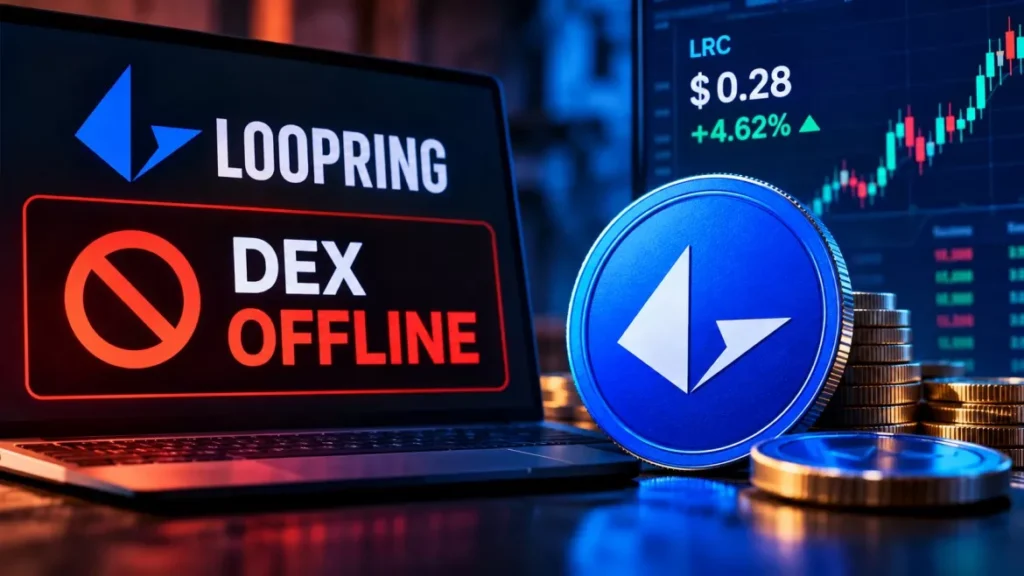

Loopring shut down its decentralised exchange, automated market maker and relayer on 28 June 2026, ending Ethereum’s first zk-rollup. The team said the project had never gained meaningful adoption. Total value locked had already fallen about 99 percent, from roughly $760 million in November 2021 to around $8 million.
What Loopring Was
Loopring was an Ethereum layer-2 protocol that used zkRollup technology to settle trades off-chain while relying on Ethereum for security.
Daniel Wang founded it in 2017 and the protocol reached Ethereum’s mainnet in December 2019. It is widely described as the first zk-rollup to run on Ethereum, which made it an early reference point for everything that followed in the layer-2 scaling field.
Its highest-profile moment came in 2022, when the beta of GameStop’s NFT marketplace launched built on Loopring’s layer 2. GameStop also worked with Immutable X, and contemporary reports disagreed on how exclusive Loopring’s role was.
What Loopring Said When It Shut Down
The team posted a closing statement on X on 28 June 2026 and stopped trading the same day, with no transition period.
Its own explanation was unusually blunt for a crypto wind-down. The reasons it gave were these:
- Adoption: “To be honest, Loopring never gained meaningful adoption.”
- Architecture: “As the first zk-rollup, we lacked a virtual machine — no composability, no real-world payment use cases.”
- Commercial skills: The team called itself “engineers at heart” and said it had not built the business development function a trading ecosystem needs.
- Competition: Rivals that were fully compatible with Ethereum smart contracts left its design behind, and the team said its “specialised architecture now feels obsolete”.
- Market pressure: “External pressures — including major exchange delistings of LRC in 2026 — only accelerated the inevitable.”
No hack, exploit or regulatory action was given as a cause. By the team’s own account this was a product that failed to find users.
How Far Loopring Fell
The decline was visible in both the protocol’s deposits and its token long before the closure.
Total value locked peaked at roughly $760 million in November 2021 and stood at about $8 million by the time of the shutdown, a fall of almost 99 percent, according to L2Beat data cited in contemporary coverage. The LRC token followed the same path, dropping from an all-time high of $3.75 in November 2021 to around one cent.
Those two figures explain the wind-down more plainly than any statement. A trading protocol with eight million dollars of deposits cannot fund the engineering it takes to compete with a zkEVM.
The Delisting Sequence That Came First
Exchanges began removing LRC months before the protocol closed, and the removals continued after it.
| Date | Event |
|---|---|
| 30 June 2025 | Loopring Smart Wallet service ceased |
| July 2025 | Dual Investment and Portal products sunset |
| 16 March 2026 | Upbit and Bithumb removed LRC trading |
| 1 April 2026 | Binance delisting took effect |
| 28 June 2026 | DEX, AMM and relayer shut down |
| 7 August 2026 | Coinbase trading suspension scheduled |
Upbit cited concerns about disclosure and long-term sustainability when it removed the token. The sequence matters because the team named those delistings as an accelerant, which makes the exchanges part of the cause rather than only a consequence.
How User Funds Were Returned
Loopring moved from a trustless exit to a process its own team controlled.
The published plan was to calculate every final user balance, publish the list, and then send funds to users’ Ethereum layer-1 addresses in batches with Loopring covering the gas fees. Users were given a two-week window to review the published figures and flag discrepancies.
Two conditions drew criticism. Withdrawals were restricted to whitelisted addresses the team controlled, which removed the trustless exit that zk-rollups are meant to guarantee, and accounts with a final balance below $10 were excluded from the distribution altogether. Holders below that floor therefore depended on interacting with their smart contract wallets directly rather than on the batch process.
Does the LRC Token Still Exist?
Yes. LRC remains an ERC-20 token on Ethereum and did not stop existing when the protocol closed.
What changed is everything behind it. Reporting on the wind-down describes no active development, no protocol revenue and no staking mechanism, which leaves the token without the utility it was issued for.
Access has narrowed rather than vanished. After the Upbit, Bithumb, Binance and Coinbase removals, LRC was still listed on a smaller set of venues including Kraken as of mid-2026, and it remains tradable on Ethereum layer-1 decentralised exchanges such as Uniswap, because an ERC-20 contract keeps working whether or not its issuer does.
Where Loopring Stands as of 18 October 2026
Loopring is not operational. The exchange, the market maker and the relayer are off, the zkRollup infrastructure was wound down over mid-2026, and no relaunch has been announced.
The closing statement of 28 June 2026 remains the team’s last substantive public word on the protocol’s future. Nothing published since then indicates a restart, a merger or a migration to another chain.
For anyone tracking the asset rather than the product, the distinction is the whole story: the company stopped, the contract did not.
Frequently Asked Questions
Is Loopring Dead?
As a product, yes. The decentralised exchange, automated market maker and relayer stopped on 28 June 2026, and reporting on the wind-down describes no active development or protocol revenue. The LRC token contract still exists on Ethereum.
Can LRC Still Be Traded?
On fewer venues than before. Upbit, Bithumb, Binance and Coinbase all removed or suspended LRC during 2026, while Kraken and some smaller exchanges still listed it as of mid-2026, and it remains available on Ethereum layer-1 decentralised exchanges.
What Happened to Balances Under $10?
They were excluded from the batch distribution. Reporting on the wind-down terms states that accounts with a final balance below $10 did not receive funds through the team’s process.
Who Founded Loopring?
Daniel Wang founded Loopring in 2017. He moved from chief executive to an advisory role in early 2022 and went on to work on Taiko, a separate zero-knowledge layer-2 project.