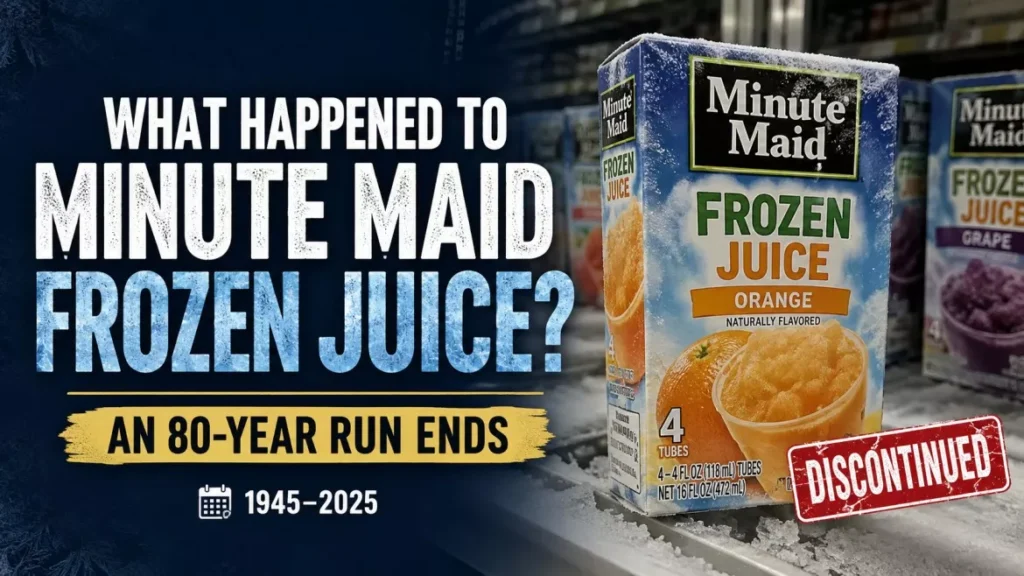

Minute Maid frozen juice concentrate was discontinued by Coca-Cola across the United States and Canada, ending an 80-year run. The company announced the decision in early February 2026 and expected the cans of orange juice, lemonade and limeade to clear shelves by that April. The wider Minute Maid brand continues.
What Exactly Was Discontinued, and What Wasn’t
Only the frozen canned concentrates were killed off. Minute Maid remains a going concern as one of Coca-Cola’s largest juice brands, and its chilled cartons, juice boxes, lemonade and sugar-free lines are unaffected.
The discontinued range covered frozen concentrated orange juice plus the frozen lemonade family, including pink lemonade, raspberry lemonade and limeade. These were the small cylindrical cans kept in the freezer case, emptied into a jug and topped up with three cans of water.
A Coca-Cola spokesperson put it directly, saying the company was discontinuing its frozen products and exiting the frozen can category in response to shifting consumer preferences. In a separate statement the company said that with the juice category growing strongly, it was focusing on products that better matched what consumers wanted.
Coca-Cola confirmed the withdrawal applies to North America. It did not announce a global exit from concentrate manufacturing, which remains a bulk commodity traded worldwide, and it did not touch Hi-C or the other juice-adjacent brands it runs alongside Minute Maid.
The distinction matters because the headlines were widely misread. A shopper seeing “Minute Maid discontinued” could reasonably conclude the brand was finished, when what ended was a single format that had been in decline since before most shoppers were born.
Why Did Coca-Cola Kill the Frozen Cans?
Demand had been shrinking for half a century, and the last few years finished it. Sales in the frozen juice category fell close to 8 percent in the 52 weeks ending 24 January, according to figures from the market research firm NIQ that were widely reported when the decision was announced.
The decline is much older than that number suggests. Frozen concentrate was how most Americans drank orange juice in the 1950s and 1960s, but improved pasteurisation and refrigerated distribution made ready-to-drink cartons practical, and shoppers stopped wanting a product that required a jug, a spoon and ten minutes of thawing.
By the 2010s frozen concentrate accounted for roughly 7 percent of the American orange juice market, according to Wall Street Journal figures cited in trade coverage of the shutdown. A category at that size supports very little dedicated freezer space in a supermarket, and freezer space is among the most expensive real estate in a grocery store.
Competition also changed shape. The shelf slot a can of concentrate once occupied now competes with energy drinks, protein shakes and functional beverages, categories that grew while juice did not.
Coca-Cola was not retreating from juice, which is the detail that explains the timing. The company reported gains in the juice category and success with a sugar-free Minute Maid variety in North America, part of the same portfolio logic behind its zero-calorie soft drinks. The frozen cans were cut to free resources for lines that were growing, not because juice itself had failed.
Why the Announcement Struck a Nerve
The reaction was disproportionate to the product’s actual sales, which is usually the sign of a discontinued item that people remember more than they buy. Coverage in February 2026 filled with readers describing childhood kitchens, and a recurring theme in the comments was some version of “I grew up on these”.
Frozen concentrate carried a specific domestic ritual: the can upended into a jug, the frozen plug broken up with a wooden spoon, three cans of cold water measured back in. That is a memory with choreography, and it does not attach to a carton.
It was also a budget staple. For decades a can of concentrate was among the cheapest ways to put juice on a table, which is exactly why its price rising above the price of ready-to-drink cartons removed its last practical argument.
The Other Half of the Story: Oranges Got Expensive
A collapsing orange supply made a cheap product stop being cheap, and cheapness was the entire point of frozen concentrate. A 12-ounce can averaged about $4.82 in December 2025, roughly 13 percent more than a year earlier, according to price data reported alongside the discontinuation.
The pressure comes from the groves. Citrus greening disease, combined with hurricanes, has cut Florida’s growing area to about a third of its size two decades ago, and the state’s 2024-25 orange crop was projected to be its smallest since before the Second World War.
Brazil, the world’s dominant supplier, is under strain too. The Brazilian crop monitor Fundecitrus forecast that the São Paulo and western Minas Gerais citrus belt would produce 255.2 million 90-pound boxes in the 2026-27 season, down about 13 percent from the previous season’s estimate, with greening alone expected to destroy close to 50 million boxes.
Global orange juice output was forecast to fall around 13 percent in 2026-27. Demand is falling as well, which is the unusual part of this market: American orange juice consumption has dropped by more than half since 2000, so higher prices are meeting fewer buyers rather than more.
Can You Still Buy Frozen Juice Concentrate?
Yes, but not from Minute Maid. The category shrank rather than vanished, and at least two kinds of replacement remained on North American shelves after Minute Maid’s exit.
| Option | Status after the Minute Maid exit | Notes |
|---|---|---|
| Minute Maid frozen cans | Discontinued | Production ended; remaining stock sold while supplies lasted through early 2026 |
| Tropicana frozen concentrate | Still sold | Tropicana, founded in 1947, continued to offer frozen canned juice |
| Supermarket private-label concentrate | Still sold | Store-brand frozen concentrates remained on the market, though ranges vary by chain |
| Minute Maid chilled cartons | Unaffected | Ready-to-drink juice, lemonade and other Minute Maid lines continue normally |
Availability of the remaining options is regional. Frozen juice is a declining category overall, so a store that stocked four concentrate varieties a decade ago may now carry one, or none.
Canadian shoppers are in the same position as American ones, since the discontinuation covered both markets. Outside North America, Coca-Cola made no equivalent announcement, so Minute Maid products elsewhere follow whatever the local range already was.
If a specific frozen concentrate matters to a household, the reliable approach is to check the freezer case rather than an online listing. Retail inventory systems have been slow to drop discontinued items, and stock photography for delisted products often remains live long after the product itself has gone.
What to Use Instead in Recipes
Frozen concentrate was never only a drink, which is why the discontinuation hit cooks harder than it hit juice drinkers. It worked as a concentrated sweetener, an acid and a tenderiser all at once, in a shelf-stable form that ready-to-drink juice cannot replicate.
Recipes built around a thawed can include marinades and rib sauces, orange chicken glazes, vintage punches such as bourbon slush, and freezer pies of the creamsicle family. In most of these the concentrate supplies intensity rather than volume, so a straight swap for ordinary juice will thin the result and dull the flavour.
The practical substitutes are another brand’s frozen concentrate, which is the closest match, or reducing ordinary orange juice on the stove to roughly a quarter of its volume and cooling it before use. For baking, some cooks replace part of the sugar and liquid rather than trying to reproduce the concentrate itself.
How Frozen Concentrate Conquered the American Breakfast
The product began as a wartime military order that was never delivered. The National Research Corporation won a United States Army contract worth about $750,000 to supply 500,000 pounds of powdered orange juice, but the war ended before the factory was even built.
What survived was the technology. The company reorganised as Florida Foods Corporation in 1945 and then Vacuum Foods Corporation, and instead of powder it commercialised frozen concentrated orange juice, a process that stripped roughly 80 percent of the water out of the juice. Researchers C. D. Atkins, Edwin Moore and Louis MacDowell had developed the underlying concentration method during the 1940s.
The first Minute Maid shipment went out on 30 April 1946. The brand name came from a Boston advertising firm, H. A. Loudon Advertising, and was chosen to signal that the juice was quick to prepare.
Marketing did the rest. In October 1948 Bing Crosby began a five-day-a-week radio show promoting the brand, running until October 1950, and the singer’s association helped turn a novelty into a household staple. Coca-Cola bought the business, with Minute Maid merging into the company in December 1960.
The timing was close to perfect. Home freezers were spreading through American kitchens in the same postwar years, supermarkets were adding frozen food cabinets, and a product that turned into fresh-tasting juice for a fraction of the cost of bottled juice arrived exactly when households had somewhere to keep it.
That advantage was technological, and technology took it away again. Once chilled distribution could move pasteurised juice across the country reliably, concentrate’s whole selling point, that water is heavy and expensive to ship, stopped mattering to the shopper.
Is Minute Maid Frozen Juice Gone for Good?
As of 29 August 2026, the product is discontinued with no announced plan to bring it back. Coca-Cola framed the move as an exit from the frozen can category rather than a pause, which is stronger language than a company uses when it intends to return.
Coca-Cola’s stated timeline had production ending in the first quarter of 2026 and remaining inventory selling through by around April. No verified public update has been issued since the spring of 2026, so occasional cans may still surface in individual stores, but nothing new is being manufactured.
Brand revivals do happen in the drinks business when nostalgia and a cheap production run line up, as the long afterlife of other discontinued beverage lines shows. Nothing of the sort has been announced here, and the supply-side maths that helped kill the product has not improved.
Frequently Asked Questions
Is Minute Maid Going Out of Business?
No. Only the frozen canned concentrates were discontinued. Minute Maid remains one of Coca-Cola’s major juice brands and continues to sell chilled cartons, juice drinks and lemonade.
When Did Minute Maid Frozen Concentrate Stop Being Made?
Coca-Cola announced the decision in early February 2026 and ended production during the first quarter of that year, with remaining stock expected to sell through by around April 2026.
Why Was Minute Maid Frozen Juice Discontinued?
Coca-Cola said it was exiting the frozen can category in response to shifting consumer preferences. Frozen juice sales fell nearly 8 percent in the 52 weeks ending 24 January, and rising orange prices had pushed the price of a can up sharply.
Who Still Makes Frozen Orange Juice Concentrate?
Tropicana, founded in 1947, continued to sell frozen canned juice after Minute Maid’s exit, and various supermarket private-label frozen concentrates remain available, though ranges vary by chain and region.
What Can I Substitute for a Can of Frozen Orange Juice Concentrate?
Another brand’s frozen concentrate is the closest match. Failing that, reduce ordinary orange juice on the stove to about a quarter of its original volume and cool it before using it in the recipe.
Why Is Orange Juice So Expensive Now?
Citrus greening disease and hurricanes have cut Florida’s growing area to roughly a third of its size two decades ago, and Brazil’s 2026-27 crop was forecast to fall about 13 percent, tightening global supply.