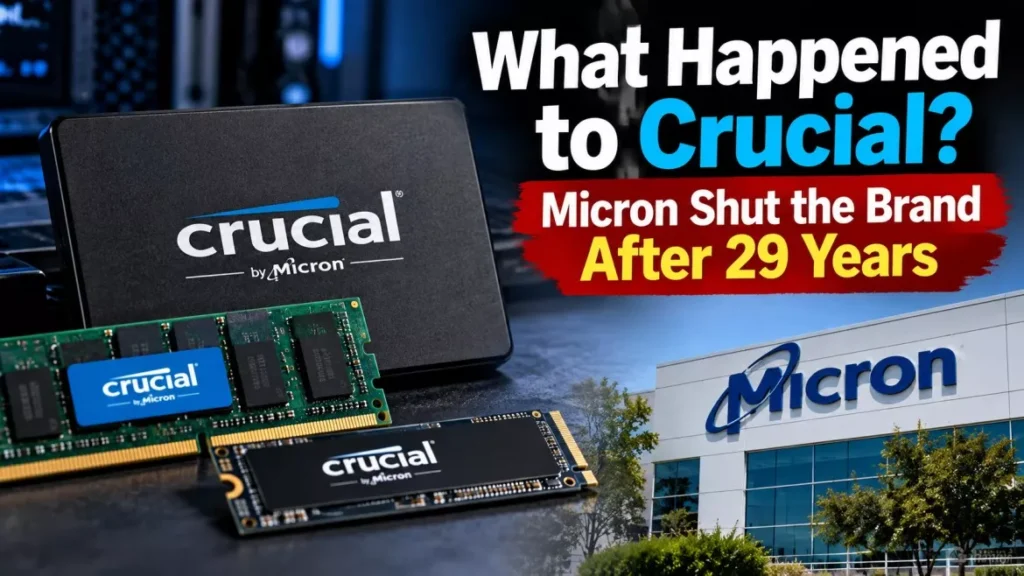

Crucial is gone as a consumer brand. Micron shut it down to redirect memory supply to AI data centre customers, announcing the exit on 3 December 2025 and ending consumer shipments in February 2026. The 29-year-old brand was wound down rather than sold.
Why Did Micron Shut Down Crucial?
Micron said it needed the memory capacity for larger data centre customers buying into the artificial intelligence build-out.
The company’s announcement from Boise, Idaho, on 3 December 2025 said it would exit the Crucial consumer business, including the sale of Crucial consumer-branded products at key retailers, e-tailers and distributors worldwide. Sumit Sadana, Micron’s executive vice president and chief business officer, said in the release that “the AI-driven growth in the data center has led to a surge in demand for memory and storage”, and that Micron had “made the difficult decision to exit the Crucial consumer business in order to improve supply and support for our larger, strategic customers in faster-growing segments”.
The logic is margin. High-bandwidth memory sold to AI accelerator makers earns far more per wafer than retail DDR5 kits and consumer SSDs, so the consumer channel was the part Micron could most afford to lose. Sadana thanked customers, partners and team members for supporting the Crucial journey “for the last 29 years”.
Micron did not leave memory. It said it would continue to support the sale of Micron-branded enterprise products to commercial channel customers globally, and the release described the move as part of a broader portfolio transformation. The company also said it would try to limit the effect on staff by redeploying them into existing open positions.
When Did Crucial Products Stop Shipping?
Crucial consumer shipments ran until the end of Micron’s fiscal second quarter, which closed in February 2026.
That covered the whole consumer range: SSDs, memory modules, flash drives and SD cards. Retail stock did not vanish on a single date, because distributors and retailers kept selling what they already held. Guidance published in August 2026 noted that shoppers could still find leftover Crucial inventory, with seller identity and warranty-replacement options varying from listing to listing.
No new Crucial models or roadmap updates have followed. The practical effect is that anything Crucial-branded on sale today is existing stock rather than current production.
Was the Crucial Brand Sold Like Lexar?
No. Micron ended Crucial itself, which is the opposite of what it did with Lexar.
The distinction matters because Micron has form for selling a consumer brand rather than closing it. In June 2017 the company announced it would discontinue its Lexar removable-media division and put selected assets up for sale. In August 2017, Longsys, a flash memory company based in Shenzhen, acquired the Lexar brand and trademark rights, though not the underlying technology. Lexar re-entered the flash storage market in 2018 and still sells products today.
Crucial has had no such second life. Micron retained the name and announced no buyer, so there is no third party in a position to revive it. Anyone expecting a Lexar-style return is waiting on a transaction that has not been announced.
What Happened to Crucial Warranties?
Micron promised continued warranty service, but through 2026 a series of claimants were offered cash refunds based on old purchase prices rather than replacement hardware.
The December 2025 release said Micron “will provide continued warranty service and support for Crucial products”. The complication is what that support turned out to be worth, because memory prices rose sharply over the same period. TrendForce projected a 105 to 110 percent quarter-on-quarter rise in PC DRAM contract prices for the first quarter of 2026, driven by capacity moving to high-bandwidth memory for AI accelerators. A kit bought cheaply in 2024 could cost several times more to replace in 2026.
Reporting on individual claims says Micron’s warranty terms let it either replace a product or refund the current market value or the original purchase cost, whichever is lower. Applied during a price spike, that wording produces refunds far below replacement cost. Three cases drew coverage:
- A 48GB DDR5 kit, reported August 2026: the owner was offered $241.86 including tax, against an equivalent kit then selling for roughly $1,400. After the case drew attention, Micron sent three 16GB Crucial Pro DDR5-6400 modules instead.
- A 128GB Crucial Pro DDR5-5600 kit, reported August 2026: one of the two 64GB modules failed, and the owner was offered $259.99, the original purchase price, against a market price of about $1,800. Crucial first approved a replacement and then withdrew it. Notebookcheck, updating the story on 5 October 2026, reported no final resolution and said the company had to check whether the returned memory had already been processed or disposed of.
- A 4TB SSD: Tom’s Hardware reported an owner offered about $200 for a drive then selling above $500, with Crucial citing depleted inventory, and said the company later met the owner’s warranty demands after a protracted exchange.
Two patterns run through the coverage. Claimants who pressed publicly tended to get better outcomes than the first offer, and in at least one case Crucial declined to return the original defective modules, citing the wind-down of its consumer business as the reason it could not arrange outbound shipments. Coverage also noted that one SSD owner raised the United States Magnuson-Moss Warranty Act and the Federal Trade Commission in correspondence; that was the customer’s argument rather than any legal finding. These are individually reported cases, not a measured failure rate, and Micron has not published claim statistics.
Who Still Sells Memory to Consumers?
Samsung and SK Hynix remain the major DRAM makers serving individual buyers directly, alongside module brands that buy chips rather than make them.
Crucial’s position was unusual because Micron manufactured the chips and sold finished retail kits under its own consumer badge. Most remaining retail memory brands assemble modules from chips bought elsewhere. Readers replacing Crucial drives have the wider field of SSD brands to choose from, while on the manufacturing side new entrants continue to appear, including CXMT’s G5 DRAM, which entered mass production in September 2026.
The supply picture has not loosened. Digitimes reported at the start of October 2026 that the market was entering the fourth quarter with weak consumer demand set against intense server buying, and that spot prices for DDR5 server modules were still climbing. Several analysts quoted through 2026 expected the structural squeeze to persist into 2027.
Is Crucial Still in Business in October 2026?
As of 8 October 2026, Crucial exists only as a warranty and support obligation. It sells nothing new.
Micron has not issued any statement since the December 2025 release reversing the exit, naming a buyer, or setting an end date for warranty support. The warranty commitment in that release carries no stated expiry, which means it is open-ended in wording and untested in duration. Owners of working Crucial hardware are unaffected until something fails; owners whose hardware has failed are in the position the 2026 cases describe.
Micron itself is not in difficulty. The exit was a reallocation by a profitable manufacturer toward a more lucrative customer base, not a retreat by a failing one, which is why the brand ended quietly rather than in a bankruptcy or a fire sale.
Frequently Asked Questions
Is Crucial RAM Still Being Made?
No. Micron ended Crucial consumer shipments at the end of February 2026 and has announced no new models. Any Crucial memory on sale now is remaining retail stock.
What Happened to Crucial SSDs?
They were discontinued in the same exit. The wind-down covered Crucial SSDs, memory modules, flash drives and SD cards, all of which stopped shipping through the consumer channel after February 2026.
Does a Crucial Warranty Still Work?
Micron said in December 2025 that warranty service and support would continue, with no stated end date. Reported 2026 claims show the remedy has often been a cash refund capped at the lower of the original purchase price or current market value, rather than replacement hardware.
Who Owns the Crucial Brand Now?
Micron. Unlike Lexar, which Micron sold to Longsys in August 2017, Crucial was wound down and the name was not sold to any third party.
Will the Crucial Brand Come Back?
There is no announced plan for it to return. As of October 2026 Micron has named no buyer and signalled no revival, and its stated priority remains data centre and enterprise customers.