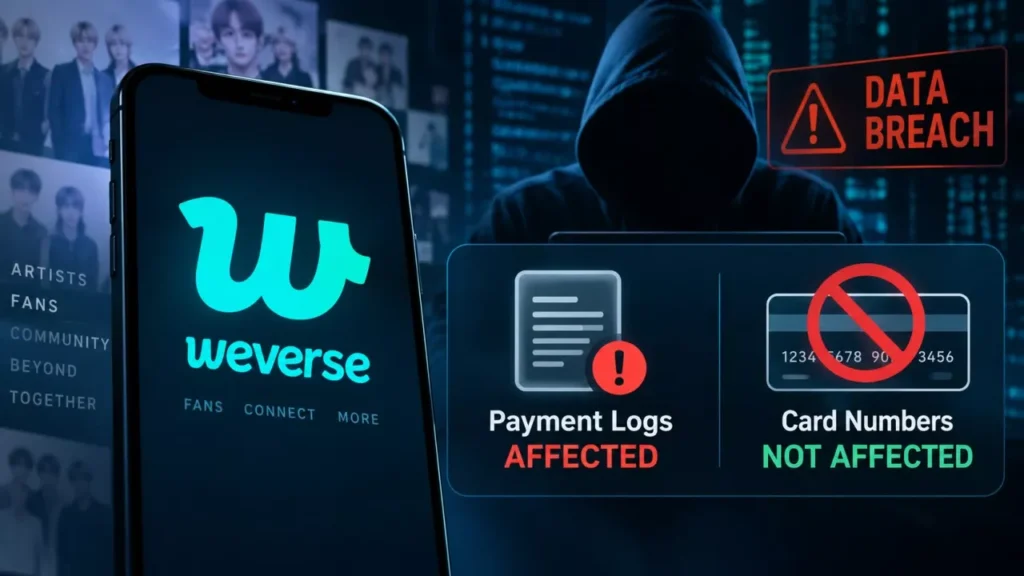

The Weverse data breach exposed payment and refund records for 422,584 accounts, the HYBE-owned fan platform said in a notice dated 6 September 2026. Names, contact details and card numbers were not among the leaked items. Weverse traced the fault to a vulnerability in its payment-processing API.
What Was Exposed, and What Was Not
The leak covers transaction metadata rather than identity documents. Weverse Company, the HYBE subsidiary that runs the platform, listed the affected items in its own customer notice.
| Exposed | Not Exposed |
|---|---|
| Internal account identifier (a number used only inside Weverse systems) | Names |
| Purchase type and payment method | Contact details |
| Payment gateway name and currency | Card numbers |
| Purchase amount, cancellation amount and purchase status | Passwords |
| Purchase and refund dates and times | Addresses |
Weverse put the scale at “422,584 cases based on account ID units”. Several outlets have rounded that to 420,000; the company’s own figure is the precise one.
Who Is Affected
Weverse has not said. Its notice gives an account count and a data-item list, but no geographic breakdown, and it has not published a way for an individual fan to check whether their account is among the 422,584.
That silence matters more than usual here. Weverse is a global platform used by fans of BTS, SEVENTEEN, TOMORROW X TOGETHER and other HYBE and partner acts, with an English-language shop and international payment options. The breach report was filed with a South Korean regulator, and much of the coverage has framed it as a South Korean incident, but nothing in Weverse’s notice limits the exposure to accounts registered in South Korea.
The practical reading, as of 9 September 2026: if you have ever bought anything through Weverse, treat yourself as possibly affected until Weverse says otherwise.
How the Leak Came to Light
This was not discovered by Weverse. It came in from outside, through South Korea’s internet security agency.
- 3 September 2026: the Korea Internet & Security Agency, known as KISA, told Weverse that an external reporter had flagged a security vulnerability in the service. Weverse began an internal inspection the same day.
- 4 September 2026: Weverse filed a breach incident report with KISA.
- 6 September 2026: Zooil Yang, president of Weverse Company, issued the public notice to customers confirming the 422,584 figure.
Weverse says it has since tightened access control on the payment-processing API, stripped internal identifier values from data that can be reached externally, and increased security monitoring and control over its deployment process.
What the Leaked Identifier Can and Cannot Do
Weverse’s position is that the internal identifier is useless outside its own systems. The notice describes it as a value used only within Weverse Company’s internal systems, says it does not directly identify a person, and states that payment forgery or unauthorised transfers are unlikely from these data items alone.
That assessment is reasonable on its face, and it is also incomplete. Purchase histories, amounts and refund timestamps are exactly the raw material a convincing scam message is built from. Someone who knows what you bought, when, for how much and in which currency can write a refund or failed-payment email that reads as genuine.
The wider risk is aggregation. Data from one leak becomes far more dangerous when combined with names and email addresses from another, and South Korea has just had a much larger one. On 3 September 2026 the Korea Herald reported a government probe finding that 39.54 million Tving accounts were compromised, covering 20 categories and 70 types of data including names, dates of birth, mobile numbers and email addresses. There is no evidence linking the two incidents, and Tving is an unrelated streaming service, but the overlap in user base is obvious.
What Weverse Users Should Do Now
Weverse’s notice does not include user guidance, so this is standard practice for a payment-metadata leak rather than instructions from the company.
- Treat any message about a Weverse refund, failed payment or suspended account as suspect, however accurate its details look. Open the Weverse app or type the address yourself rather than following a link.
- Check your card and payment-app statements for the period covering your Weverse purchases.
- Change your Weverse password if you reuse it anywhere else, and turn on any additional sign-in verification the account offers.
- Keep the notice’s dates in mind. A message that claims to be follow-up about this incident but predates 6 September 2026 is not genuine.
Payment-adjacent leaks have a long tail, as readers who followed earlier warnings about card users exposed by cyberattacks will recognise. The damage rarely arrives on the day of the announcement.
What Weverse Has Not Said
As of 9 September 2026, several material questions are open, and Weverse has answered none of them publicly.
- Whether the data was actually taken by a malicious party, or only demonstrated as reachable by the person who reported the flaw.
- Whether accounts outside South Korea are included in the 422,584.
- How long the payment API was exposed before 3 September 2026.
- Whether individual affected users will be notified directly.
The Korea JoongAng Daily reported that Weverse intends to pursue legal action over the incident. That detail comes from a single outlet and Weverse’s own customer notice does not mention it.
Fan platforms have become a standing target because they hold payment relationships with very large, very engaged user bases, much as messaging and community services have. The Discord breach that put 600 million users’ message history up for sale made the same point about community platforms.
Frequently Asked Questions
Was My Card Number Leaked in the Weverse Data Breach?
No. Weverse’s notice states that actual card numbers were not among the exposed items. What leaked was payment metadata: method, gateway, currency, amounts, status and timestamps.
How Do I Know if My Weverse Account Is Affected?
You cannot check yet. Weverse has published an account count but no lookup tool and no statement on direct notification. Anyone who has made a purchase through Weverse should assume possible exposure.
Does the Weverse Data Breach Affect Fans Outside South Korea?
Weverse has not said. The incident was reported to a South Korean regulator, but the company’s notice contains no geographic limit on the affected accounts.
Was Weverse Hacked?
Weverse describes a vulnerability in its payment-processing API that was reported to it via KISA on 3 September 2026. It has not said publicly whether a malicious party exploited that flaw or how the exposure was demonstrated.
Is This Related to the Tving Breach?
No evidence links them. Tving is a separate South Korean streaming service, and its far larger breach stemmed from a hacking incident detected in May 2026 and reported to authorities in June.