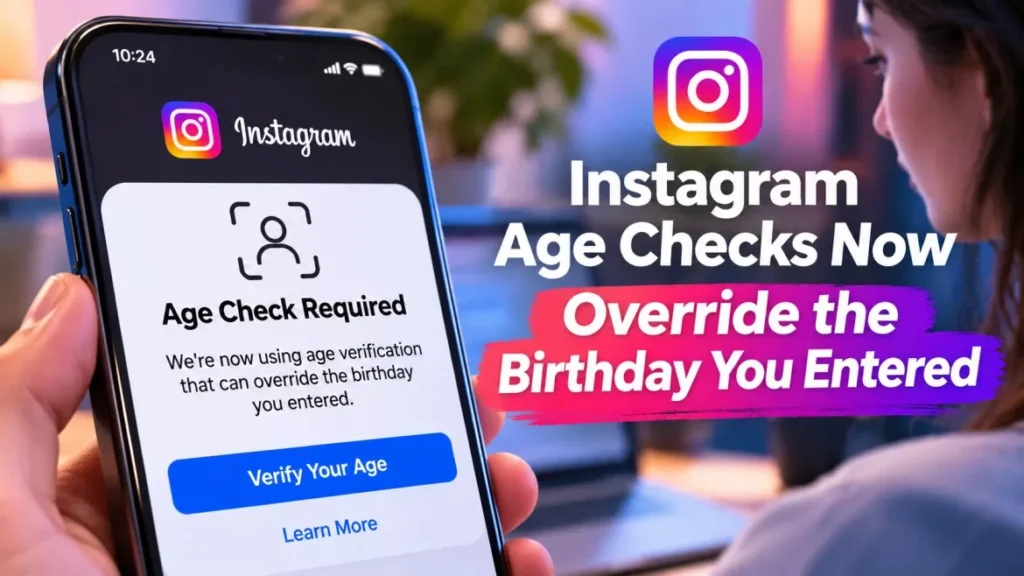

Instagram age checks now run in every country, using artificial intelligence to estimate how old a user is. Meta announced the global expansion on 9 November 2026, and accounts the system judges to be teenagers move into Teen Account protections even if the stated birthday says otherwise. Meta published no accuracy figure.
What Changes on an Account Placed in Teen Protections
A reclassified account loses settings rather than access. Meta’s announcement says Teen Accounts “automatically limit who can contact them, the content they see, and their time on our apps,” and the specific restrictions have been in place in earlier markets for some time.
- Private by default: The account is switched to private, so new followers must be approved.
- Direct messages: Only people the account already follows or is connected to can send a message.
- Comments: Harmful comments are hidden automatically.
- Content rating: Teens are placed in Instagram’s 13+ content setting, which Meta compares to an age-appropriate film rating.
- Loosening the settings: Users under 16 need a parent’s permission to make any built-in protection less strict.
Published summaries of Meta’s agreement with US state attorneys general also describe a two-hour daily limit and an overnight block on most of the app for teens. Those terms were still awaiting court approval when the summaries were written, Meta’s own announcement does not repeat them, and they are framed as applying in participating US jurisdictions rather than worldwide.
Where Instagram Age Checks Already Ran, and What Is New
This is an expansion, not a first launch. Reuters and Al Jazeera report that Meta first ran the system in the United States, the United Kingdom, Canada and Australia, and other coverage places a further extension to Brazil and the European Union earlier in 2026. Meta’s announcement itself does not list the earlier markets.
| Surface | Status | Timing Meta has given |
|---|---|---|
| Expanding globally | Announced 9 November 2026 | |
| Rollout continuing | No date given | |
| Threads | Not started | “Later this year” |
As of 10 November 2026, the worldwide expansion covers Instagram only. Facebook is described as still receiving the technology with no completion date, and Threads has not begun. Meta says it is “encouraged by the results” of the earlier rollouts but has released no country-by-country data and no error rate.
What Meta Says Its System Looks At
Meta’s announcement does not list the signals its model reads. The detail comes from reporting rather than the company: TechCrunch says the system weighs contextual clues drawn from posts, comments, bios and captions, such as messages wishing someone a happy birthday or references to a school year.
One country has an additional, non-AI check. In Australia, Meta has begun accepting Apple’s age-range signal, where a parent can have the app store confirm a device user’s age and Apple then passes a range to developers, “confirming whether the teen meets the app’s age requirement,” in Meta’s words. Meta says it uses that signal voluntarily and alongside its own estimation, not as a replacement for it.
Changing a birthday is handled separately and more strictly. Multiple outlets report that a user trying to move a date of birth from a minor’s to an adult’s must submit a government-issued identity document or complete a face-based age estimate through the identity firm Yoti. Meta’s 9 November announcement does not describe that flow.
What Happens to Accounts Suspected of Belonging to Under-13s
Meta says it is investing in technology to “proactively catch accounts that may belong to children under 13,” and attributes that work to its agreement with the attorneys general. The announcement stops there and does not say what follows a flag.
Secondary coverage of the rollout reports that suspected under-13 accounts are deactivated and the holder must prove their age to stop the account being deleted. Meta has not confirmed that sequence in its own post, so treat the deletion timeline as reported rather than established. Instagram’s stated minimum age is 13, and an under-13 account is a terms violation rather than a setting to be adjusted.
If Instagram Wrongly Decides You Are a Teen
This is the part Meta’s announcement leaves out, and it is the question an adult who has just lost their settings will have. The post names no appeal route, publishes no false-positive rate and gives no indication of how long a review takes.
Two things are known. Legal analyses of the attorney-general agreement say it requires Meta to adopt an age-assurance framework within a year of the effective date, to cap false positives subject to third-party certification, to give wrongly flagged users a route of appeal, and to minimise the data it collects while running the checks. And the same identity checks used for a birthday change — an identity document, or a Yoti face scan — are the mechanisms Meta already has in place for proving an age in the app.
Beyond that, the step-by-step guides circulating online are not Meta documentation. Review timelines, menu paths and the claim that mutual followers can vouch for an age are unverified, and some vary by country. Anyone offering to unlock an account for a fee, or claiming a contact inside Meta, is running a scam.
Why Meta Is Doing This Now
The company ties the expansion directly to its agreement with 52 bipartisan attorneys general covering US states, territories and the District of Columbia, reached in August 2026. Reuters notes the rollout also arrives while Meta faces lawsuits alleging its platforms harm young users.
Regulatory pressure is not confined to the United States. The European Commission has proposed the EU Kids Act, which would bar under-13s from social media entirely and is not yet in force, and eight US states have separately sued OpenAI seeking mandatory age checks. A system that assigns an age without asking is cheaper for a platform than one that demands documents from everyone, which is part of why Meta is building it this way.
Parents in the United States will start seeing an in-feed Instagram video this month explaining how teens are placed into these settings. It links to a guide by Larry Magid of ConnectSafely that Meta says is available to parents worldwide. Instagram has been reshaping the product around retention and safety in parallel, including a 90-minute long-form video format tested in October 2026.
What Meta Has Not Said
- Accuracy: No error rate, no false-positive figure, and no results from the markets where the system already ran.
- Reach: No number for how many accounts have been or will be reclassified.
- Appeals: No named process, no timeline, and no route published alongside the announcement.
- Signals: No list of the inputs the model uses. Reporting on whether photo analysis infers physical traits has been inconsistent, and Engadget corrected an earlier claim that Meta analyses bone structure in images.
- Timing: No completion date for Facebook and no firmer date than “later this year” for Threads.
The full announcement is on Meta’s newsroom.
Frequently Asked Questions
Can Instagram Age Checks Override the Birthday on My Account?
Yes. Meta says the system identifies people it suspects are teenagers even when they have entered an adult birthday, and places those accounts into Teen Account protections regardless of the stated date.
Which Countries Are Covered?
All of them, on Instagram, following the 9 November 2026 announcement. Facebook is still receiving the technology with no stated completion date, and Threads begins later in 2026.
What Do I Lose If My Account Is Reclassified?
The account becomes private, direct messages are restricted to existing connections, harmful comments are hidden, and the 13+ content setting applies. Users under 16 cannot loosen these without a parent’s permission.
How Do I Prove I Am an Adult?
Meta’s announcement names no appeal route. For birthday changes, outlets report the options are a government-issued identity document or a face-based age estimate run by Yoti. Check Instagram’s own help pages, because the process differs by country.
Does Meta Publish How Often It Gets an Age Wrong?
No. Meta says it is encouraged by earlier results but has released no accuracy rate or false-positive figure. Analyses of its attorney-general agreement say false-positive limits and third-party certification are required under that deal.