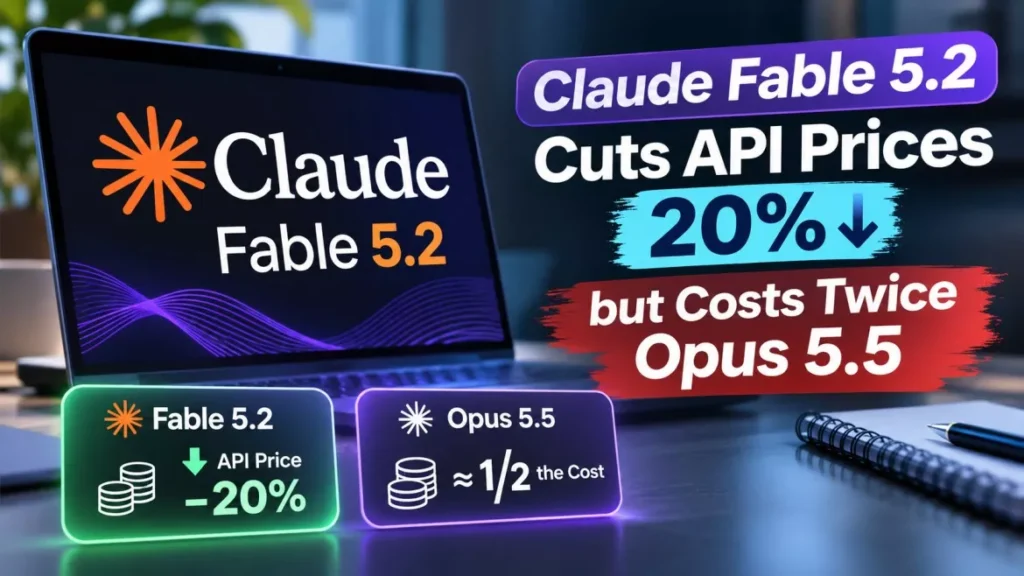

Anthropic has released Claude Fable 5.2 and Claude Mythos 5.2. From 9 November 2026 the models cost $8 per million input tokens and $40 per million output tokens, 20% below Fable 5.1, and generate output up to 30% faster. Fable 5.2 is on every paid Claude plan; Mythos 5.2 is not.
What Claude Fable 5.2 Costs Now
The new rate is $8 per million input tokens and $40 per million output tokens, down from $10 and $50 on Claude Fable 5.1. That is a 20% cut on both halves of the meter, and it applies to Claude Mythos 5.2 as well, which shares Fable 5.2’s specifications and pricing.
The cut reaches further than the headline rate. Reading a cached prompt now costs $0.20 per million tokens rather than $0.25, which matters because cache reads dominate spending on long agent runs. The figures below come from Anthropic’s published price list, in US dollars per million tokens as of 10 November 2026.
| Rate | Claude Fable 5.1 | Claude Fable 5.2 | Claude Opus 5.5 |
|---|---|---|---|
| Input | $10 | $8 | $4 |
| Output | $50 | $40 | $20 |
| Cache read | $0.25 | $0.20 | $0.20 |
| Cache write (5 minutes) | $12.50 | $10 | $5 |
| Cache write (1 hour) | $20 | $16 | $8 |
| Batch API | $5 / $25 | $4 / $20 | $2 / $10 |
| Fast mode | Not offered | $16 / $80 | $8 / $40 |
Fast mode is the one place the bill goes up rather than down. Anthropic says it raises token generation speed by up to 2.5 times and charges double the standard rate, so $16 and $80 per million tokens on Fable 5.2. Batch requests go the other way, at half price.
Why Fable 5.2 Still Costs Twice as Much as Opus 5.5
A 20% cut does not make Fable 5.2 Anthropic’s cheap option. It remains exactly twice the price of Claude Opus 5.5, which is $4 and $20 per million tokens, and Anthropic’s own guidance is to reach for Opus first.
The company says that for most everyday coding and knowledge work, developers should start with Claude Opus 5.5, and positions Fable 5.2 for demanding reasoning and long-horizon agentic work instead: agent sessions that run for hours, multistep research, and analysis carried through to a finished document or spreadsheet. Anthropic also reports that Fable 5.2 at High effort scored about level with Opus 5.5 at Max effort while costing roughly half as much per task, which is an argument for switching models rather than for turning Fable up.
Cached tokens narrow the gap. Both models read cached input at $0.20 per million tokens, so a workload dominated by cache hits sees far less than a 2x difference. Uncached input and all output still cost double. Anthropic made a similar 20% reduction in September 2026, alongside a steeper round of cuts from OpenAI, and the pattern of rivals trimming rates has continued; Google is moving the other way on one model, with Gemini 4 Argon pricing set to double on 1 December 2026.
What Claude Subscribers Get, and When It Stops
Subscribers do not pay per token, and for them the launch is a time-limited offer rather than a price change. The terms differ sharply by plan, and the most generous ones expire first. These details come from Anthropic’s launch-offer page.
- Pro and standard Team seats: Fable models are included from launch on 9 November 2026 through 16 November 2026 at 11:59 pm PT, capped at 50% of your weekly usage limits, plus one limit reset that expires at the same moment.
- Max, Ultra, premium Team seats and premium legacy seat-based Enterprise seats: One to three Fable limit resets depending on how long the account has been paying, usable any time before 8 March 2027 at 11:59 pm PT.
- Tenure thresholds for those resets: Under six months from the first paid bill earns one reset, six to 12 months earns two, and more than 12 months earns three.
- Free plan: No Fable access and no resets.
- Also excluded: Standard seats on legacy seat-based Enterprise plans, self-serve Enterprise and usage-based Enterprise. Resets are not available on HIPAA-ready Enterprise plans.
- Billing cutoff: Paid billing had to be in place before 9 November 2026 at 10:00 am PT to qualify for a reset.
Two details are easy to miss. A reset does not lift the ceiling: it returns the weekly usage already spent on Fable models and leaves the 50% cap in place. And the allowance does not roll over, so once 16 November passes, Fable on a Pro plan runs on usage credits if the account has them enabled. Anthropic applied the same pattern of plan-tiered access when it opened the Claude Duet waitlist to Pro and Max subscribers in October 2026.
To claim a reset, open Settings, then Usage, then select “Reset for free” under Limit resets. It can be used at any point before expiry, not only after hitting a wall.
How the Effort Setting Changes the Bill
For anyone paying per token, the effort setting moves cost far more than the 20% cut does. Anthropic’s system card reports the average cost per task on the FrontierCode 2.0 agentic coding benchmark at four settings, and the spread is roughly eighteenfold.
| Effort | Cost per task | FrontierCode 2.0 score |
|---|---|---|
| Medium | $2.48 | 37.6% |
| High | $6.72 | 45.3% |
| Xhigh | $14.19 | 49.1% |
| Max | $44.70 | Below the Xhigh result |
Max is the trap: it cost about three times Xhigh and scored lower. The headline 49.1% figure is an Xhigh result, so quoting that score and budgeting at the Medium rate will not match.
Defaults differ by surface, which is worth checking before a bill arrives. Adaptive thinking is always on and cannot be switched off; the effort parameter defaults to high on the Claude API, while Medium is the default in the Claude apps and Claude Code.
What the Benchmarks Show
Anthropic says one of the two new models leads on 13 of the 15 score lines it published. Every figure below is the company’s own, measured before release, and should be read as a vendor claim.
| Benchmark | Fable 5.2 | Fable 5.1 | Opus 5.5 | GPT-6 Astra | Gemini 4 Carbon |
|---|---|---|---|---|---|
| FrontierCode 2.0 (Xhigh) | 49.1% | 32.4% | 45.5% | 42.8% | 41.1% |
| FrontierSWE v2 | 69.9% | 56.3% | 62.3% | 65.5% | 61.2% |
| AutomationBench | 51.4% | 31.4% | 42.5% | 41.4% | 53.9% |
| RoboDojo Sim | 64.9% | 27.6% | 39.4% | 29.8% | Not published |
| Humanity’s Last Exam (with tools) | 74.2% | 65.6% | 67.7% | 57.2% | Not published |
AutomationBench is the exception Anthropic published against itself: Gemini 4 Carbon leads there at 53.9%. Independent testing was thin on launch day. The evaluation firm Vals AI placed Fable 5.2 at 71.31% on its own index, narrowly ahead of Claude Sonnet 5.5 at 70.85%, but ranked it second on SWE-bench Multimodal at 62.29%, behind Opus 5.5 at 70.21%. Those are one organisation’s results, and Artificial Analysis reported a less favourable picture on agentic knowledge work, so the two independent readings do not yet agree.
Anthropic also reports that Fable 5.2 blocks about 55% fewer harmless requests than Fable 5.1, roughly 60% fewer in cybersecurity and 40% fewer in biology. That claim rests on early internal testing across claude.ai, Claude Code and Cowork.
Who Can Use Claude Mythos 5.2
Mythos 5.2 is the same underlying model without Fable’s cybersecurity and biology safeguards, and it is not for sale to the public. Anthropic restricts it to organisations verified through its trusted access programmes.
- Security teams: Apply through the Cyber Verification Program, which also covers advanced cyber capability on Opus 5.5, Sonnet 5.5 and Mythos 5.1.
- Life sciences researchers: Apply through the Life Sciences Verification Program.
- Claude Enterprise customers: Reach Mythos 5.2 indirectly through the Claude Security product.
On Anthropic’s CVE Rediscovery evaluation, Mythos 5.2 found 89.6% of known vulnerabilities, against 78.3% for Mythos 5.1. Both Fable 5.2 and Mythos 5.2 require 30-day data retention for safety monitoring and are not available under zero-data-retention terms unless Anthropic expressly authorises it, which rules them out for some regulated buyers.
Where Things Stand as of 10 November 2026
As of 10 November 2026, Claude Fable 5.2 is generally available under the model ID claude-fable-5-2 on the Claude API, Amazon Bedrock, Microsoft Foundry, Claude Platform on AWS and both the Google-managed and Anthropic-managed options on Google Cloud. It carries a 1 million token context window, a 128,000 token maximum output and a June 2026 knowledge cutoff, and Anthropic commits to keeping it running until at least 9 November 2027.
Mythos 5.2 remains gated to verified organisations, with no published plan to open it more widely. The free Fable week on Pro and standard Team seats ends on 16 November 2026 at 11:59 pm PT. CNBC reported that the launch arrived as Anthropic prepared an initial public offering roadshow; the company has not tied any pricing commitment to that timetable.
Frequently Asked Questions
How Much Does Claude Fable 5.2 Cost?
Claude Fable 5.2 costs $8 per million input tokens and $40 per million output tokens on standard API pricing. Batch requests are half that, at $4 and $20, and fast mode is double, at $16 and $80.
Is Claude Fable 5.2 Cheaper Than Claude Opus 5.5?
No. Opus 5.5 is $4 and $20 per million tokens, half Fable 5.2’s rate. Anthropic recommends starting with Opus 5.5 for most everyday coding and knowledge work.
Can Free Claude Users Try Fable 5.2?
No. Anthropic says the launch offers are not available on the Free plan. Fable models require a paid plan, and some Enterprise seat types are excluded as well.
When Does the Free Fable Week End on a Pro Plan?
It ends on 16 November 2026 at 11:59 pm PT. After that, Fable usage on a Pro plan runs on usage credits if the account has them enabled, and any unused allowance from the week does not carry over.
How Do I Claim a Fable Limit Reset?
Open Settings, then Usage, and select “Reset for free” under Limit resets. The reset returns weekly usage already spent on Fable models; it does not raise the 50% weekly cap.
Who Can Access Claude Mythos 5.2?
Only organisations verified through Anthropic’s Cyber Verification Program or Life Sciences Verification Program, plus Claude Enterprise customers using the Claude Security product. It is not available to individual subscribers.