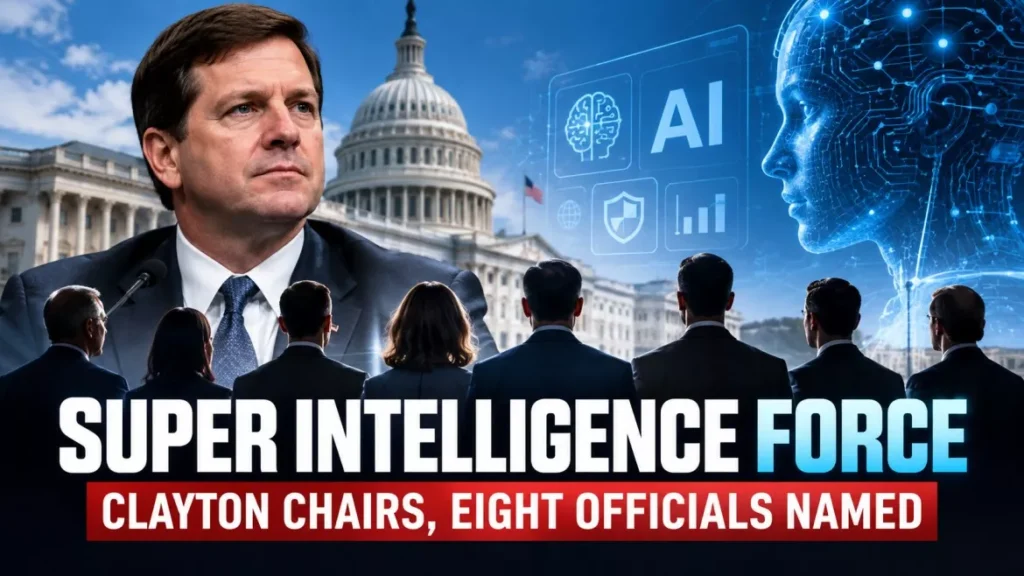

President Donald Trump has named Director of National Intelligence Jay Clayton to chair a new United States federal panel called the Super Intelligence Force. Trump named the chair, three vice chairs and four further members in a Truth Social post on Sunday 4 October 2026. No executive order creating the body has been published.
The panel is a White House body inside the US executive branch, so its remit runs to federal agencies and to companies that deal with them. It carries no authority over AI developers in other countries.
Who Sits on the Super Intelligence Force
Trump’s post named eight serving officials, with Clayton as chair and three vice chairs drawn from a regulator, the Pentagon and the federal personnel agency.
| Role | Name | Day job |
|---|---|---|
| Chair | Jay Clayton | Director of National Intelligence |
| Vice chair | Andrew Ferguson | Chairman, Federal Trade Commission |
| Vice chair | Emil Michael | Under Secretary of War for Research and Engineering, and Chief Technology Officer |
| Vice chair | Scott Kupor | Director, Office of Personnel Management |
| Member | JD Vance | Vice President |
| Member | Pete Hegseth | Defense Secretary |
| Member | Scott Bessent | Treasury Secretary |
| Member | Susie Wiles | White House Chief of Staff |
Clayton and the panel report to Trump and to Wiles, according to the Associated Press and CBS News accounts of the post. The Wall Street Journal reported that two people from outside government will also advise the group: David Sacks, the venture capitalist who held the AI czar role earlier in Trump’s second term, and Condoleezza Rice, a former Secretary of State. Reuters relayed that detail on 4 October 2026.
Clayton became Director of National Intelligence in August 2026. He chaired the Securities and Exchange Commission, the US markets regulator, in Trump’s first term, and was United States attorney for the Southern District of New York before the intelligence appointment.
What Trump’s Post Actually Said
The post set a coordinating purpose rather than a rulebook. Trump wrote that he was acting “following the Historic White House Accord on Super Intelligence, where the World’s most important Technology Companies came together, and confirmed their responsibilities to the American People”, and said he was “announcing the formation of the Super Intelligence Force (SIF)”.
He said the group would coordinate federal engagement with consumers, public interest groups, religious organisations, critical infrastructure providers and Super Intelligence companies, and work to keep the United States ahead in the technology. The accord he referred to was the voluntary commitment six AI and chip companies signed at the White House on 29 September 2026; that document carries no penalties, as covered in our earlier report on the White House AI accord.
The post did not state a budget, a staff, a legal authority, a meeting schedule or a date by which the group would produce anything.
Where the 120-Day Report Clock Came From
The widely repeated figure of 120 days is newspaper reporting, not a published federal deadline. The Wall Street Journal published an interview with Clayton on Saturday 3 October 2026 describing the group’s charter, including a report to the President within 120 days on the risks and opportunities of the technology. Reuters and Bloomberg both carried that account on 3 and 4 October 2026, each attributing it to the Journal.
In that interview Clayton said “the president asked that a group be put together”, and, on the case for moving quickly, that “the risk of not being first is high”. Reuters reported that the group would also recommend what role the federal government should play in governing the technology, and review how agencies currently report breaches, hacks and similar incidents.
Neither the White House nor Clayton’s office has published the charter. The Associated Press and CBS News accounts of Trump’s post, published on 4 October 2026, do not mention a 120-day deadline at all. Readers should treat the clock as reported by one newspaper and relayed by two wires, rather than as an official term.
The Only Published Order Is About Terminology
As of 5 October 2026, the Federal Register carries no presidential document establishing the Super Intelligence Force, and none signed on or after 1 October 2026. The relevant order on the public record is Executive Order 14434, “Inaugurating the Era of Super Intelligence”, signed on 29 September 2026 and published in the Federal Register of 2 October 2026 at 91 FR 63129.
That order is about words. Section 2(a) directs agencies, to the maximum extent permitted by law, to use “Super Intelligence” and “SI” in place of “Artificial Intelligence” and “AI” in official correspondence, public communications, websites, reports, policy documents and other non-statutory documents. Section 1 goes further in tone, stating that the executive branch “will not acknowledge the usage of ‘Artificial Intelligence’ and ‘AI’ in any applicable setting”.
Three limits in the text matter for anyone reading contracts or filings:
- Section 2(b): nothing in the order requires altering previously issued regulations, presidential actions, contracts, grants or other historical documents.
- Section 3(a): “SI” means the same technologies as “artificial intelligence” already defined in section 9401(3) of title 15 of the United States Code, so the scope of what is covered does not change.
- Section 4(c): the order creates no right or benefit enforceable at law against the United States or any person.
The order sets one deadline of its own. Section 3(b) gives the Assistant to the President for Science and Technology 60 days from 29 September 2026 — so until roughly 28 November 2026 — to send the President proposed legislative language defining “Super Intelligence” in statute, including an assessment of whether it should modify or supersede the existing legal definition of artificial intelligence. Changing the statute itself would take an Act of Congress.
What Has Not Been Settled
The gap between an announcement and a functioning body is wide, and several practical questions are open. This is the second time in three weeks that a federal AI panel has been announced by social media post; our report on the 19 September Trump AI Force announcement noted at the time that no order had been issued and no chair named. The chair and the membership have now been filled in. The paperwork has not.
- Legal basis: no executive order, memorandum or charter establishing the group has been published.
- Funding and staff: neither the post nor the reported charter names an appropriation, a secretariat or a host agency.
- Publication of the report: it has not been said whether the report, if delivered, will be released publicly or kept internal.
- Effect on companies: nothing announced so far imposes an obligation on an AI developer, a cloud provider or a federal contractor. The September accord remains voluntary.
- Overlap with existing roles: how the group’s work sits alongside the FTC’s own authority, Pentagon procurement and the terminology work already assigned to the science adviser has not been explained.
Frequently Asked Questions
What Is the Super Intelligence Force?
It is a United States federal panel announced by President Trump on 4 October 2026 to coordinate the federal government’s engagement on advanced AI, which the administration calls Super Intelligence. It is chaired by Director of National Intelligence Jay Clayton.
Who Is on the Super Intelligence Force?
Trump named eight officials: Clayton as chair; Andrew Ferguson, Emil Michael and Scott Kupor as vice chairs; and JD Vance, Pete Hegseth, Scott Bessent and Susie Wiles as members. The Wall Street Journal reported that David Sacks and Condoleezza Rice will advise from outside government.
Did Trump Sign an Executive Order Creating the Super Intelligence Force?
Not one that has been published. As of 5 October 2026 the Federal Register contains no order establishing the group. The only Super Intelligence order on the record is Executive Order 14434 of 29 September 2026, which deals with terminology.
When Is the Super Intelligence Force Report Due?
The Wall Street Journal reported on 3 October 2026 that the charter calls for a report to the President within 120 days. That deadline has not been confirmed in any published federal document, and the Associated Press and CBS News accounts of Trump’s announcement do not mention it.
Does the Super Intelligence Force Have Power Over AI Companies?
Nothing announced so far gives it binding authority. It is described as a coordinating and reporting body within the US executive branch, and the White House accord that preceded it is voluntary and carries no penalties.
What Does Executive Order 14434 Require Agencies to Do?
It directs US federal agencies, to the maximum extent permitted by law, to use “Super Intelligence” and “SI” instead of “Artificial Intelligence” and “AI” in correspondence, public communications, websites, reports and other non-statutory documents. It does not require rewriting existing regulations, contracts or grants.